India's factory output growth, measured by the Index of Industrial Production (IIP), moderated to 6.7 percent in July from a robust 8.8 percent in June, as weaker performance in manufacturing, electricity and gas supply, along with subdued mining activity, weighed on overall industrial production, according to data released by the Ministry of Statistics and Programme Implementation (MoSPI). Despite the slowdown, industrial activity has remained broadly resilient in the current fiscal year, supported by steady domestic demand amid global economic uncertainty and elevated energy prices.
However, the July reading was significantly higher than the 3.5 percent growth recorded in July 2025. During the April–July 2026 period, IIP expanded 6.3 percent, compared with 3.9 percent growth in the corresponding period last year. Manufacturing growth was driven by engineering goods (electrical and non-electrical), automobiles and other transport equipment, electronics, and plastic and rubber products. Strong output in beverages, wood products, paper, and non-metallic mineral products also supported overall industrial growth.
Commenting on the data, Madan Sabnavis, Chief Economist at Bank of Baroda, said: “Industrial growth for July has shown considerable buoyancy at 6.7 percent, taking the average growth for the first four months of the fiscal year to 6.3 percent. This is particularly impressive as manufacturing, which carries a 76 percent weight in the IIP, grew 7.3 percent and aligns well with the strong financial performance reported by companies during the April–June 2026 quarter, a trend that appears to have continued into July.”
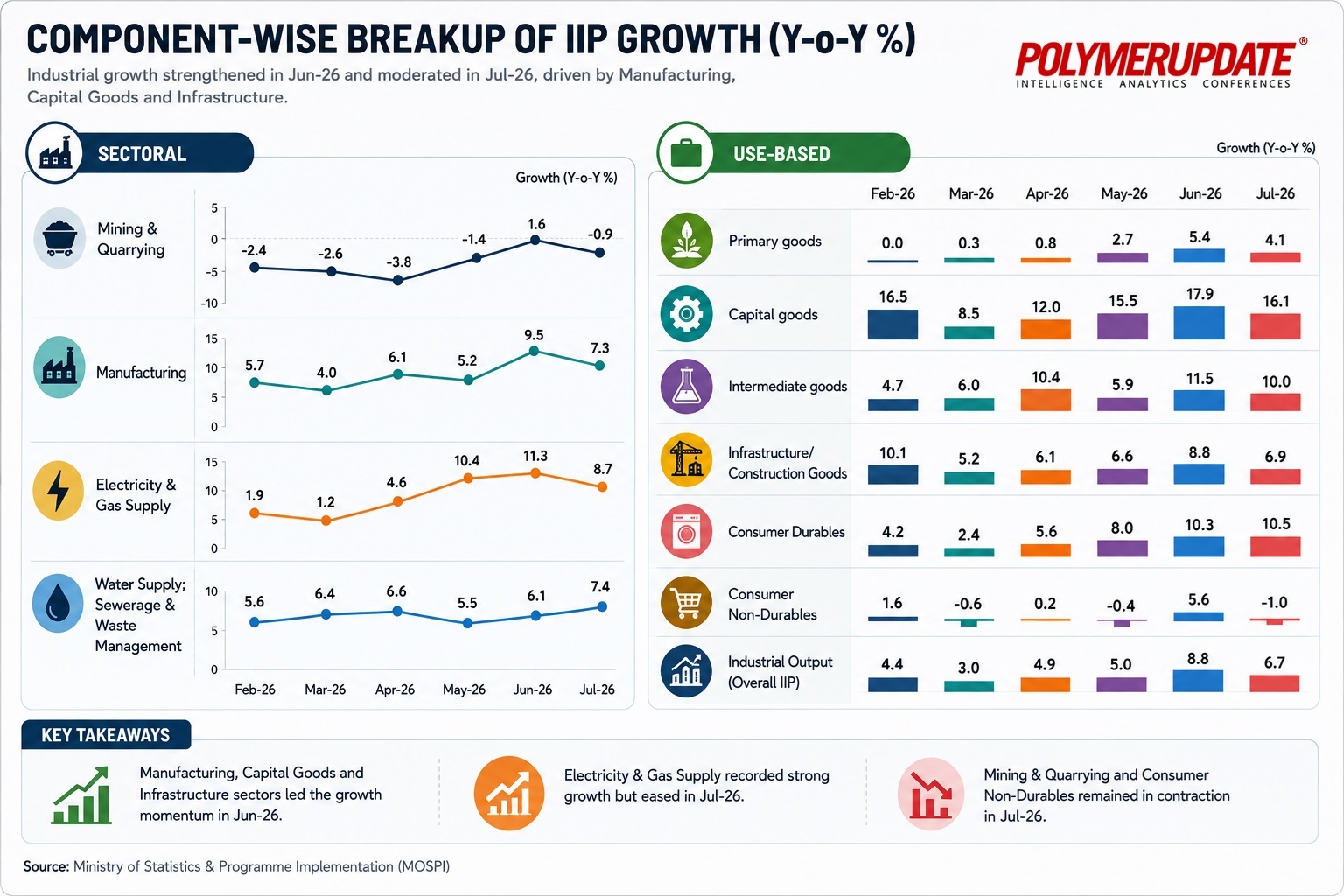 Sector-wise performance
The manufacturing sector's growth moderated to 7.3 percent in July from 9.5 percent in June. Output growth slowed in export-oriented industries such as textiles (3.9 percent in July versus 13.2 percent in June) and leather and related products (0.8 percent versus 7.9 percent). Among other segments, weaker production of chemicals (-2.7 percent in July versus -1.0 percent in June) and pharmaceuticals (-5.6 percent versus 3.0 percent) also weighed on overall manufacturing output.
Commenting on the data, Devendra Pant, Chief Economist at India Ratings and Research, said: “The deceleration was visible across nearly 98 percent of the index. Electricity generation grew 8.7 percent in July 2026, down from 11.3 percent in June, though higher than 2.4 percent in July 2025. Manufacturing growth eased to 7.3 percent from 9.5 percent in June, but remained above 5.1 percent a year earlier. Meanwhile, mining and quarrying contracted 0.9 percent, compared with 1.6 percent growth in June and 10.7 percent growth in July 2025, largely due to the high base created by strong metallic mineral production, including rare earth minerals. Water supply, sewerage and waste management, which accounts for about 2 percent of the index, was the only broad sector to record higher sequential growth at 7.4 percent, compared with 6.1 percent in June 2026 and 7.5 percent in July 2025.”
Growing sectorsHowever, this weakness was offset by double-digit growth in machinery and equipment, and motor vehicles, trailers and semi-trailers. Mining sector growth slipped into negative territory, contracting by 0.9 percent in July, compared with 1.6 percent growth in the previous month. Capital goods and infrastructure goods performed well, growing by 16.1 percent and 6.9 percent, respectively. This is a positive sign for a revival in manufacturing, which has been anticipated for some time. The government's continued push for infrastructure development during the first four months of the fiscal year has also strengthened backward linkages across the industrial sector.
Within the use-based classification, the consumer goods segment presented a mixed picture. While output of consumer durables grew by a strong 10.5 percent in July, consumer non-durables contracted by 1 percent. Steady consumer demand and the positive impact of the earlier GST rate rationalisation may have supported the healthy growth in consumer durables. Looking ahead, rising inflationary pressures and their impact on consumption remain key risks to watch. Weather-related disruptions and their potential impact on rural demand also warrant close monitoring.
Among other components, growth in infrastructure/construction goods and capital goods was encouraging at 6.9 percent and 16.1 percent, respectively. The strong performance of these segments is positive, particularly amid continued global economic uncertainty. Analysts expect the government's capital expenditure push to remain supportive of growth in these segments.
Way forwardOverall, the global economic landscape remains challenging amid persistent geopolitical tensions. Volatile energy prices, supply-chain disruptions and elevated input costs remain key headwinds for industrial activity. On the domestic front, rising inflationary pressures and weather-related uncertainties pose risks to consumption and investment. Looking ahead, industrial activity will need to navigate an uncertain external environment while addressing challenges on the domestic front.
DILIP KUMAR JHA
Editor
dilip.jha@polymerupdate.com