India’s real gross domestic product (GDP) grew a stronger-than-expected 7.8 percent in the April-June 2026 quarter (Q1FY2026-27), accelerating from 6.9 percent in the corresponding quarter of the previous year and signalling continued resilience in domestic economic activity despite a challenging global environment, the Ministry of Statistics & Programme Implementation (MoSPI) showed in a report. The latest estimate puts real GDP, measured at constant prices, at Rs 81.36 lakh crore (Rs 1 lakh crore = Rs 1 trillion) in the first quarter of FY 2026-27, compared with Rs 75.46 lakh crore in Q1 FY26. In nominal terms, GDP expanded 10.3 percent to Rs 88.27 lakh crore from Rs 80 lakh crore a year earlier.
The performance was broad-based, with services, manufacturing, construction and investment emerging as key pillars of growth. Real Gross Value Added (GVA) increased 8.2 percent during the quarter, while nominal GVA rose 11.5 percent. Real GVA stood at Rs 73.82 lakh crore, compared with Rs 68.21 lakh crore in the year-ago quarter, while nominal GVA increased to Rs 80.53 lakh crore from Rs 72.24 lakh crore. The stronger-than-anticipated growth has prompted economists to reassess the outlook for the full financial year, with some seeing annual GDP growth potentially reaching around 7 percent.
Madan Sabnavis, Chief Economist at Bank of Baroda, said Q1 GDP growth was significantly higher than expected, compared with the bank’s forecast of 7-7.2 percent. GDP growth for Q1 has come at a much higher than expected rate of 7.8 percent,” Sabnavis said, adding that nominal GDP growth of 10.3 percent was partly supported by higher inflation entering the deflator indices.”
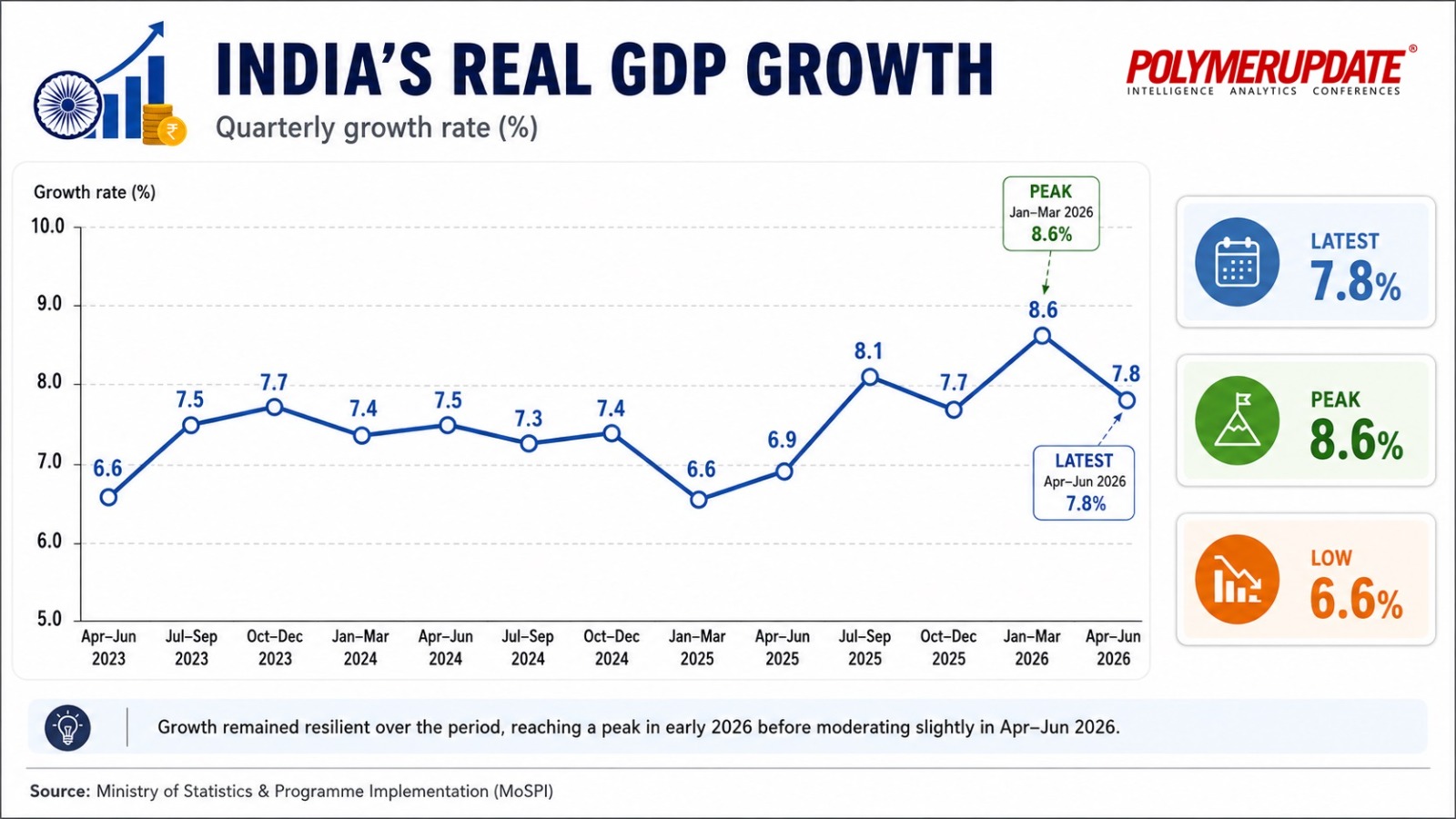 Investment emerges as a major growth engine
One of the most significant features of the quarter was the sharp improvement in capital formation. Gross Fixed Capital Formation (GFCF) grew 11.9 percent in real terms during Q1 FY27, more than doubling the 5.8 percent growth recorded in the corresponding quarter of FY26. According to Sabnavis, capital formation increased to 34.3 percent of GDP in nominal terms from 31.4 percent a year earlier, with nominal growth of 20.4 percent. He described this as a major takeaway from the data, noting that both government and private-sector expenditure contributed to the expansion.
Private investment appears to have been supported by spending in sectors such as data centres, power and metals, while continued government infrastructure expenditure provided an additional boost. The acceleration in capital formation is particularly significant because investment-led growth tends to have a broader multiplier effect on industrial production, construction, logistics and services.
The latest numbers therefore suggest that India’s growth cycle is being supported not only by consumption but increasingly by capacity creation and infrastructure spending. For the industrial economy, this is an important development. Sustained capital expenditure can generate demand for steel, cement, engineering products, machinery, petrochemicals and a range of intermediate goods, potentially strengthening the manufacturing ecosystem in the quarters ahead.
Services remain the strongest pillarThe tertiary sector continued to be the principal driver of the economy, expanding 10 percent at constant prices during Q1 FY27. The financial, real estate, information technology and professional services segment was particularly strong, registering growth of 12.1 percent. Robust bank credit and deposit growth contributed to the financial services performance, while technology and professional services continued to benefit from India's expanding digital and knowledge economy.
Trade, hotels, transport, communication and related services grew 8.5 percent, although this represented a moderation from the 9.8 percent growth recorded a year earlier. Sabnavis attributed the slowdown partly to the high base and disruptions caused by the ongoing geopolitical situation, particularly in the aviation sector. Public administration, defence and other services also performed better, growing 7.5 percent compared with 4.6 percent in the corresponding period last year.
The improvement was attributed to higher spending by both the Centre and state governments. The strength of services reinforces India's structural shift towards a service-led economy. However, the composition of growth also highlights the importance of strengthening manufacturing and other tradable sectors to ensure that the expansion remains balanced and generates employment across a wider section of the economy.
Manufacturing and construction provide industrial supportThe secondary sector recorded 8.6 percent growth at constant prices, reflecting strong activity across manufacturing, electricity and construction. Manufacturing growth was particularly impressive at 9.2 percent, compared with 8.3 percent in the year-ago period. According to Sabnavis, infrastructure-oriented companies were among the key contributors to manufacturing growth, based on corporate performance during the quarter.
The improvement in manufacturing is significant for India's industrial outlook. Stronger infrastructure investment is creating demand across several manufacturing value chains, while expanding domestic capacity in areas such as power, metals and data-centre infrastructure is supporting capital goods and intermediate industries. Construction activity also strengthened, growing 7.7 percent compared with 5.2 percent a year earlier. Continued infrastructure activity during the summer months helped sustain construction momentum despite weather-related disruptions later in the quarter.
Electricity generation recorded growth of 8.9 percent, a substantial improvement from the contraction seen in the corresponding period last year. Extended hot-weather conditions before the arrival of the monsoon kept electricity demand elevated, supporting power generation. Mining, however, remained a weak spot. The sector contracted amid a high base effect as well as heavy rains and flooding, which disrupted mining activity.
Agriculture grows despite weather disruptionsThe primary sector expanded 2.9 percent at constant prices, with agriculture and allied activities growing 3.6 percent. Although agricultural growth was lower than the previous year, Sabnavis cautioned against reading too much into the moderation. The quarter largely reflected residual rabi activity and allied sectors, some of which were affected by flooding.
The agricultural performance nevertheless remains important for the broader economy because rural incomes and farm output have significant implications for consumption demand. A healthy agricultural sector could provide additional support to consumer spending in the coming quarters, particularly if monsoon conditions remain favourable.
GVA growth outpaces GDPAnother notable feature of the data was the faster growth in GVA compared with GDP. Real GVA grew 8.2 percent, compared with GDP growth of 7.8 percent. Sabnavis attributed the difference partly to a higher subsidy bill. Subsidies are netted from taxes when calculating GDP from GVA, and higher food and fertiliser subsidy expenditure contributed to the divergence.
The distinction is important when assessing the underlying momentum of productive activity. The stronger GVA growth indicates that the performance of the economy's production sectors was even more robust than the headline GDP figure suggests.
Outlook turns more positiveThe Q1 performance has strengthened expectations for the full-year economic outlook. Sabnavis said GDP growth could reach around 7 percent for FY27, potentially marking the fourth consecutive year in which the economy records growth above 7 percent. Such an outcome would underline the resilience of India's domestic economy at a time when the global outlook remains clouded by geopolitical tensions, volatile commodity prices, trade disruptions and uneven growth across major economies.
The key question now is whether the momentum seen in the first quarter can be sustained through the remainder of FY27. Continued government capital expenditure, a revival in private investment, strong services activity and improving manufacturing performance will be crucial. At the same time, risks remain. Weather disruptions could affect agriculture and infrastructure, while external shocks, elevated energy prices and geopolitical tensions could influence trade, inflation and corporate investment decisions.
For India's industrial sectors, however, the Q1 numbers offer a constructive signal. The combination of double-digit growth in fixed investment, stronger manufacturing and construction activity, and robust services growth suggests that the economy entered FY27 on a firm footing.
If investment momentum persists and private-sector capital expenditure broadens beyond a few infrastructure-intensive industries, the current expansion could develop into a more durable and broad-based industrial cycle. The 7.8 percent Q1 growth rate therefore represents more than a strong headline number—it points to an economy increasingly supported by investment, infrastructure and high-value services alongside its traditional consumption drivers.
DILIP KUMAR JHA
Editor
dilip.jha@polymerupdate.com