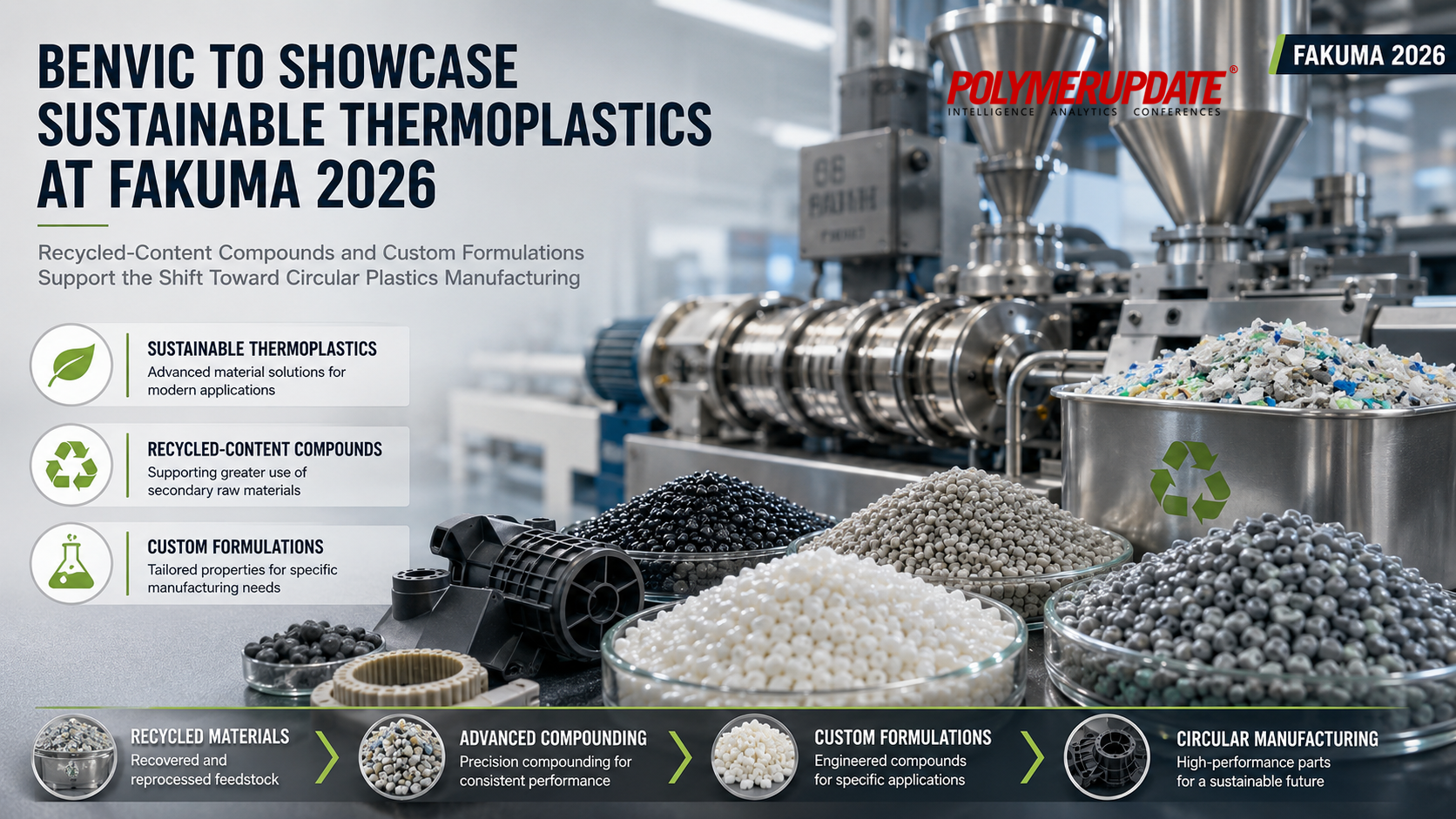
As the plastics industry accelerates its transition toward circular manufacturing and stricter sustainability regulations, European compounder Benvic is set to present its latest portfolio of high-performance thermoplastic solutions at Fakuma 2026, scheduled to be held in Friedrichshafen, Germany, from October 12–16. The exhibition will serve as a platform for the company to demonstrate its expanded capabilities in engineering thermoplastics, recycled-content compounds and bespoke formulations designed for demanding industrial applications.
Building on its long-established leadership in PVC compounding, Benvic is strengthening its position as a single-source solutions provider for sustainable thermoplastics across multiple polymer families. By combining expertise in PVC, polypropylene, thermoplastic elastomers and recycled engineering plastics, the company enables manufacturers to source high-performance materials from a single partner while supporting compliance with evolving environmental regulations and circular economy requirements.
 Expanding beyond PVC
For decades, Benvic has been recognised as a specialist in customised PVC compounds, supplying formulations tailored to the performance and cost requirements of customers across diverse industries. However, the company's strategy has evolved significantly in recent years as manufacturers increasingly seek durable materials containing recycled content without compromising technical performance. A key milestone in this transformation was Benvic's acquisition of a polypropylene (PP) and thermoplastic elastomer (TPE) engineering and manufacturing unit in Ferrara, Italy.
The acquisition has broadened the company's technical expertise beyond PVC, enabling it to develop advanced compounds for engineering applications while leveraging post-consumer recycled (PCR) feedstocks. The expanded product portfolio is aimed at sectors including automotive, electrical and electronics (E/E), electrotechnical equipment and fluid management systems—industries facing growing pressure to reduce carbon footprints and comply with Europe's new sustainability framework.
Addressing new European regulationsThe demand for recycled-content plastics is being driven in large part by upcoming European regulations, particularly the Ecodesign for Sustainable Products Regulation (ESPR) and the End-of-Life Vehicles Regulation (ELVR). These initiatives encourage greater use of recycled materials, improved product circularity and enhanced environmental transparency throughout the value chain. Benvic says its development philosophy centres on creating bespoke formulations that match the technical specifications of virgin materials while incorporating PCR feedstocks.
Rather than offering generic recycled grades, the company works backwards from customer performance requirements to engineer practical, cost-effective compounds suited to specific applications. This customised approach enables manufacturers to adopt recycled materials without extensive redesign of components or processing conditions, easing the transition toward regulatory compliance.
Overcoming the challenges of recycled plasticsWhile mechanical recycling remains the most widely used route for recovering plastics, it presents significant technical challenges. Variability in feedstock quality, inconsistent colour, odour, reduced impact strength and processing instability often limit the use of recycled materials in demanding applications. Benvic's expertise lies in addressing these limitations through careful sourcing, characterisation and formulation of PCR materials.
By selecting recycled feedstocks based on their physical and chemical characteristics, the company aligns material properties with end-use performance requirements. The result is a range of compounds capable of delivering reliable colour matching, controlled odour emissions, improved impact resistance and consistent mechanical performance—qualities essential for automotive interiors, electrical housings and technical industrial components.
Process stability drives manufacturing efficiencyBeyond material performance, Benvic is placing strong emphasis on processing efficiency, recognising that stable production is critical to reducing overall manufacturing costs. Its PCR-based compounds have been engineered to provide consistent melt behaviour and reliable processability during injection moulding. Improved processing stability helps converters minimise cycle interruptions, reduce scrap rates and achieve higher production efficiency, making recycled-content materials more attractive for large-scale industrial manufacturing.
For processors, this means the transition to sustainable materials can be achieved with fewer compromises in productivity, an increasingly important consideration as recycled-content requirements become mandatory across several product categories.
A broader sustainable polymer portfolioBenvic's sustainability strategy extends well beyond PVC, PP and TPE. The company is also developing mechanically recycled solutions based on recycled ABS (rABS) and recycled polyamide (rPA), further expanding its offering for engineering applications. These additional material families allow customers to source multiple sustainable polymers from a single supplier rather than managing separate procurement channels for different resin technologies.
Benvic’s consolidated approach is designed to help manufacturers streamline their supply chains while gaining access to consistent technical expertise across a broader range of polymer technologies. By combining capabilities in multiple polymer platforms, the company aims to offer integrated material solutions for complex products that rely on different engineering plastics, enabling customers to simplify sourcing, improve development efficiency and address evolving performance and sustainability requirements through a single partnership.
Supporting customers through the circular transitionBenvic's value proposition extends beyond supplying compounds. The company also assists customers in evaluating the environmental impact of material choices through cradle-to-gate life cycle assessments (LCA) and verified environmental performance data. This analytical support enables product designers and manufacturers to quantify the environmental benefits of alternative materials, compare formulation options and make informed decisions aligned with sustainability targets and regulatory reporting requirements.
As environmental performance becomes an increasingly important consideration in procurement and product development, combining advanced material engineering with life-cycle analysis can provide manufacturers with a more comprehensive approach to sustainable product design. By assessing environmental impacts from raw material selection through production, companies can identify lower-impact alternatives, optimise material choices and develop products that deliver the required technical performance while supporting circular economy objectives.
Fakuma as a showcase for future-ready materialsFakuma 2026 is expected to attract thousands of plastics processors, machinery manufacturers and material suppliers from across Europe and beyond, making it one of the industry's most influential trade fairs. For Benvic, the event represents more than a product exhibition—it marks the company's evolution from a PVC specialist into a broader sustainable compounding partner capable of delivering customised engineering thermoplastics with recycled content.
As circular economy principles increasingly influence material selection across the automotive, electronics and industrial sectors, Benvic is expanding its focus on converting post-consumer plastic waste into high-performance materials. Through advanced compounding expertise and the development of recycled-content solutions, the company aims to help manufacturers meet demanding technical requirements while supporting compliance with Europe’s evolving sustainability regulations and accelerating the transition towards a more circular plastics industry.
DILIP KUMAR JHA
Editor
dilip.jha@polymerupdate.com