As of September 3, 2026, prices in the local Delhi polymer market continued to maintain a clear price differential between prime and recycled materials, making recycled grades an attractive option for converters focused on managing raw material costs. While upstream and feedstock costs continued to influence prime polymer values, recycled material prices were more closely linked to scrap availability, collection and processing costs, quality and local buying interest. Demand remained largely need-based, with buyers choosing recycled grades where product specifications and processing requirements permitted.
 Polypropylene (PP) comparison
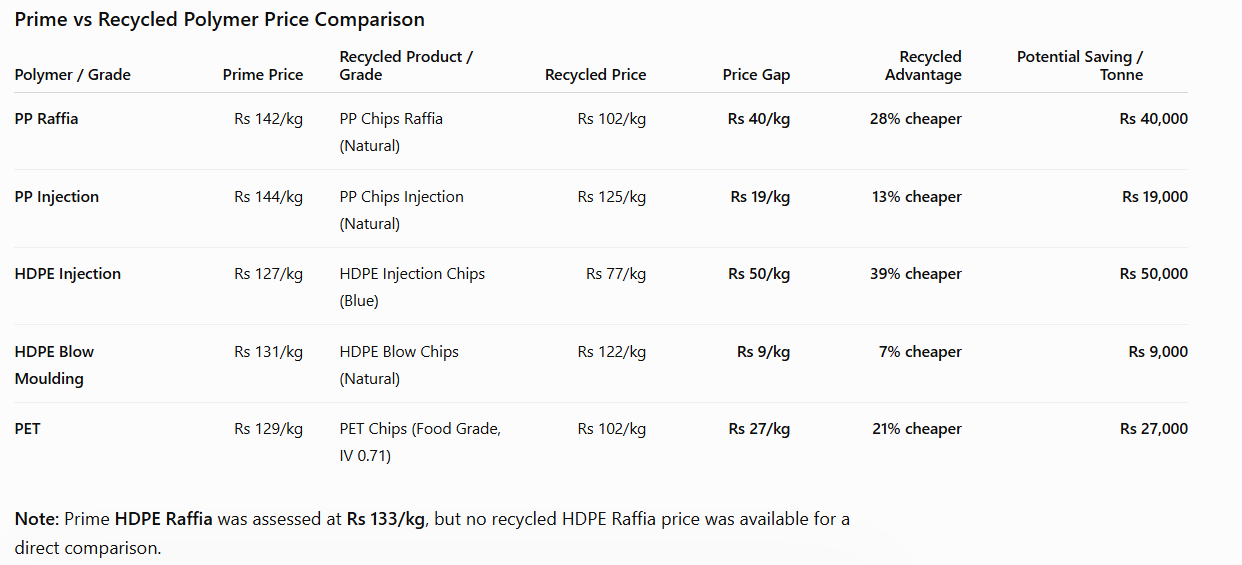
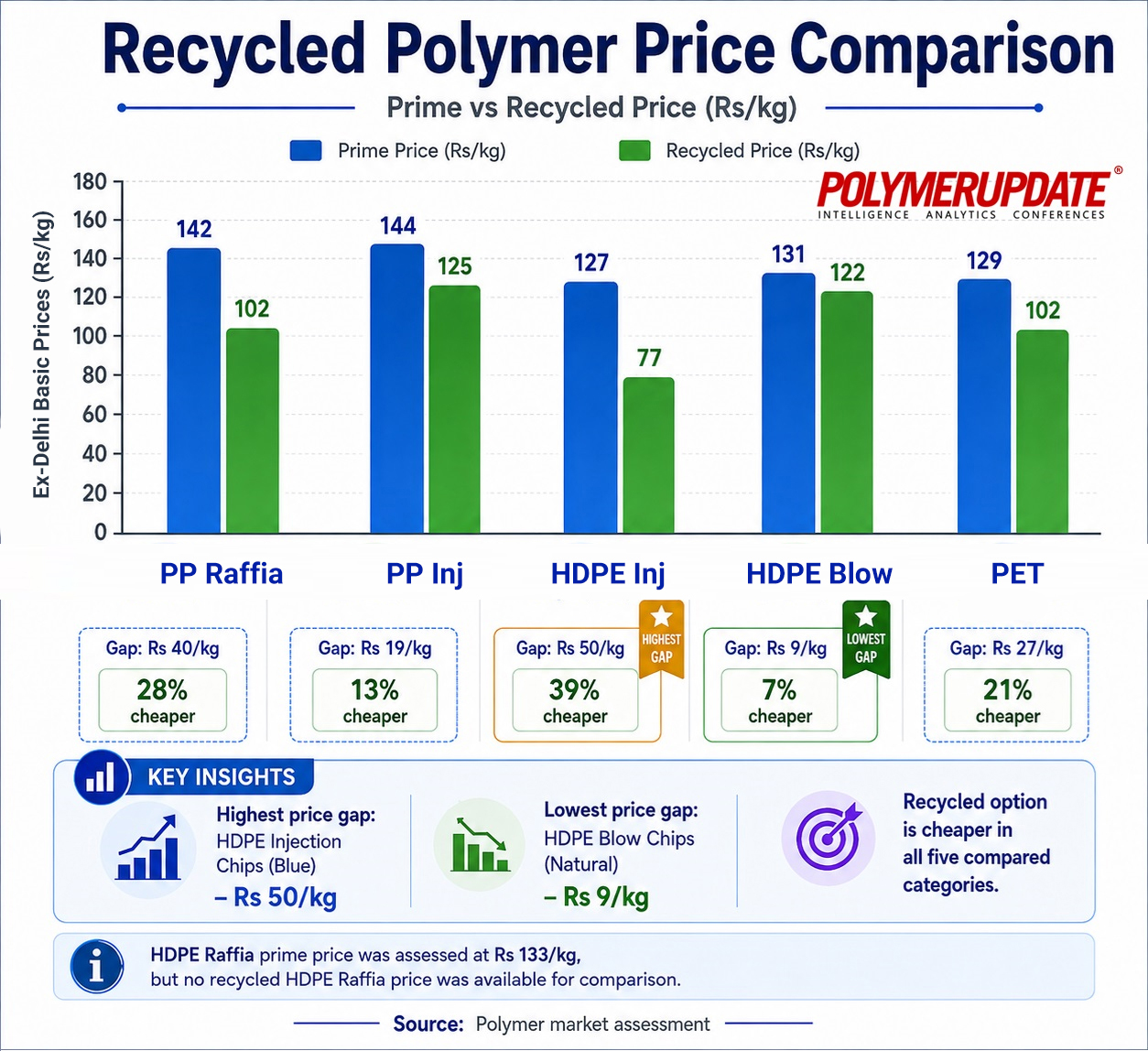
In the PP Raffia segment, prime material was assessed at Rs.142/kg, while recycled PP Chips Raffia (Natural) stood at Rs.102/kg, making recycled material Rs 40/kg, or around 28%, cheaper than prime PP. This represents a potential raw material cost saving of approximately Rs.40,000/tonne. The sizeable gap makes recycled PP Raffia an attractive alternative for converters where product specifications permit the use of recycled material.
For PP Injection, prime material was assessed at Rs.144/kg, compared with Rs.125/kg for recycled PP Chips Injection (Natural). Recycled material was therefore Rs 19/kg, or around 13%, cheaper, equivalent to a potential saving of approximately Rs.19,000/tonne. As this price gap is narrower than in raffia, buyers may place greater importance on quality consistency, processing performance and finished-product requirements when deciding between prime and recycled material.
The sizeable discount for recycled raffia continued to make it an economical alternative for suitable applications, while the smaller injection grade gap may keep buyers more focused on quality and processing performance when choosing between prime and recycled material.
 High density polyethylene (HDPE) comparison
In the HDPE Injection segment, prime material was assessed at Rs.127/kg, while recycled HDPE Injection Chips (Blue) were at Rs.77/kg. This created a substantial difference of Rs.50/kg, making recycled material around 39% cheaper and providing a potential cost saving of approximately Rs.50,000/tonne. The wide gap could encourage greater recycled material consumption in applications where colour, quality and performance specifications allow.
For HDPE Blow Moulding, prime material was assessed at Rs.131/kg, compared with Rs.122/kg for recycled HDPE Blow Chips (Natural). The recycled grade was only Rs.9/kg, or around 7%, cheaper, representing a potential saving of approximately Rs.9,000/tonne. With such a narrow price difference, the incentive to shift from prime to recycled material is relatively limited, and buyers may prefer prime resin where consistent quality and performance are important.
The wide injection grade discount could encourage recycled consumption in less quality-sensitive applications, while the narrow blow moulding spread may reduce the immediate cost incentive to substitute prime resin.
Meanwhile, prime HDPE Raffia was assessed at Rs.133/kg, but no corresponding recycled HDPE Raffia price was available for a direct comparison.
Polyethylene terephthalate (PET) comparisonThe PET market continued to show a significant price differential between virgin and recycled material, with recycled PET maintaining a clear cost advantage over virgin PET. Recycled PET was therefore approximately 21% cheaper than virgin PET, representing a price difference of around Rs.27/kg. The substantial price gap is enhancing the attractiveness of recycled PET for converters seeking to manage raw-material costs. While virgin PET continues to receive support from upstream and feedstock costs, recycled PET pricing remains closely linked to the availability of used PET bottles, collection costs, processing expenses, and the supply of consistent, good-quality recycled chips. The current Rs.27/kg discount could encourage greater adoption of recycled PET in applications where the required quality and performance standards can be met.
Food-grade recycled PET with suitable intrinsic viscosity (IV), high purity, and consistent quality may see stronger buying interest as converters look to increase recycled content while maintaining cost competitiveness. However, virgin and recycled PET are not universally interchangeable. Factors such as IV, purity, colour, consistency, processing performance, and food-contact compliance remain important considerations when buyers determine the appropriate level of recycled material for their applications.
Overall, the current price differential gives recycled PET a clear economic advantage over virgin PET, while quality, technical specifications, and end-use requirements will determine the actual scope for substitution.
Overall, recycled polymers remained cheaper than prime materials across the comparable grades in the Indian market. However, the size of the discount varied significantly by polymer and application. Wider gaps in PP Raffia and HDPE Injection provide a stronger economic incentive for recycled consumption, while narrower spreads in some grades make quality and performance more important in purchasing decisions. Continued movements in upstream and feedstock costs could influence prime resin values, while scrap availability, recycling costs, recycled-material quality and downstream demand are expected to remain key drivers for the recycled market.