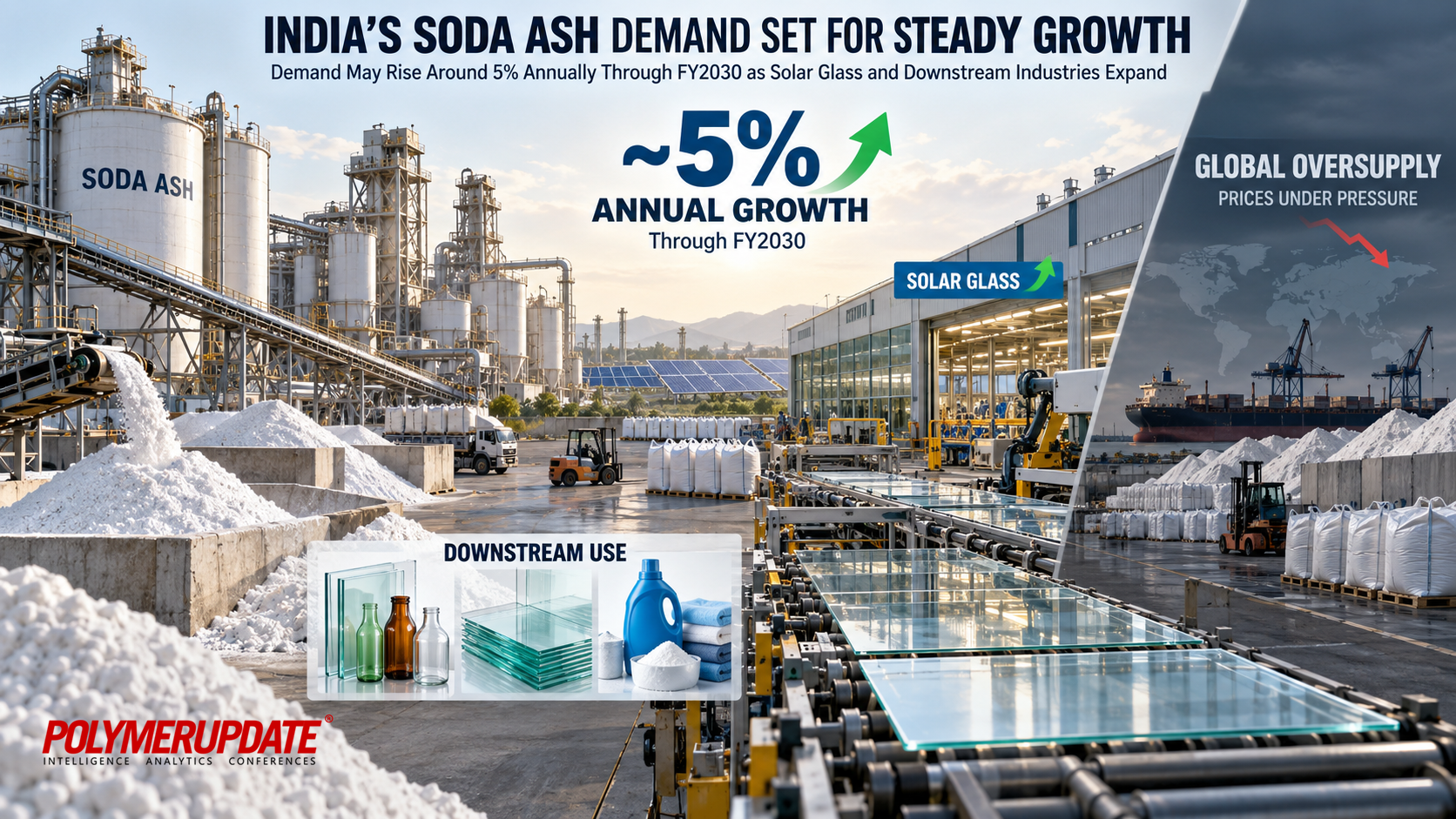
India’s soda ash demand is expected to grow at a compound annual growth rate (CAGR) of around 5 percent between FY2027 and FY2030, driven by a sharp increase in downstream consumption amid robust economic growth, according to the latest study by India Ratings and Research (Ind-Ra). However, the study, titled Chemical Insights, cautions that soda ash prices are likely to remain under pressure during this period due to persistent global oversupply.
“The domestic soda ash industry is entering a new phase of growth, led by demand from both traditional end-use sectors and emerging renewable-energy applications such as solar glass. However, despite the favourable domestic demand outlook, global market conditions remain challenging. Significant capacity additions, particularly in China, are likely to keep the global soda ash market oversupplied over the medium term, resulting in elevated competitive intensity and limiting any sustained recovery in international soda ash prices,” said Pradeep Singh, Analyst, Corporate Ratings, Ind-Ra.
Domestic prices, while influenced by import-parity dynamics and recent conflict-driven supply disruptions, are likely to remain better supported than global prices due to policy measures, higher freight costs and growing domestic demand. Nevertheless, the pricing power of domestic producers is likely to remain constrained as global oversupply persists and low-cost natural soda ash producers in the US, Türkiye and China continue to exert competitive pressure.
Moreover, Indian producers face structural cost challenges due to the predominantly synthetic nature of domestic soda ash production, which is more energy-intensive than natural soda ash production. Any sustained increase in energy, fuel, raw material and logistics costs could weigh on profitability, particularly as prices normalise from recent highs. Consequently, operational efficiency, cost optimisation, successful capacity ramp-up and the ability to substitute imports will be key determinants of utilisation levels, margins and returns over the next investment cycle.
 Benefits from solar glass sector
Solar glass is expected to be a key growth driver of domestic soda ash demand in the near term. Recent policy measures, including duty relief on key solar glass inputs and continued protection against low-cost imports, are likely to support capacity expansion, import substitution and investment in the domestic solar value chain. India’s solar glass capacity remains well below domestic requirements, creating significant growth potential. Bridging this gap could increase soda ash demand over the medium term. Accordingly, domestic soda ash demand is likely to grow by 4.5–5 percent annually during FY2027–30, compared with around 3–3.5 percent historically, led by demand from solar glass but partly offset by the gradual shift towards liquid detergents.
India is likely to remain a net soda ash importer during FY2027–30, although import dependence should decline as new domestic capacities ramp up. However, rising exports from China could continue to influence import-parity pricing across Asia, including India. Consequently, import substitution will remain critical to improving utilisation and returns from upcoming domestic capacities. The proposed anti-dumping duties, if implemented, could help mitigate import pressures to some extent and support domestic pricing and profitability.
Next capex cycleThe next phase of soda ash capacity additions during FY2027–30 is being driven by widening demand-supply gaps, rising import dependence—with net imports increasing to 700,000 tonnes per annum (tpa) in FY2026 from 313,000 tpa in FY2022—high capacity utilisation and accelerating demand growth. Producers have announced 2.169 million tpa of new capacity additions, which could increase India’s installed capacity to around 6.819 million tpa by FY2030, from approximately 4.650 million tpa in FY2026.
The industry is expected to remain highly concentrated, with the top three players accounting for around 78 percent of installed capacity in the near term. Planned expansions include GHCL Limited (1.10 million tpa), RSPL Limited (0.50 million tpa), Tata Chemicals Limited (0.41 million tpa), and Tuticorin Alkali Chemicals Limited (0.16 million tpa). This marks the next major phase of capital expenditure after a decade of 4.1 percent CAGR in capacity growth, with most incremental capacity coming online during FY2019–20. Domestic capacity is concentrated in western India, close to key raw material sources.
Global oversupplyThe global soda ash market entered a structural oversupply in 2025, driven mainly by large capacity additions in China amid subdued domestic demand. This oversupply is likely to persist through 2026–2027, as planned capacity additions, largely in China, are expected to outpace incremental demand growth. China, the US, Türkiye and India together account for around 80 percent of global soda ash capacity. Global demand growth slowed to around 1 percent year-on-year (yoy) in 2025, due to weak glass consumption in the construction, automotive and packaging sectors. Demand is likely to improve gradually over 2026–2027, supported by solar glass, lithium carbonate applications, and a recovery in construction and automotive activity. However, the pace of recovery will depend on demand trends in key markets such as China, Europe and the US.
Global oversupply and weak demand in China and Western markets are likely to keep competition elevated over the medium term. China, which accounts for nearly half of global soda ash capacity, is likely to increase exports due to recent and planned capacity additions, supported by the scale and cost efficiency of its producers. The US is likely to remain the largest exporter, benefiting from low-cost reserves and recent capacity expansions, followed by Türkiye and China. Global trade in soda ash is crucial, as major demand centres are not aligned with domestic production capacities.
Cost advantageNatural soda ash producers in the US, Türkiye and, increasingly, China enjoy a structural cost advantage over synthetic producers, supporting sustained pricing pressure in an oversupplied market. India’s largely synthetic production base remains at a relative cost disadvantage, although its proximity to customers and lower inland freight costs provide some cushion against import competition. Weak demand in Europe has further intensified competition as exporters increasingly target alternative markets, putting additional pressure on higher-cost producers.
Despite easing from the peaks seen during the 2022–2023 energy crisis, European soda ash producers continue to face relatively high production costs and remain among the most vulnerable to capacity rationalisation. Reflecting these pressures, around 1 million tonnes per annum (mtpa) of soda ash capacity was permanently closed in Europe in 2025, primarily due to high energy costs, regulatory burdens and competition from lower-cost imports. The closures highlight the growing pressure on higher-cost producers to improve competitiveness or reduce capacity amid persistent global oversupply.
Price outlookAverage soda ash prices are likely to be higher year-on-year (yoy) in FY27, supported by the sharp rise recorded during April–June 2026 following the Middle East conflict. However, as supply disruptions ease, prices are likely to normalise amid persistent global oversupply. In addition, growing low-cost natural soda ash production in the US, Türkiye and China is likely to limit any sustained price recovery. Domestic soda ash prices averaged INR 38,67 a tonne during April–June 2026, up 21 percent yoy, following a 14 percent yoy decline in FY26 due to oversupply. Although recent price gains may provide near-term support, producers’ margins are likely to remain range-bound as prices normalise and cost pressures persist over the medium term.
DILIP KUMAR JHA
Editor
dilip.jha@polymerupdate.com