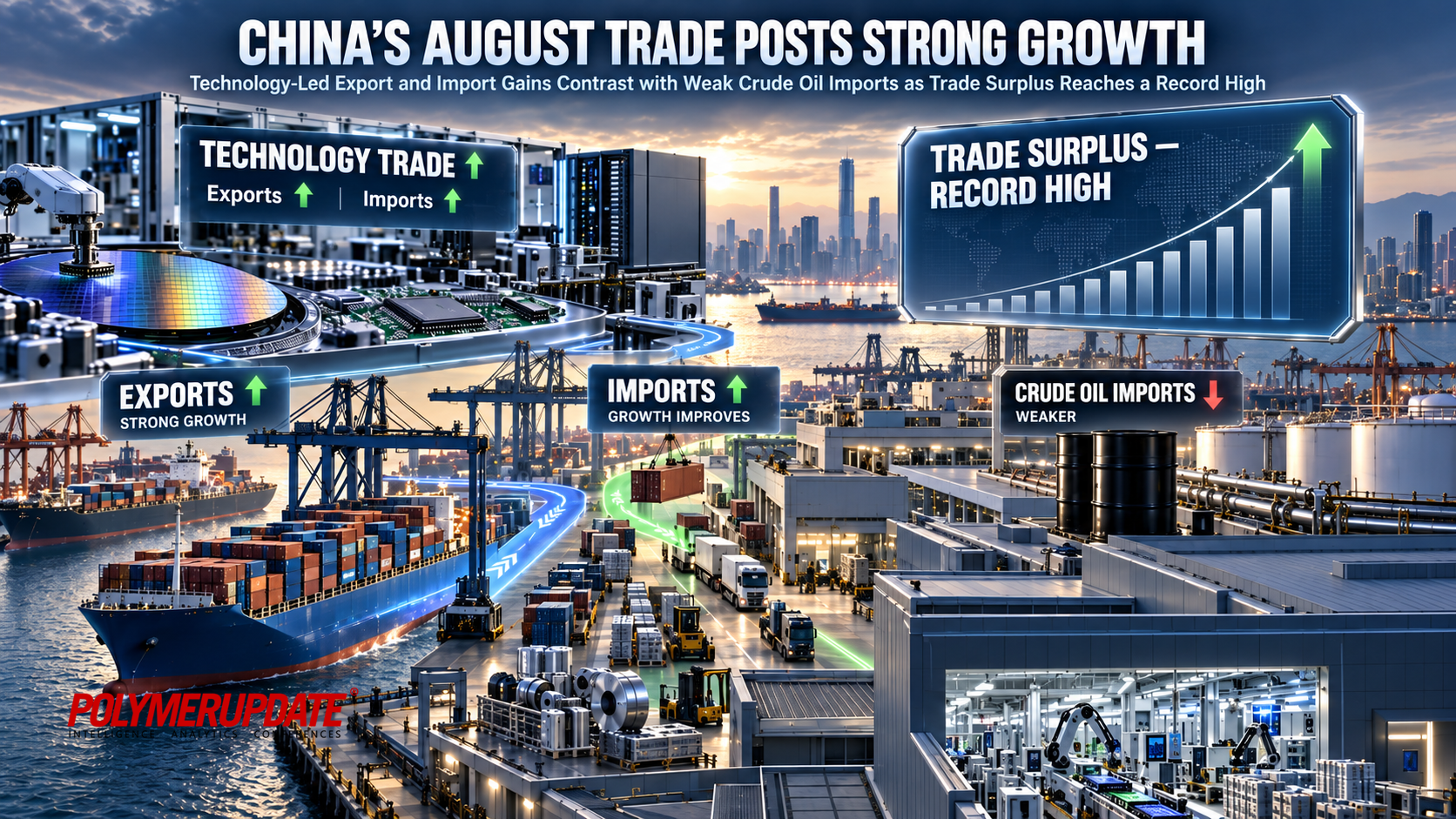
China’s trade momentum strengthened further in August, with both exports and imports recording robust year-on-year growth, led increasingly by technology-related products. The latest trade figures suggest that external demand for Chinese goods remains resilient despite ongoing tariff uncertainties and concerns over the durability of the global technology investment cycle. Chinese exports rose 25.0 percent year-on-year in August, accelerating from 23.9 percent in July and broadly matching market expectations.
The increase took year-to-date export growth to 19.3 percent, with exports reaching approximately US$ 2.92 trillion. The performance highlights the continuing strength of China’s external sector and its growing dependence on overseas demand to support economic activity. The composition of export growth, however, points to an increasingly technology-driven trade profile. Semiconductor exports surged 129.8 percent year-on-year in August, while exports of automatic data-processing machines jumped 76.5 percent. These figures underline the growing importance of high-technology goods in China’s export expansion as global demand for computing equipment, electronics and other technology products remains strong.
The strength was not confined to technology. Most of China’s major export categories continued to record substantial increases, although the pace of growth in some sectors moderated. Automobile exports rose 43.0 percent year-on-year in August, while ship exports increased 21.0 percent. The slowdown in these categories compared with earlier months suggests that the broader export recovery is becoming increasingly concentrated in technology-intensive products.
 US market begins to narrow the gap
The geographic distribution of China’s exports also showed signs of becoming more balanced. Exports to the United States continued to recover on a year-on-year basis, extending a five-month improvement streak. Year-to-date exports to the US were up 6.1 percent, bringing growth closer to the rates recorded in several other major markets.
The strongest export growth was recorded in China’s trade with South Korea, where exports increased 35.3 percent year-to-date, followed by Taiwan at 33.2 percent and Russia at 30.7 percent. Exports to ASEAN and Africa also remained particularly strong, with both markets recording growth of around 25.8 percent. By comparison, exports to Japan and Canada increased by a more modest 8.1 percent and 10.2 percent, respectively.
The broadening of export growth across emerging and Asian markets is significant because it reduces China’s dependence on any single major destination. At the same time, the gradual recovery in exports to the US suggests that trade flows are adapting to changing tariff and supply-chain conditions.
Nevertheless, the external strength contrasts sharply with relatively weaker domestic demand. Economists have increasingly described this divergence as a “K-shaped” recovery, in which external demand significantly outpaces consumption and investment within China. Government efforts to strengthen domestic demand have continued, but the August trade data indicate that exports remain a critical engine of economic growth.
Technology drives imports higherChina’s import performance was also strong, although it fell somewhat short of market expectations. Imports increased 28.2 percent year-on-year in August, compared with a revised 27.6 percent increase in July. The latest figure was below market expectations of 31.0 percent, but still represented a substantial expansion.
Technology again emerged as the principal driver. Imports of high-technology products surged 68.7 percent year-on-year in August, the fastest monthly growth recorded so far this year. Year-to-date, high-tech imports were up 46.0 percent. Imports of automatic data-processing machines were particularly strong, increasing 209 percent year-on-year in August, compared with a year-to-date growth rate of 105 percent. Semiconductor imports also accelerated sharply, rising 83.6 percent in August against year-to-date growth of 61.7 percent.
The acceleration in technology imports provides evidence that Chinese companies and industries continue to invest heavily in the technology race. It also indicates that China’s manufacturing and technology sectors are importing sophisticated equipment and components even as the country seeks to strengthen domestic capabilities and reduce dependence on foreign technology. This trend could have important implications for global supply chains. Strong Chinese demand for semiconductors, computing equipment and other high-technology products could support manufacturers across Asia and reinforce regional trade integration.
Crude oil imports remain weakThe picture is markedly different for crude oil. Chinese customs data showed that crude oil imports increased for a second consecutive month on a sequential basis, with volumes rising 6.2 percent month-on-month in August. However, imports remained sharply lower than a year earlier, declining 23.4 percent year-on-year. The weakness in crude oil imports reflects broader changes in China’s energy demand and refining activity. While technology-related imports are accelerating, the decline in crude purchases points to a more cautious approach in parts of the industrial and energy economy.
The contrasting trends underline the structural changes taking place in China’s import basket. Technology products are gaining importance, while some traditional industrial commodities and manufactured goods are experiencing weaker demand. The automotive sector is another example. Strong domestic competition, particularly from Chinese manufacturers, has contributed to a sharp decline in foreign vehicle purchases. Auto imports fell 19.9 percent year-to-date, reflecting the increasing competitiveness of domestic producers and changing consumer preferences.
Trade surplus heads towards recordDespite the strong increase in imports, China’s exports continue to grow at a faster pace, pushing the country’s trade surplus towards a new annual record. The trade surplus reached US$ 119.1 billion in August, marking the fourth consecutive month in which it exceeded US$ 100 billion. Year-to-date, China’s trade surplus was up 3.1 percent year-on-year compared with the corresponding period last year. If the current momentum continues, the country could post its highest-ever annual trade surplus.
The development is likely to attract greater scrutiny from China’s trading partners, particularly at a time when governments in major economies are seeking to protect domestic industries and reduce trade imbalances. A widening Chinese trade surplus could intensify calls for Beijing to increase domestic consumption and allow greater access to its market for foreign goods. The implications extend beyond trade policy. Net exports contributed around 0.8 percentage points to China’s GDP growth during the first half of the year, and their contribution could increase in the third quarter if export momentum remains strong.
Questions over sustainabilityThe immediate outlook for China’s trade remains positive, but significant uncertainties remain. The durability of the global technology investment cycle will be crucial, particularly given the exceptional growth in semiconductor and computing-related trade. Any moderation in global demand for technology products could have a disproportionate impact on China’s export performance.
Tariff risks also remain an important consideration. Changes in trade policy in the US and other major economies could affect Chinese exporters, supply chains and investment decisions. At the same time, Chinese manufacturers are continuing to expand into markets across Asia, Africa, Europe and other regions, potentially helping offset weakness in individual destinations. The latest data therefore present a mixed picture. China’s external sector remains remarkably strong, with exports growing at a rapid pace and technology products emerging as the principal engine. Imports are also expanding quickly, but their composition reveals a structural shift towards high-technology goods.
For policymakers, the challenge is to convert this external strength into broader and more sustainable domestic economic momentum. For global markets, meanwhile, China’s rising technology exports, accelerating high-tech imports and record-scale trade surplus signal that the country will remain a powerful force in global manufacturing and trade.
As ING Economics Chief Economist for Greater China Lynn Song has highlighted, the key question is whether this export-led strength can persist in the face of tariff risks and uncertainty over the global technology investment cycle. For now, however, China’s trade engine continues to run at full speed, with technology firmly in the driving seat.
DILIP KUMAR JHA
Editor
dilip.jha@polymerupdate.com