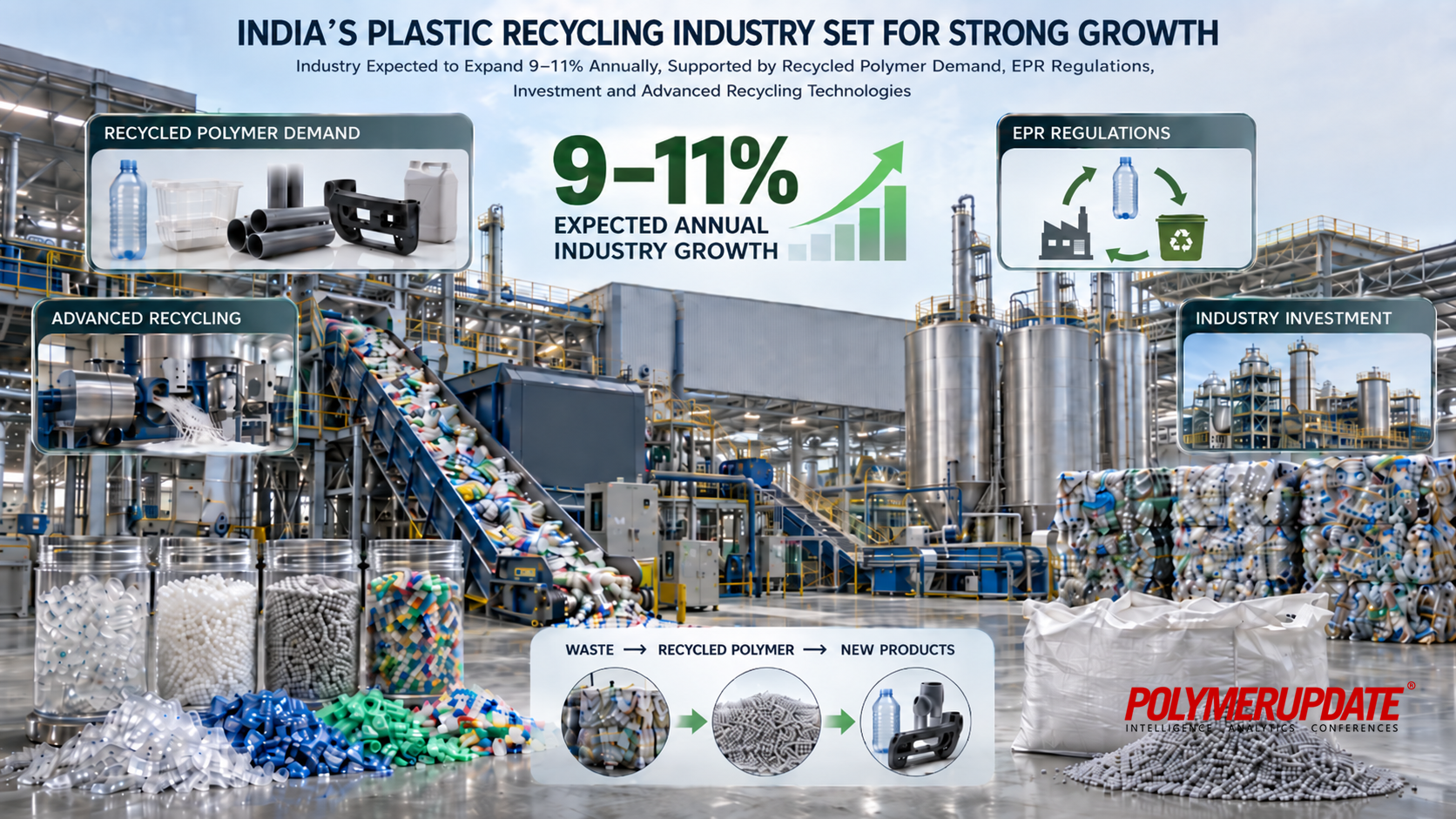
India’s plastic recycling industry is expected to expand at a robust annual growth rate of 9–11 percent over the next five to ten years, fuelled by rising demand for recycled polymers, stronger environmental regulations and growing investments in advanced recycling technologies, industry leaders said. The optimistic outlook comes at a time when India is accelerating its transition towards a circular economy, with policymakers and manufacturers increasingly viewing recycled plastics as a strategic resource capable of reducing dependence on imported petrochemicals while improving resource security.
Speaking at a recent event, Shailendra Singh, Director General of the Association of Plastic Recyclers Bharat (APR Bharat), said the country’s recycling ecosystem has undergone a remarkable transformation during the past decade. “The plastic recycling ecosystem in India has changed significantly, supported by stronger regulations such as Extended Producer Responsibility (EPR), recycled-content mandates, increased investments and the adoption of world-class technologies. We expect the market to grow at around 9–11 percent compound annual growth over the next five to ten years, driven primarily by rising demand for recycled plastics,” Singh added.
 Regulations driving industry growth
The sector’s growth is being underpinned by India’s evolving regulatory framework, particularly the implementation of EPR rules that require producers, importers and brand owners to ensure the collection and recycling of plastic packaging waste. Recycled-content mandates are also encouraging manufacturers to incorporate recycled materials into their products, creating a more predictable demand for recycled polymers.
Industry participants believe these measures are gradually formalising a sector that has traditionally depended heavily on informal waste collectors while attracting greater investment into organised recycling infrastructure. However, Singh cautioned that significant structural challenges remain. “Collection, source segregation and integrating the informal sector into the formal recycling economy continue to be the biggest hurdles. Unless these issues are addressed, the full potential of plastic recycling cannot be realised,” he said.
India generates millions of tonnes of plastic waste annually, but inconsistent segregation at the household and commercial levels continues to affect the quality and quantity of recyclable material reaching processing facilities. Experts argue that improving collection efficiency could substantially increase recycling rates while creating livelihoods across the value chain.
Virgin polymer volatility strengthens recycling caseRecent fluctuations in virgin polymer prices have further reinforced the economic importance of recycled plastics. According to Singh, volatility in global petrochemical markets has exposed India’s dependence on imported raw materials, making recycled polymers increasingly valuable as an alternative domestic resource.
“Recent fluctuations in virgin polymer prices have highlighted India’s dependence on imported petrochemicals and the need to promote recycled plastics to improve resource security and self-reliance,” he said. India imports substantial quantities of several key petrochemical feedstocks and polymers, leaving domestic manufacturers vulnerable to geopolitical disruptions, shipping constraints and crude oil price volatility. Expanding recycling capacity could help moderate these risks by creating a stable domestic supply of secondary raw materials.
Circular economy needs collective actionThe conference also highlighted the broader environmental and social dimensions of recycling. Maharashtra Pollution Control Board (MPCB) Chairman Siddhesh Ramdas Kadam called for stronger collaboration among industry, government, citizens and educational institutions to accelerate India’s circular economy ambitions. Drawing attention to Mumbai’s mounting waste challenge, Kadam cited a recent large-scale clean-up at Juhu Beach where volunteers collected nearly 180 tonnes of waste within six hours. By comparison, municipal authorities remove an average of 80–120 tonnes of waste daily from the city’s beaches and surrounding coastal areas.
He argued that enforcement alone cannot solve India’s waste crisis. “We need to focus on small, practical steps such as segregation of waste at source. Ten smaller chains can ultimately create one large chain that makes a significant difference. “The waste generated from manufactured products ultimately becomes the raw material for the recycling industry. Industry therefore has both an economic and social responsibility,” he added. He also urged manufacturers to recognise their broader responsibility in the recycling ecosystem.
Recycling capacity enters expansion phasePrivate investment is emerging as another major growth driver, with organised recyclers expanding capacity to meet anticipated demand from consumer goods, packaging and automotive sectors. Hyderabad-based Banyan Nation, one of India’s leading plastic recyclers, announced plans to increase its recycling capacity fivefold over the coming years.
Kiarah Ahuja, General Manager and Head of Business Development at Banyan Nation, said the company has been addressing India’s polyolefin recycling challenge since 2013 by building one of the country’s earliest organised supply chains for high-quality recycled high-density polyethylene (HDPE). “Our Hyderabad facility currently has an annual recycling capacity of 10,000 tonnes. We are scaling this to 50,000 tonnes through a new Bengaluru facility over the next four years,” Ahuja said.
She emphasised that the industry’s next phase of growth would depend less on capacity alone and more on establishing reliable, certified recycling systems capable of delivering consistent material quality. “As the market scales, the focus needs to shift towards building dependable recycling capacity and strengthening supply chains. EPR has the potential to do for recycled plastics what renewable purchase obligations did for solar energy by creating sustained market demand,” she said.
While plastics dominated discussions, the event also underscored the growing importance of recycling across other material streams, particularly metals and electronic waste. If current challenges are addressed, recycled plastics could become a cornerstone of India’s resource security strategy, reducing import dependence while supporting the nation’s broader sustainability and circular economy objectives.
OutlookIndia’s recycling industry is increasingly moving beyond waste management towards becoming a critical component of the country’s manufacturing ecosystem. Rising regulatory support, expanding organised capacity and growing demand for sustainable materials are expected to drive long-term investment across the value chain. Nevertheless, experts agree that achieving the sector’s projected 9–11 percent annual growth will depend on solving foundational issues—particularly efficient collection systems, universal source segregation and the successful integration of millions of informal waste workers into the formal economy.
DILIP KUMAR JHA
Editor
dilip.jha@polymerupdate.com