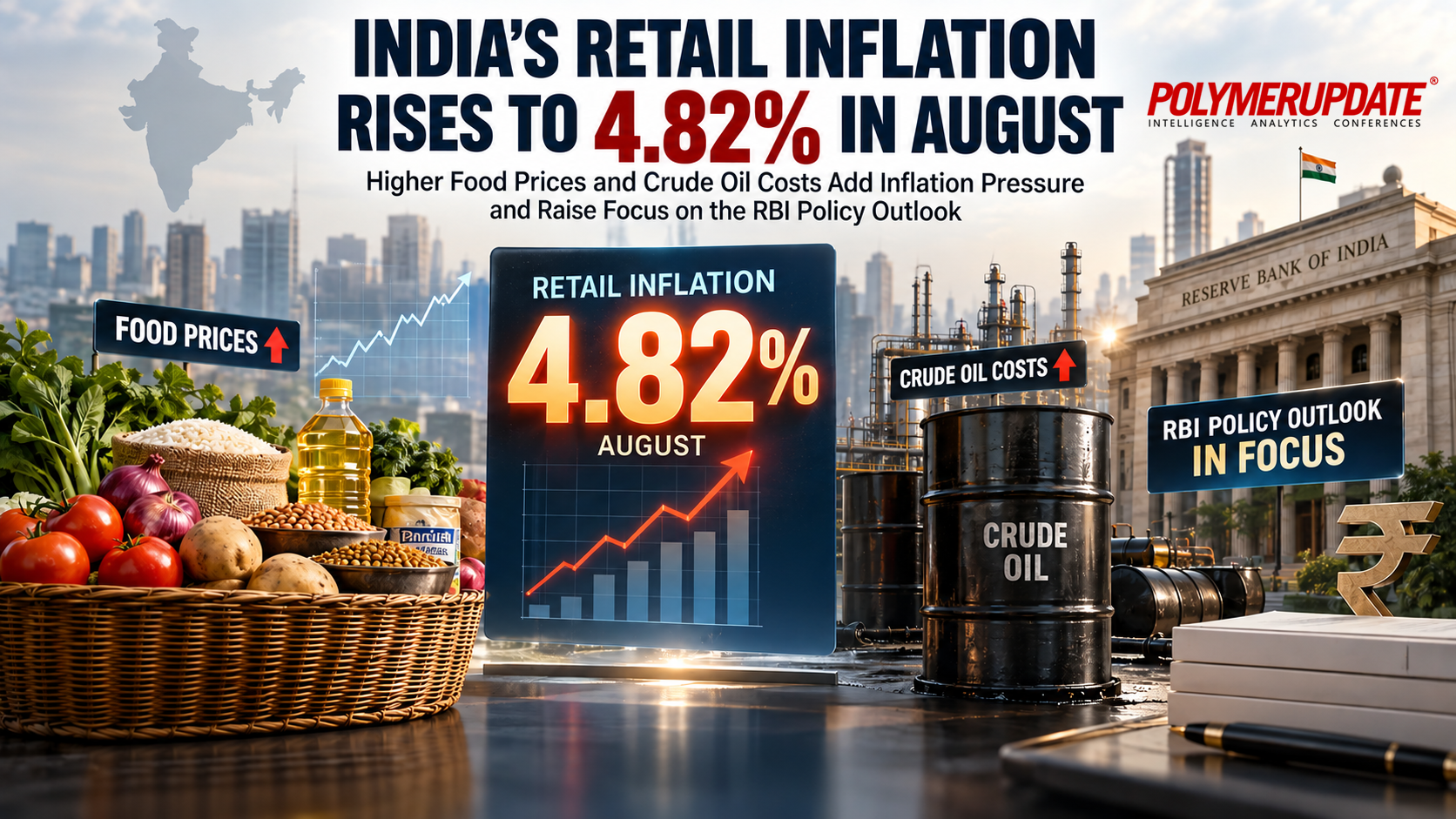
India’s retail inflation accelerated for the 10th straight month to 4.82 percent in August 2026 from 4.5 percent in July, marking a broad-based strengthening of price pressures across food and non-food categories and moving inflation further above the Reserve Bank of India’s 4 percent medium-term target. Economists warned that the inflation trajectory could become more challenging in the coming months as elevated food prices coincide with a sharp rise in global crude oil prices amid continuing geopolitical tensions in West Asia.
Devendra Kumar Pant, Chief Economist at India Ratings & Research (Ind-Ra), commented, “Consumer Price Index (CPI)-based inflation rose 4.82 percent year-on-year in August, compared with our forecast of 4.6 percent, after increasing from 4.45 percent in July, 4.38 percent in June and 3.93 percent in May. The latest reading marks a continuation of the upward trend and leaves inflation above the RBI’s 4 percent benchmark. Inflation in the second quarter of FY27 is likely to be marginally higher than the RBI’s forecast of 4.7 percent, with Ind-Ra estimating it at around 4.9 percent.”
He expects headline inflation to rise further to a 21-month high of around 5 percent in September, driven primarily by higher food and energy prices. “Barring pan, tobacco and intoxicants and health, year-on-year inflation for other commodity groups in August was higher than in July, suggesting a generalisation of inflation, although at a slower pace than envisaged earlier,” Pant said.
 Rising food inflation - a major concern
Food inflation remains a major concern which moved up to 5.95 percent in August from 5.52 percent in July, 5.32 percent in June and 4.78 percent in May, reaching a 19-month high despite improved rainfall. Prices of several mass-consumption items, including ginger, garlic and onions, registered high double-digit increases. Erratic monsoon rainfalls with flood in some areas and drought in others have caused severe damage to the kharif season crop.
However, sown area reached around 105.67 million hectares by late August, marking a significant recovery and still standing about 1.5 percent lower than the same period last year. This represents a sharp improvement from June and July, when sowing faced a severe deficit of up to 23 percent due to delayed southwest monsoon rains and El Niño concerns
Higher inflation was also recorded across unconventional food items such as pan and tobacco products at 7.34 percent, operation of personal transport equipment at 7.40 percent, food and beverage serving services at 8.41 percent, transport services for goods at 14.64 percent and other personal effects at 44.56 percent. These increases contributed to the rise in headline inflation.
Core inflation strengthensCore inflation also strengthened, with Ind-Ra estimating it at 4.3 percent in August, up from 4 percent in July and the highest level in nine months. The increase was partly driven by discretionary spending. Inflation in restaurants and accommodation services rose to 8.4 percent from 7.7 percent in July, while inflation in social protection and miscellaneous services increased to 15.2 percent from 14.8 percent.
Pant said rising prices of discretionary services point to resilient consumer demand and suggest that inflationary pressures are becoming more broad-based.
The impact of higher energy prices is also becoming increasingly visible. Transport inflation rose to 4.6 percent in August from 4.44 percent in July, 4.31 percent in June and only 1.75 percent in May. Inflation in restaurant and accommodation services increased to 8.38 percent from 7.72 percent in July, 6.91 percent in June and 5.75 percent in May, highlighting the impact of higher commercial liquefied petroleum gas prices amid the continuing West Asia conflict.
High energy price impactMeanwhile, incomplete pass-through of elevated crude oil and petroleum product prices had so far shielded consumers from the full impact of the surge in global energy costs. However, this protection could diminish if crude prices remain elevated. Crude oil prices, which were hovering around US$ 80-85 a barrel before the August monetary policy meeting, have breached the US$ 100 a barrel mark since September 9. Economists identified elevated crude prices as the main risk to the inflation outlook.
Crisil Chief Economist Dharmakirti Joshi also cautioned that food inflation warrants close attention despite improved sowing activity. He said, “It would be premature to conclude that agricultural risks have receded, as concerns have shifted from acreage to productivity, particularly for crops dependent on rainfall.” According to Crisil Intelligence’s Deficient Rainfall Impact Parameter as of September 13, cotton, bajra, maize, tur, groundnut and soybean remain vulnerable to deficient rainfall. Joshi said the combination of weather-related risks and an unfavourable statistical base effect could keep food inflation elevated in the months ahead.
External risks have also intensified. Inventory depletion and persistent geopolitical tensions in West Asia have prompted Crisil Intelligence to raise its FY27 Brent crude forecast to US$ 88-93 a barrel, implying an annual increase of 25-32 percent. “Elevated energy prices invariably find their way into the broader cost structure of the economy,” Joshi said, adding that robust demand is allowing producers to increasingly pass higher fuel and input costs on to consumers.
The transmission of higher energy and input costs is already visible in wholesale inflation, which rose to 9.9 percent in August. Crisil estimates core inflation at 4.2 percent, up from 3.9 percent in July, and now expects CPI inflation to average 5.1 percent during the current fiscal year, compared with 2 percent in FY26. Joshi said strong economic growth has sustained demand while renewed conflict in West Asia is adding pressure on input costs. Together, these factors are reducing the room for monetary policy to remain on the sidelines for an extended period.
Vulnerable to external and internal shocksCare Ratings Chief Economist Rajani Sinha, meanwhile, attributed the rise in headline inflation primarily to higher food prices, with pressures visible in sugar, rice, edible oil and vegetables such as onions. Delayed planting of onions following a late monsoon has postponed the arrival of the new crop, while lower sugarcane yields and greater diversion of sugarcane towards ethanol production have tightened domestic sugar supplies.
She also noted that volatile global energy prices amid the Middle East conflict have pushed up transport costs, while higher cooking fuel and food prices have kept restaurant and accommodation inflation elevated. Inflation in information and communication services also rose sharply, potentially reflecting the impact of strong global demand for memory chips associated with the artificial intelligence boom. The inflation outlook remains vulnerable to both external and weather-related risks. Uncertainty over shipping through the Strait of Hormuz remains an upside risk to global energy prices, while below-normal rainfall and concerns over agricultural yields pose domestic risks. Edible oil prices also require close monitoring because India remains heavily dependent on imports and global prices are elevated.
To peak in Oct-Dec quarterCare Ratings expects CPI inflation to peak in the third quarter of FY27 and average around 5 percent for FY27. Sinha said the Monetary Policy Committee is likely to remain data-dependent, with its decisions guided by evolving growth and inflation dynamics. A sustained increase in inflation could strengthen the case for a rate hike in the coming months.
The October RBI policy meeting is therefore emerging as a key event for financial markets. Pant expects the central bank to hold policy rates in October, but said liquidity conditions in the banking system would be a leading indicator of future monetary policy action. With strong growth supporting demand, food inflation rising, crude oil prices above US$ 100 a barrel and core inflation showing signs of broadening, the RBI faces a difficult balancing act between supporting economic activity and preventing inflationary pressures from becoming entrenched.
DILIP KUMAR JHA
Editor
dilip.jha@polymerupdate.com