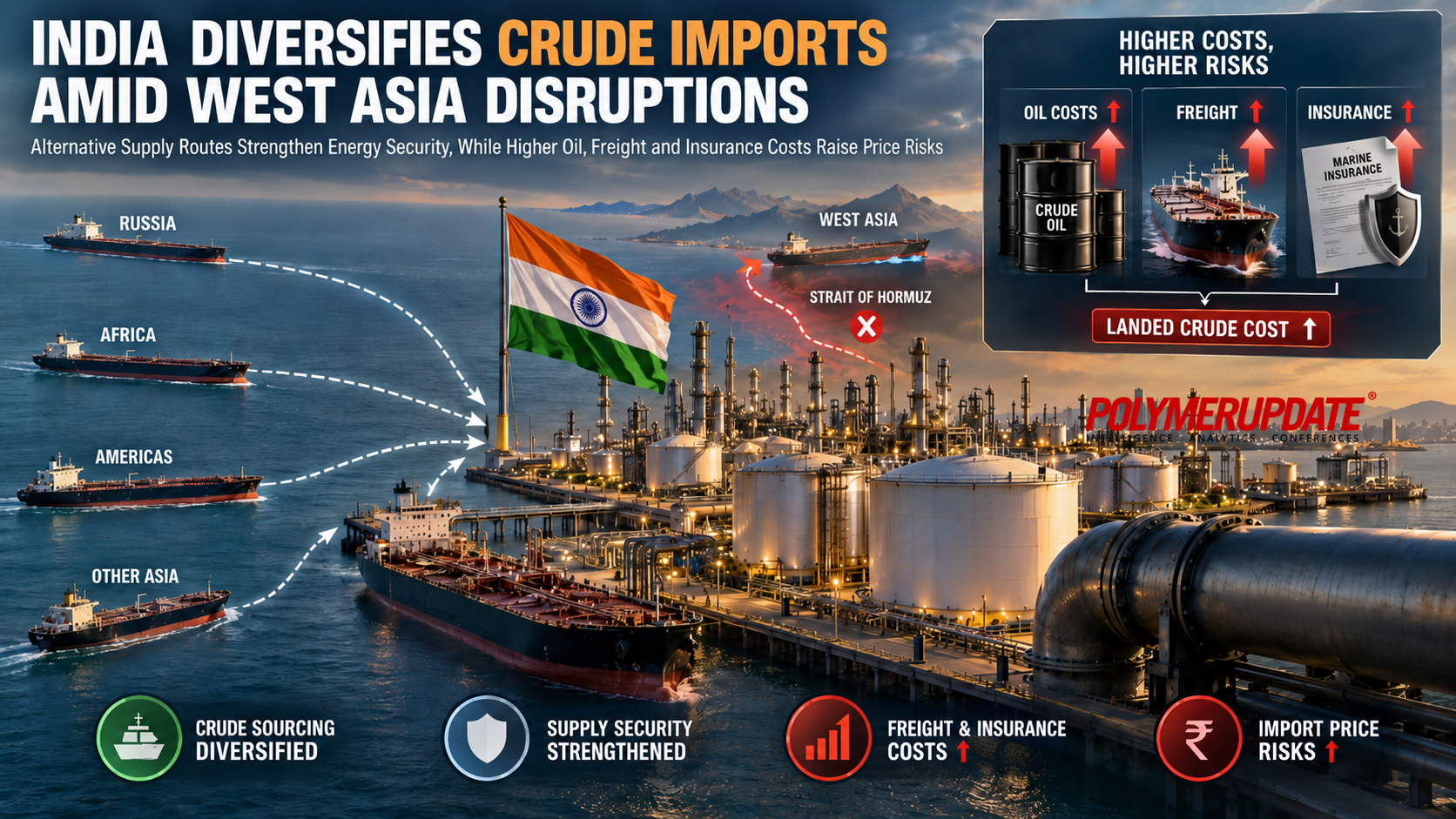
India has reinforced its energy security by diversifying crude oil procurement and routing nearly 70 percent of its imports outside the Strait of Hormuz, enabling the country to withstand one of the largest supply disruptions in the history of the global oil market even as Brent crude prices remain above US$107 a barrel. However, dependence on the remaining 30 percent of imports that still transit through the Strait of Hormuz continues to pose a significant challenge amid persistent missile and drone attacks on oil tankers and merchant vessels by Iran's Islamic Revolutionary Guard Corps (IRGC), Yemen's Houthi rebels, and ongoing naval operations involving United States forces in the region.
The assurance comes amid escalating conflict across West Asia that has simultaneously disrupted shipping through the Strait of Hormuz and the Bab el-Mandeb Strait—two maritime chokepoints that together underpin a substantial share of global seaborne oil trade. While India's refineries continue to receive adequate crude supplies, policymakers acknowledge that the country is facing a severe price shock driven by higher oil prices, freight rates and marine insurance premiums rather than an immediate physical shortage of crude.
Speaking at a recent inter-ministerial briefing in New Delhi, Sujata Sharma, Joint Secretary in the Ministry of Petroleum and Natural Gas, said India's crude oil supply remains secure despite the regional crisis. “The volume of crude oil already secured by the government exceeds what would normally have arrived through the Strait of Hormuz, while oil marketing companies have successfully sourced cargoes from multiple international suppliers. India now imports crude oil from 40 countries, reflecting a long-term strategy to reduce dependence on any single producing region. Gas companies have also diversified procurement, with two liquefied natural gas (LNG) cargoes from new sources currently on their way to India,” Sharma added.
 India's import cushion grows stronger
India's total crude oil imports average around 5 million barrels per day (bpd), while domestic consumption stands at approximately 5.5 million bpd. The country imports nearly 85–88 percent of its crude requirement, making it the world's third-largest oil importer and one of the most vulnerable major economies to disruptions in global energy trade. Traditionally, around 2 million bpd of the country's crude imports moved through the Strait of Hormuz. However, aggressive diversification over the past few years has fundamentally altered the sourcing pattern.
Today, little over two-third percentage of total crude supplies are sourced or routed outside Hormuz, compared with roughly 55 percent previously. Russia has remained India's largest single crude supplier, while Iraq and Saudi Arabia continue to be major Middle Eastern contributors. Imports from Brazil, West Africa and other Latin American producers have also increased, providing refiners with greater flexibility amid geopolitical uncertainty.
State-run refiners including Indian Oil Corporation, Bharat Petroleum Corporation and Hindustan Petroleum have simultaneously diversified the grades of crude they process. Instead of relying predominantly on Gulf medium-sour crude, they are increasingly refining Russian Urals, Brazilian offshore crude and heavier African grades, improving operational resilience while optimizing refinery economics.
Dual chokepoint crisis rattles global marketsThe ongoing conflict has created an unprecedented disruption across the global oil supply chain. Before the outbreak of war, nearly 20 million barrels per day of crude and petroleum products flowed through the Strait of Hormuz. Those volumes have now fallen to a fraction of normal levels, forcing Gulf producers to cut overall oil production by an estimated 10 million barrels per day as alternative pipeline capacity remains insufficient. The pressure has intensified further at the Bab el-Mandeb Strait, the narrow waterway connecting the Red Sea with the Gulf of Aden between Yemen and the Horn of Africa.
Around 5 percent of global oil trade passes through this corridor. During 2024 alone, approximately 4.1 billion barrels of crude oil and refined petroleum products transited the strait, while Saudi Arabia shipped nearly 75 percent of its oil exports through the route. With Houthi forces expanding territorial control around Bab el-Mandeb and commercial vessels increasingly coming under attack, the simultaneous disruption of both chokepoints has sharply elevated concerns over global energy supplies.
Supply secured, but prices remain vulnerableEnergy analysts describe the current situation as a supply-chain cushion versus a price shock. India's diversified sourcing has ensured that crude cargoes continue reaching domestic refineries, preventing shortages in fuel availability. However, diversification cannot insulate the country from internationally benchmarked oil prices. As Brent crude has climbed above US$ 107 a barrel, freight charges, war-risk insurance and shipping costs have risen sharply, increasing the landed cost of every imported barrel.
Analysts warn that if Hormuz and Bab el-Mandeb were simultaneously blocked for a prolonged period, international crude prices could surge to US$ 130–135 a barrel, creating significant inflationary pressure through higher transport, electricity and food costs. The impact would likely be felt by consumers through higher fuel prices, rising utility bills and increased logistics costs across the broader economy, even if physical crude supplies remain available.
Government monitors shipping and citizensThe government has also intensified monitoring of maritime operations in the conflict zone. Rajesh Kumar Sinha, Special Secretary in the Ministry of Ports, Shipping and Waterways, said 28 Indian-flagged vessels carrying 778 Indian seafarers are currently operating in the Persian Gulf. Authorities, ship managers and recruitment agencies are coordinating closely with Indian embassies and local governments to ensure crew safety and provide medical assistance wherever required. He added that port operations across India remain stable and all ports have been instructed to facilitate uninterrupted export-import trade.
Meanwhile, Ministry of External Affairs spokesperson Randhir Jaiswal said Indian missions across Gulf Cooperation Council countries remain in continuous contact with the Indian community. He confirmed that two Indian nationals have died and one remains missing after merchant vessels came under attack, while several injured Indians are receiving treatment with consular support.
Energy security enters a new phaseThe ongoing West Asian crisis has demonstrated that modern energy security is no longer measured solely by access to crude oil reserves. It increasingly depends on a diversified import portfolio, resilient maritime supply chains, strategic petroleum reserves, flexible refinery configurations capable of processing multiple crude grades, and alternative LNG procurement from geographically diverse suppliers. India's decision to expand crude sourcing from 40 countries and reduce its dependence on the Strait of Hormuz has significantly strengthened its ability to withstand geopolitical disruptions.
However, diversification offers protection against supply shortages—not against global price volatility. As crude, freight and marine insurance costs rise amid tensions in the Strait of Hormuz and the Bab el-Mandeb Strait, India remains exposed to imported inflation despite uninterrupted refinery operations and stable fuel availability. The crisis serves as a reminder that geopolitical shocks in distant maritime corridors can quickly translate into higher transportation costs, elevated energy prices and broader inflationary pressures across the domestic economy.
DILIP KUMAR JHA
Editor
dilip.jha@polymerupdate.com