Click the icon to add a specified price to your Dashboard list. This makes it easy to keep track on the prices that matter most to you.

As EPR certificate volumes soar, a widening gap between digital compliance and verified physical recycling is becoming India's central circular-economy risk
| Professor Dr. Sajjid Mitha CEO & Founder, PolymerUpdate · PolymerUpdate Academy · RACE Expos and Conferences |
India's plastic recycling story increasingly looks impressive on a spreadsheet.
That may be precisely the problem.
Since the introduction of Extended Producer Responsibility (EPR) for plastic packaging in 2022, India has built an increasingly sophisticated digital compliance architecture. Producers, importers and brand owners (PIBOs) are required to account for packaging placed on the market and discharge their obligations through registered Plastic Waste Processors (PWPs).
The numbers are now substantial.
In its 2024–25 annual report, the Ministry of Environment, Forest and Climate Change (MoEFCC) reported that registered PWPs had generated EPR certificates equivalent to 10.464 million tonnes of plastic packaging waste, of which 8.696 million tonnes had been transferred online to PIBOs. By January 2026, the ministry reported a much larger cumulative figure: 18.064 million tonnes of EPR certificates generated and 14.442 million tonnes transferred, with 57,746 PIBOs and 2,969 PWPs registered on the system. (MoEFCC)
On paper, this looks like a circular-economy success story.
But there is a more fundamental question that the plastics industry needs to confront:
How much of the plastic represented by those certificates actually passed through a recycling plant—and how much passed only through a compliance system?
That is not an accusation of fraud. It is a question of measurement.
And in commodity markets, measurement is everything.
THE DISCONNECT BETWEEN PHYSICAL MATERIAL AND COMPLIANCE
India's own numbers illustrate why a distinction needs to be drawn between reported compliance and physical material movement.
CPCB data supplied by states and Union territories put national plastic-waste generation at approximately 4.136 million tonnes in 2022–23, compared with 3.902 million tonnes in 2021–22 and 3.360 million tonnes in 2018–19. The government itself cautions that plastic-waste estimates can vary according to data sources, assumptions and methodology. (Press Information Bureau)
Yet EPR certificates are now being generated in quantities that are several times the annual reported national plastic-waste figure.
There are legitimate reasons why these datasets cannot simply be divided into one another. EPR certificates relate specifically to regulated packaging obligations, while the national waste figure is an estimate of total plastic waste generation. The datasets can also cover different accounting periods and material flows.
But the disparity raises an important question:
What, precisely, is the EPR system measuring?
The distinction can be illustrated simply:
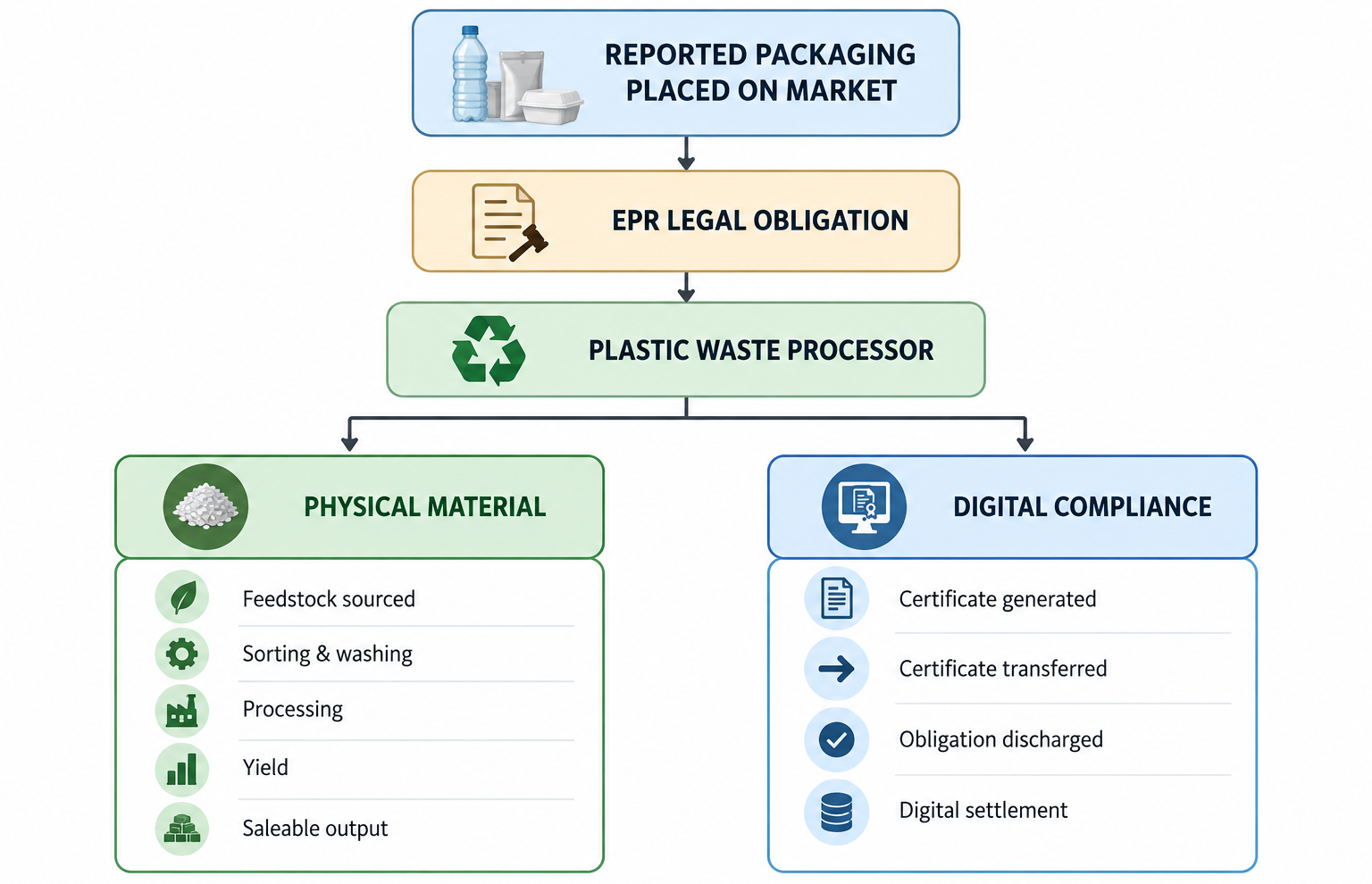
The compliance number is therefore not necessarily the physical recycling number.
That distinction matters because plastic is not a homogeneous commodity.
A tonne of clean post-consumer PET bottles is not economically equivalent to a tonne of contaminated multilayer sachets.
A tonne of relatively clean HDPE containers is not the same recycling proposition as flexible film contaminated with organic residues.
And a tonne of collected plastic waste is certainly not equivalent to a tonne of specification-grade secondary polymer.
This is a familiar principle in petrochemical markets.
Feedstock, processing throughput and saleable output are three different numbers.
Recycling should be analysed with the same industrial discipline.
CPCB's 2022–23 annual report put India's reported recycling capacity at approximately 935,290 tonnes per year, alongside around 237,119 tonnes per year of co-processing capacity, based on information supplied by states and Union territories for 2021–22. (Central Pollution Control Board)
The numbers therefore tell different stories.
One concerns the scale of the compliance system.
The other concerns reported physical processing infrastructure.
They should not be confused.
THE CRITICAL CONTROL POINT: CAN THE MATERIAL BE AUDITED?
The conventional EPR chain contains several potential verification points.
The missing question is the one that matters most:
Can the physical material be independently audited?
A credible industrial framework should be able to answer a straightforward series of operational questions:
- Was the waste physically collected?
- Where did it originate?
- Was it sorted into identifiable polymer fractions?
- How much entered the processing plant?
- What was the actual input-to-output mass balance?
- How much process residue was generated?
- How was that residue managed?
- Who purchased the recovered polymer?
- Does the physical output correspond to the quantity against which the EPR certificate was issued?
This is not merely a theoretical concern.
In January 2024, CPCB directed state pollution-control authorities to verify registered PWPs and their declared processing capacities. The regulatory framework also requires supporting documentation and provides for physical verification by the relevant authorities. The subsequent National Green Tribunal record shows that, as of 31 August 2024, 2,482 PWPs had declared aggregate processing capacity of about 25.02 million tonnes per year, while approximately 7.94 million tonnes of EPR certificates had been generated. (Indian Kanoon)
The significance is greater than the numbers themselves.
It points to a basic industrial principle:
Nameplate capacity is not production.
And production is not necessarily saleable output.
"Capacity verification sounds like a paperwork exercise until you actually walk a plant floor. A lot of registered capacity exists on a licence document and nowhere else."
COMPLIANCE AUDITOR, WESTERN INDIA
COMMODITY ECONOMICS VERSUS REGULATORY MANDATES
Recycling is ultimately an industrial process governed by commodity economics.
The basic equation is straightforward:
Value of recovered polymer + EPR support ≥ collection + sorting + transport + processing + financing + residue-management costs.
When that equation works, recycling can become commercially sustainable.
When it does not, the physical market looks for alternatives: downcycling, informal processing, co-processing, refuse-derived fuel, landfill—or, at the extreme, environmental leakage.
This equation becomes particularly difficult for low-value flexible packaging.
The value-density problem
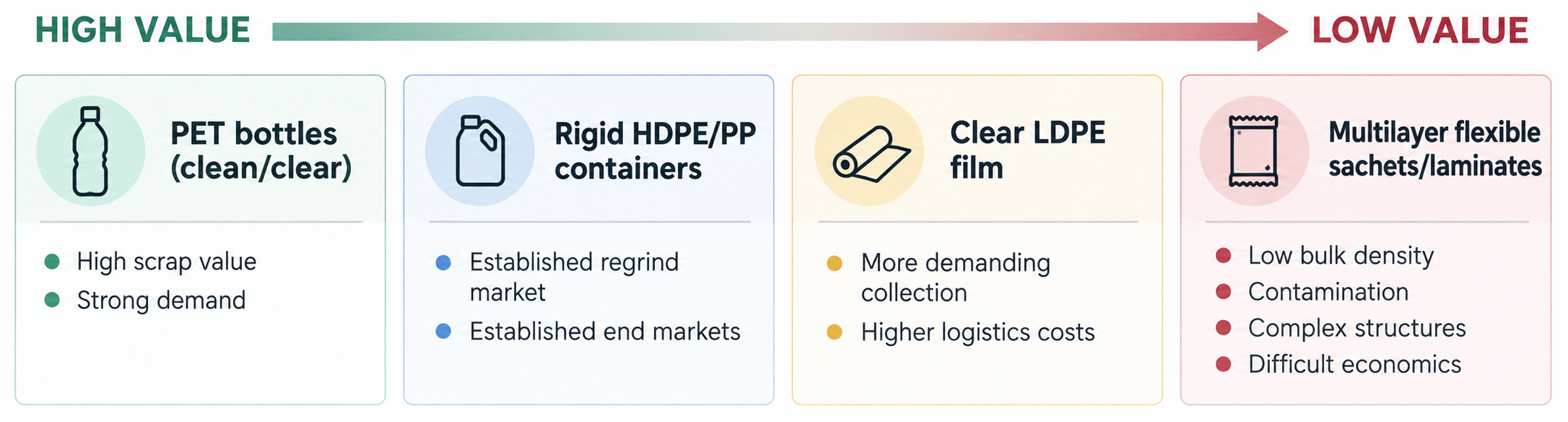
A tonne of clean PET bottles can carry considerably more recoverable economic value than a tonne of low-density, contaminated flexible packaging.
Flexible packaging creates a difficult logistics equation: it is light, bulky and often contaminated. Moving it over long distances can consume a disproportionate share of its economic value before the material reaches a processing line.
As one industry participant, speaking anonymously, put it:
"The industry does not simply have a collection problem. It has a value-density problem. If the cost of moving and processing the material exceeds the value of the recovered polymer, somebody has to bridge the difference."
That is part of the economic rationale for EPR.
But the money has to reach the physical recycling chain, not merely the compliance chain.
WHEN THE CERTIFICATE BECOMES MORE VALUABLE THAN THE POLYMER
EPR has created a tradeable compliance instrument.
That is not inherently a problem.
A functioning certificate market can mobilise capital into recycling infrastructure and transfer part of the post-consumer cost of packaging back to producers and brand owners.
Indeed, India's 2024 amendments explicitly provided for electronic platforms for the trading of EPR certificates and established a framework for price discovery. (MoEFCC)
The risk emerges when financial liquidity develops faster than physical traceability.
At that point, the certificate can become economically more important than the underlying polymer.
A GST invoice demonstrates that a commercial transaction occurred.
A digital ledger demonstrates that a certificate moved between accounts.
Neither, by itself, proves that a tonne of post-consumer plastic was physically collected, processed and converted into usable secondary polymer.
This is the central distinction between financial compliance and physical circularity.
Moving a certificate is easy.
Moving, sorting, washing, processing and selling low-density plastic scrap is not.
The regulatory framework therefore needs to be designed around the element that is hardest to verify:
the physical material flow.
NAMEPLATE CAPACITY IS NOT THROUGHPUT
The scale of India's registered infrastructure illustrates why capacity verification is vital.
According to CPCB data submitted to the National Green Tribunal, as of 31 August 2024 there were 41,972 registered PIBOs and 2,482 registered PWPs. The PWPs had declared aggregate processing capacity of approximately 25.02 million tonnes per year. At that point, EPR certificates equivalent to approximately 7.94 million tonnes had been generated, of which 6.279 million tonnes had been transferred. (Indian Kanoon)
These figures should not automatically be interpreted as evidence of over-reporting.
They demonstrate something more basic:
declared capacity, actual utilisation, certificate generation and realised output are different metrics.
No serious petrochemical analyst evaluates an ethylene cracker by looking only at nameplate capacity.
Actual output depends on feedstock availability, operating rates, maintenance, unplanned outages, energy consumption, process yields and market conditions.
A recycling plant is no different.
Its actual output depends on:
- feedstock availability;
- contamination and moisture;
- sorting efficiency;
- equipment uptime;
- filtration requirements;
- energy consumption;
- polymer degradation;
- process losses; and
- the quality and marketability of the resulting resin.
The same industrial discipline applied to petrochemicals needs to be applied to recycling.
Installed capacity is potential. Output is production. Saleable, market-grade resin is the commercial reality.
"Ask any processor what their real utilisation rate is, not their licensed capacity, and the number usually drops by half. That gap is where the industry needs better data, not more paperwork."
RECYCLING PLANT OPERATOR, SOUTHERN INDIA
RISING EPR TARGETS WILL TEST THE SYSTEM
India is progressively increasing its minimum recycling obligations.
Under the notified framework, the minimum level of recycling, excluding end-of-life disposal, for Category II flexible packaging is 30% of the EPR target in 2024–25, 40% in 2025–26, 50% in 2026–27 and 60% from 2027–28 onwards. Category III follows the same trajectory. (IndiaCode by eCourtsIndia)
That represents a significant increase in compliance demand.
But raising a regulatory target does not automatically create physical recycling capacity.
If collection economics remain weak, feedstock remains contaminated and processing yields remain low, higher targets can produce an unintended market outcome: greater competition for compliance instruments without a proportionate increase in physical recycling throughput.
That could drive up compliance costs.
It could also increase the value of verification.
The next phase of EPR development should therefore focus not simply on counting more tonnes, but on increasing the confidence attached to every tonne counted.
"Every step-up in the target puts more pressure on the same thin layer of genuinely auditable capacity. Unless collection economics improve first, you just get more expensive certificates, not more recycled plastic."
EPR COMPLIANCE CONSULTANT
GERMANY OFFERS A DIFFERENT LESSON
Germany's VerpackG framework and the Central Agency Packaging Register (ZSVR) are often cited as mature EPR reference points.
The important lesson is not simply that Germany recycles more.
It is that the system combines producer registration, financial responsibility, collection infrastructure, public registers and independent verification.
ZSVR operates the LUCID packaging register and publishes public registers of producers and auditors. Auditors and other authorised experts can verify completeness declarations and volume-flow records. The register allows companies, authorities, consumers and other stakeholders to check whether producers have met registration requirements. (Öffentliche Register)
Germany's deposit-return system also demonstrates the power of assigning an economic value to discarded material.
For single-use beverage packaging subject to the deposit system, consumers pay a statutory €0.25 deposit, creating a direct financial incentive to return the container. Germany's Federal Environment Ministry says the return rate for single-use plastic bottles is estimated at more than 96%, with nearly all returned PET subsequently mechanically recycled. (BMU)
The comparison with India is therefore less about Germany versus India and more about incentive architecture.
India has something Germany does not have at the same scale: an enormous informal collection economy.
The kabadiwala system performs a critical economic function, collecting and sorting material that formal municipal systems often struggle to capture.
The opportunity is not necessarily to displace this network.
It is to integrate it into the formal circular economy, so that the economic value created by EPR follows the material and the people who collect it.
"The kabadiwala network already does the hard part of segregation at source, cheaper and often better than mechanised sorting lines. Formalising that role, not replacing it, is the fastest way to raise India's real recovery rate."
WASTE-MANAGEMENT SECTOR CONSULTANT
THE RECYCLING PROBLEM OFTEN BEGINS BEFORE THE WASTE EXISTS
Recycling cannot fully resolve a packaging-design problem.
If a package is technically or economically difficult to recycle, downstream infrastructure can compensate only to a limited degree.
Multilayer flexible structures combining materials such as PET, PE, PA, aluminium and adhesives can provide excellent barrier properties while using relatively little material.
From a packaging-efficiency perspective, they can be highly effective.
From the perspective of conventional mechanical recycling, however, their material complexity can make high-value recovery considerably more difficult.
This is why the EPR debate needs to move upstream.
The question should not simply be:
How many tonnes of packaging waste did we process?
It should also be:
How was the packaging designed, and what proportion of its material can realistically be recovered at commercial scale?
Germany's current regulatory approach illustrates this principle. Its ZSVR recyclability methodology assesses packaging according to actual sorting and recovery practices and seeks to measure the share of material that can realistically obtain a second life. (Verpackungsregister)
For India, the policy implications are clear:
- design for recycling should be strengthened;
- mono-material structures should be encouraged where technically viable;
- recycled-content requirements should be aligned with genuine availability of suitable secondary polymer;
- and EPR economics should increasingly reward packaging that is demonstrably easier to recover.
The objective should not be to penalise technically necessary packaging.
It should be to make recyclability an economic variable in packaging design.
MASS BALANCE IS THE NEXT FRONTIER
India does not necessarily need another layer of administrative bureaucracy.
It needs better industrial data.
A more robust EPR system would connect the digital certificate with the physical chain:
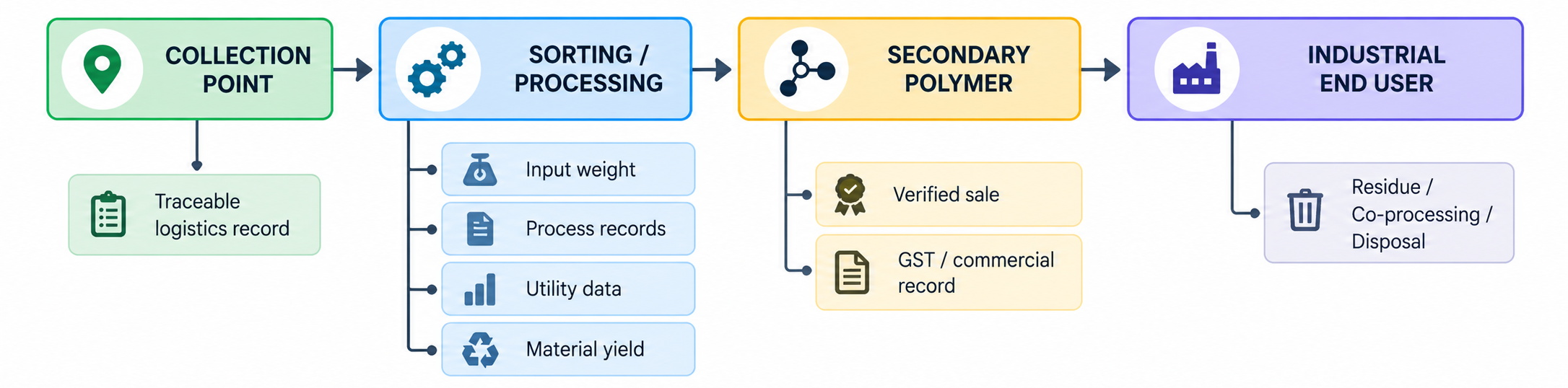
The objective should be a defensible mass balance:
Input material = recovered product + process losses + residues
with appropriate tolerances for moisture, contamination and process-specific yields.
Four mechanisms could materially strengthen the system.
GST-linked mass balance
Tax invoices could be cross-referenced with verified weighbridge records and physical material movements.
Utility-verified processing
Electricity, water and fuel consumption could be used as secondary indicators of production.
This should not become a simplistic formula—energy consumption varies by polymer, technology and plant configuration—but it can be a powerful anomaly-detection tool.
Polymer-specific yield benchmarks
Expected conversion yields should be established according to polymer type, feedstock quality and processing technology.
The objective is not to impose one artificial yield on every plant.
It is to identify implausible discrepancies between declared input, processing capacity and output.
Verified industrial off-take
The strongest evidence that recycling has occurred is not simply that waste entered a plant.
It is that usable secondary material emerged and was sold into another industrial application.
That is where the physical circular economy becomes visible.
"Nobody is asking for a forensic audit of every tonne. Even a credible sampling regime tied to utility data and off-take invoices would change the conversation, because right now almost none of that gets cross-checked."
POLYMER TRADER AND RECYCLED-RESIN BUYER
THE METRIC THAT SHOULD MATTER
India's plastic-waste debate has increasingly focused on volume.
But gross volume figures can be misleading.
The metric that should sit at the centre of EPR is:
"Verified tonnes of plastic collected, processed and converted into usable secondary raw material that is actually reintroduced into the economy."
That is the number that matters.
Not certificates generated.
Not certificates transferred.
Not registered capacity.
Not nameplate capacity.
Not declarations.
Verified physical material.
India has built an increasingly sophisticated digital architecture for EPR. The next challenge is to connect that architecture to the physical material economy.
The country's progress should not be judged by whether its compliance database becomes larger.
It should be judged by whether the gap between digital compliance and physical recycling becomes smaller.
That distinction will become increasingly important as EPR obligations rise, recycled-content requirements expand and the market for secondary polymers develops.
There is also a larger economic opportunity here.
A transparent EPR system would not merely improve environmental compliance. It could create a more investable recycling industry by giving financiers, recyclers, converters and brand owners greater confidence in the quantity and quality of recovered material entering the market.
That is ultimately what circularity requires.
A tonne of waste must become a tonne of measurable industrial feedstock—not merely a line item on a compliance portal.
EPR was never intended simply to generate digital certificates. Its purpose was to extend producer responsibility beyond the point of sale and ensure that packaging is collected, processed and, wherever technically and economically viable, returned to productive use.
The true test of India's circular-economy ambition therefore begins where the digital portal ends:
at the collection point, at the weighbridge, on the recycling plant floor, at the extruder—and ultimately in the verified shipment of secondary polymer to the next industrial user.
| Professor Dr. Sajjid Mitha is the CEO and Founder of PolymerUpdate, PolymerUpdate Academy, and RACE Expos and Conferences. |