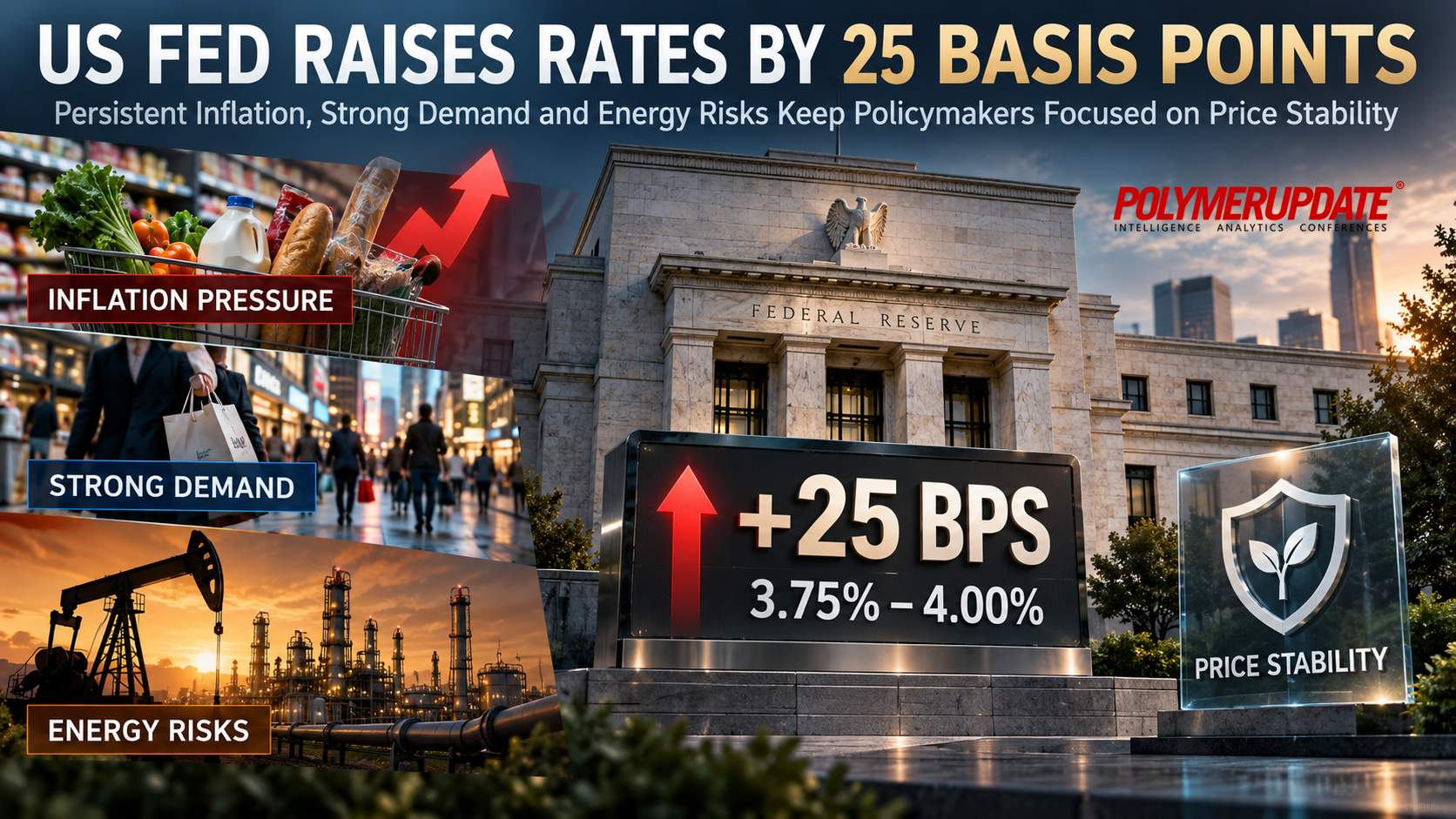
The US Federal Reserve raised its benchmark federal funds rate by 25 basis points to a target range of 3.75-4.00 percent, marking its first rate increase since July 2023, as persistent inflation, resilient domestic demand and strong productivity growth continued to challenge the central bank’s efforts to restore price stability. The decision was taken unanimously in a two-day Federal Open Market Committee (FOMC) meeting held from September 15-16, signalling broad support within the Committee for a more restrictive monetary policy stance.
The Fed Chair Kevin Warsh said the move was intended to support a “timelier return” of inflation to its 2 percent objective while maintaining ample reserves in the banking system. The decision came amid a backdrop of solid economic activity, robust capital investment and continued resilience in household spending. At the same time, the central bank acknowledged that uncertainty remains elevated, partly because of geopolitical developments, while inflation remains above its target.
The latest move represents an important shift in the Fed's policy trajectory after an extended period without a rate increase. The central bank's updated projections indicate that another hike could follow before policymakers enter a prolonged period of holding rates at restrictive levels. US Bureau of Labour Statistics estimated retail inflation stabilising at 3.4 percent in August, substantially higher than the median goal of 2 percent.
 Another hike remains on the table
According to James Knightley, Chief International Economist, US, at ING Economics, the Fed has signalled that it could raise rates once more before embarking on a long hold extending through 2027.
The central bank's projections point to one additional 25-basis-point increase this year, broadly consistent with current market expectations. The median projection for the federal funds rate was around 4.1 percent at the end of 2026, indicating that policymakers see scope for another move.
However, Knightley believes the current tightening cycle could ultimately prove to be a “one and done” episode. He argues that the labour market contains more slack than the headline unemployment rate suggests and that the inflation outlook could improve if energy flows from the Persian Gulf normalise. The Fed's latest projections nevertheless reflect a more cautious approach to inflation. The central bank expects personal consumption expenditures (PCE) inflation to remain elevated at 3.7 percent in 2026, before easing to 2.3 percent in 2027 and 2.1 percent in 2028. These projections remain materially above the Fed's 2 percent objective in the near term.
Inflation remains the central concernThe Fed's decision reflects concern that inflationary pressures could prove more persistent than previously anticipated. Higher energy prices, tariff-related cost pressures and resilient domestic demand have complicated the disinflation process. Oil prices above US$ 100 a barrel have emerged as an additional risk, particularly amid continuing disruptions to energy flows through the Middle East. Prolonged supply constraints could raise transportation, fuel and production costs and slow the decline in headline inflation.
At the same time, strong consumer spending suggests that demand remains sufficiently firm to allow businesses to pass some higher costs through to consumers. US retail sales rose 1.2 percent in August, underscoring the resilience of household demand and providing another reason for policymakers to remain cautious about easing financial conditions.
Strong productivity and capital investment are also supporting economic activity. Investment associated with artificial intelligence and other technology-related sectors has remained robust, helping to sustain growth even as monetary conditions remain restrictive. The FOMC said economic activity is expanding at a solid pace, while job gains have kept pace with the workforce and the unemployment rate has changed little. This combination gives policymakers greater room to focus on inflation rather than responding to an immediate deterioration in labour-market conditions.
Labour market provides counterargumentThe outlook for further rate increases, however, is not without uncertainty. Knightley pointed to a substantial slowdown in employment growth over the broader period from January 2025 through July 2026. Although August payroll growth was relatively healthy at 162,000, the monthly average increase over the earlier period was only around 31,000. He also highlighted a decline of roughly one percentage point in the labour-force participation rate since early 2025. In his assessment, this indicates that the economy may have more labour-market slack than the unemployment rate of around 4.1 percent alone suggests.
Wage growth of about 3 percent could also help contain underlying inflationary pressures. If labour costs remain moderate and housing-related inflation continues to cool, some of the current price pressures could gradually dissipate. Shelter, which carries a substantial weight in the US consumer price index, could provide further disinflationary support as property-market activity remains subdued and private-sector rents moderate. The major uncertainty, therefore, remains energy. A sustained improvement in oil and gas flows through the Strait of Hormuz could reduce energy costs and accelerate the decline in headline inflation, potentially weakening the case for repeated rate increases.
Bond market remains under pressureThe Fed's decision also had significant implications for the US Treasury market. The 10-year Treasury yield initially remained relatively stable around 4.95 percent, after having recently traded above the psychologically important 5 percent level. The rate increase itself had been largely anticipated by financial markets, limiting the immediate reaction at the long end of the yield curve. The two-year Treasury yield, which is more sensitive to expectations for monetary policy, reacted more noticeably. It rose by around 10 basis points to close to 4.7 percent, reflecting the unanimous rate increase and the possibility of another hike.
The yield curve consequently flattened, with the spread between two- and 10-year Treasury yields falling below 30 basis points. Knightley cautioned that the apparent calm in longer-dated Treasury yields should not necessarily be interpreted as a durable change in the underlying trend. Persistent inflation, large fiscal deficits, substantial Treasury issuance and expectations surrounding productivity gains from artificial intelligence could continue to place upward pressure on long-term borrowing costs. He said the 10-year yield could again move above 5 percent, with the market potentially considering the 5.25 percent-5.50 percent range if inflation and fiscal concerns remain prominent.
Dollar gains as Fed maintains hawkish stanceThe higher-for-longer message also provided support to the US dollar. The prospect of additional tightening increases the relative attractiveness of US assets and raises the threshold for expectations of a sustained dollar decline. The greenback could receive further support if upcoming US economic data reinforce expectations of another rate increase. Following the Fed announcement, the euro weakened below US$ 1.1500 against the dollar.
ING expects the euro to face near-term downside risks toward the US$ 1.1330-US$ 1.1360 area, although it retains a more constructive longer-term outlook if geopolitical tensions ease and energy prices decline. A stabilisation of energy supplies would be particularly important because lower oil prices could reduce inflationary pressures in the US and other major economies, potentially narrowing the divergence between monetary-policy expectations.
Markets await next policy signalThe Fed's latest decision has therefore reinforced the message that policymakers remain focused on inflation despite the resilience of economic activity. The unanimous 25-basis-point increase, together with projections pointing to another possible hike, suggests that the central bank is not yet prepared to declare victory over inflation.
At the same time, the divergence between the Fed's projections and some private-sector assessments highlights uncertainty over how much additional tightening the economy can absorb. For now, however, the central bank's message remains clear: inflation is still too high, and monetary policy will remain sufficiently restrictive to bring price growth back towards the 2 percent target.
DILIP KUMAR JHA
Editor
dilip.jha@polymerupdate.com