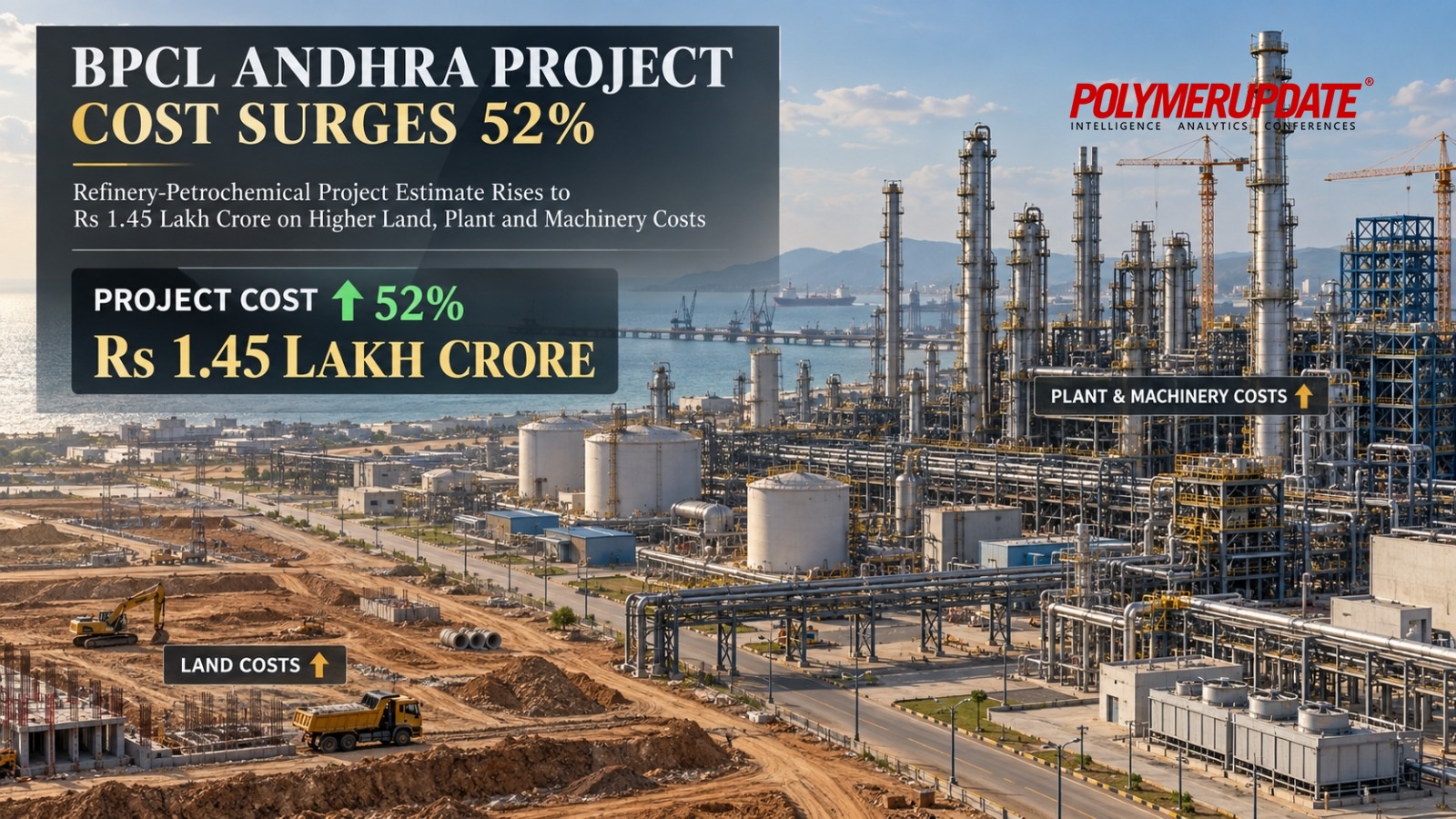
India's state-owned Bharat Petroleum Corporation Ltd. (BPCL) is facing a cost escalation of more than 52 percent in its proposed greenfield oil refinery and petrochemical complex in Andhra Pradesh over the past year, primarily due to a sharp rise in land acquisition and plant and machinery costs, among other factors. The additional expenditure could put significant financial pressure on the project, lead to execution delays, and erode profit margins, potentially affecting its long-term commercial viability.
Following a meeting with Andhra Pradesh Chief Minister N. Chandrababu Naidu, BPCL Chairman and Managing Director Sanjay Khanna said the project's estimated cost has risen to Rs 1.45 lakh crore, compared with the original estimate of Rs 95,000 crore approved in September 2025. The proposed integrated greenfield refinery and petrochemical complex will have a processing capacity of 9 million tonnes per annum (MTPA) and will be developed near Ramayapatnam Port, between the Prakasam and Nellore districts of Andhra Pradesh.
 Expedite the project
Chief Minister N. Chandrababu Naidu convened a meeting with BPCL Chairman and Managing Director Sanjay Khanna on Wednesday to review the progress of the project and directed the company to expedite the commencement of construction. An official release from the Andhra Pradesh government said the Chief Minister also proposed the development of a downstream petrochemical park in the vicinity of the refinery. The statement said a 9 million tonnes per annum (MTPA) integrated greenfield refinery is under development, with final environmental clearance expected by the end of September. The project's investment cost is likely to be finalised in October after Engineers India Limited (EIL) submits its detailed study report, following which construction is expected to begin.
According to the release, the refinery will manufacture Euro-6 compliant transportation fuels, including motor spirit (petrol), high-speed diesel and aviation turbine fuel (ATF), with a combined annual production capacity of about 5.4 million tonnes. It will also produce nearly 3.2 million tonnes of petrochemicals and downstream products, including high-density polyethylene (HDPE), low-density polyethylene (LDPE), linear low-density polyethylene (LLDPE), polypropylene and polyvinyl chloride (PVC), along with other value-added by-products.
Current statusThe Andhra Pradesh government has already handed over around 75 percent of the 6,000 acres of land required for the refinery project and has assured that the remaining land will be transferred by the second week of October. Meanwhile, a proposal was also put forward for the refinery major to jointly develop, along with the Andhra Pradesh Industrial Infrastructure Corporation (APIIC), a master plan for a downstream petrochemical park spread across approximately 1,500 acres adjacent to the refinery.
A statement from the Andhra Pradesh government further said that demand for petrochemicals is evolving rapidly, driven by accelerating urbanisation and the continued expansion of India's manufacturing sector. Noting that the country's petrochemical intensity index currently stands at around 5 percent and is projected to increase to 15–20 percent over the next decade, Naidu emphasised that the refinery should be designed to meet future industrial and market requirements.
Strategic investmentIf materialised, the project would represent a strategic investment to expand the company's petrochemical portfolio and align with India's goal of becoming a global refining and petrochemical hub. The initial phase involves land acquisition and preliminary studies. The company currently has a total refining capacity of 35.3 million tonnes per annum (MMTPA), with plans to expand this to 45 MMTPA by 2028. BPCL's existing refining capacity is spread across its refineries in Mumbai, Kochi and Bina. The company is currently assessing the feasibility of the project, including potential land acquisition and infrastructure development.
India, the world's third-largest oil-importing and oil-consuming nation, is projected to add 1 million barrels per day (bpd) of incremental oil demand by 2030, the highest increase among all countries. Recognising India's strong growth potential, BPCL is evaluating the establishment of a greenfield refinery-cum-petrochemical complex near Ramayapatnam Port in Andhra Pradesh. Pre-project activities are already underway.
Consistently high capacity utilisation, driven by multiple reliability-improvement initiatives, a diversified crude basket, meticulous sourcing and processing strategies, and sustained efforts to reduce energy consumption, has enabled BPCL to outperform the benchmark Singapore gross refining margin (GRM). To build on this momentum, the company's Mumbai Refinery is set for a major upgrade involving the replacement of the existing Catalytic Cracking Unit (CCU) and Fluidized Catalytic Cracking Unit (FCCU) with a state-of-the-art Petro Resid Fluidized Catalytic Cracking Unit (PRFCC) and associated facilities. The project was approved at an investment of Rs 14,200 crore last year.
Petrochemical triggerBPCL has developed ambitious plans to add new capacities and has made substantial progress towards achieving them. For instance, the Kochi Polypropylene Project is progressing on schedule, marking a key milestone in the company's efforts to diversify its product portfolio and enhance operational efficiency.
Further, in pursuit of its vision to establish a world-scale ethylene cracker, site work has commenced at the Bina Refinery, marking an important step towards developing new integrated production capacities. These foundational developments are complemented by ongoing operational achievements, with the company continuing to record strong production and sales volumes for niche petrochemical products, reflecting its growing presence and capabilities in this critical segment.
The company also plays a significant role in strengthening India's industrial foundation. To secure the country's energy future amid shifting global energy dynamics, it is vital to address the energy trilemma of ensuring energy security, maintaining affordability and advancing sustainability. Enhancing access to equity oil will be critical to making a meaningful contribution to India's energy security. India's current crude oil demand is estimated at 5.5 million barrels per day (bpd), and the country is expected to account for a significant share of the projected 2.5 million bpd increase in global oil demand by 2030.
Third largest refining capacityBPCL has the third-largest refining portfolio in India, accounting for approximately 14 percent of the country's overall refining capacity. Bharat Petroleum, India's second-largest public-sector oil marketing company and a Fortune 500 integrated energy major, has established a strong presence across the entire energy value chain. With a cumulative refining capacity of 35.3 MMTPA across its Mumbai, Kochi and Bina refineries, along with a nationwide marketing network of more than 23,500 fuel stations and 6,200 LPG distributors, BPCL plays a pivotal role in strengthening India's energy security. The company has made significant progress in evolving from a conventional oil refining and marketing entity into a diversified energy player.
India's refining sector is entering a transformative phase, with growth increasingly being driven by petrochemical integration. BPCL's two major petrochemical projects at Bina and Kochi, involving a combined capital investment of Rs 54,000 crore, are progressing well and remain on schedule in terms of both execution and financing. To support the Bina project, BPCL has secured a Rs 31,802 crore loan agreement with a State Bank of India-led consortium, the largest financing arrangement in the company's history.
Recognising India's strong growth potential, BPCL is evaluating the establishment of a greenfield refinery-cum-petrochemical complex near Ramayapatnam Port in Andhra Pradesh. Pre-project activities are currently underway. The strategic investment would further expand BPCL's petrochemical portfolio, provide a natural hedge against volatility in petroleum product margins over the long term, and align with India's vision of becoming a global refining and petrochemical hub.
DILIP KUMAR JHA
Editor
dilip.jha@polymerupdate.com