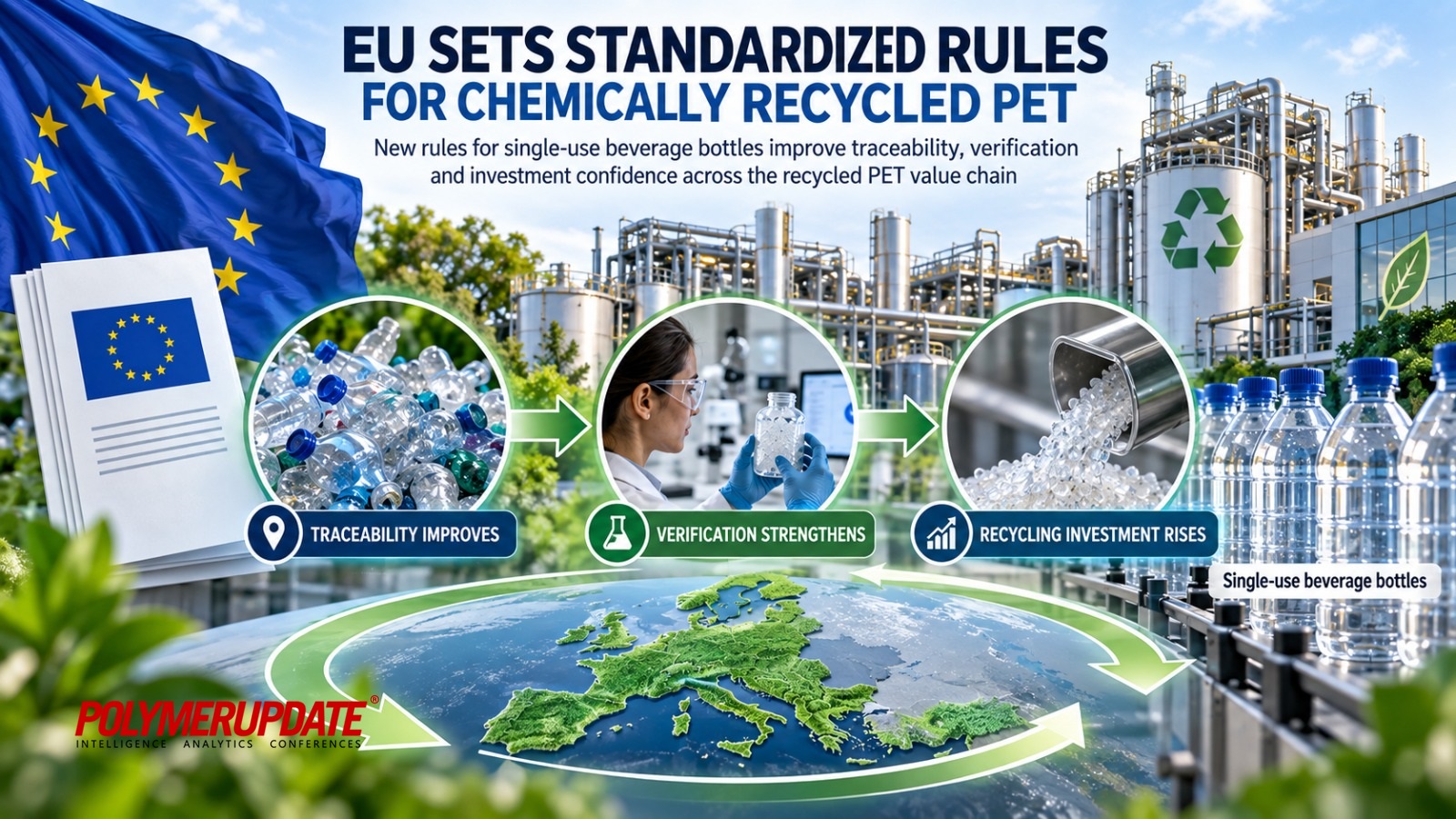
The European Union has taken a significant step towards strengthening its circular plastics economy by introducing standardized rules for calculating, verifying and reporting chemically recycled polyethylene terephthalate (PET) content in single-use plastic beverage bottles. The new framework is expected to provide long-awaited regulatory clarity for advanced recycling technologies while supporting investments in recycled plastics across Europe.
The European Commission’s Implementing Decision establishes a harmonized methodology for measuring recycled PET produced through chemical recycling processes, enabling manufacturers to demonstrate compliance with recycled content obligations under the EU’s Single-Use Plastics Directive (SUPD). The rules are designed to ensure that recycled content claims are transparent, scientifically verifiable and consistent across all member states.
The decision comes at a time when Europe’s plastics recycling industry is facing mounting economic pressure from weak demand, volatile raw material prices and increasing competition from lower-cost virgin polymers. By creating a common accounting system for chemically recycled plastics, the Commission believes the new legislation will improve investor confidence and encourage commercialization of advanced recycling technologies capable of processing difficult-to-recycle plastic waste.
 Regulatory certainty for advanced recycling
Unlike mechanical recycling, which physically processes sorted plastic waste into recycled resin, chemical recycling breaks plastic down into molecular building blocks that can be converted into virgin-quality polymers. The technology has attracted considerable interest from global petrochemical producers and packaging companies because it offers a potential solution for contaminated or mixed plastic waste streams that are unsuitable for conventional recycling.
However, one of the industry’s biggest challenges has been the absence of uniform rules governing how recycled content should be measured when multiple products emerge from the same chemical recycling process. The European Commission said the new Implementing Decision addresses this gap by establishing detailed rules for calculating, verifying and reporting chemically recycled PET used in single-use beverage bottles. The framework is intended to create a level playing field for recyclers, resin producers, converters and brand owners while preventing inconsistent recycled content claims across the supply chain.
Jessika Roswall, European Commissioner for Environment, Water Resilience and a Competitive Circular Economy, said the plastics recycling sector requires greater policy certainty to unlock investment in innovative technologies. She noted that clear regulatory rules would help businesses invest confidently in chemical recycling, complement existing mechanical recycling systems and accelerate the transition towards a more competitive and sustainable circular economy across Europe.
Mass balance becomes the cornerstoneAt the heart of the new legislation is a comprehensive mass balance accounting methodology, widely regarded as the most practical approach for allocating recycled content in chemical recycling facilities. Under chemical recycling, eligible plastic waste is converted into feedstock that may subsequently generate several different products, including plastics, chemicals and fuels. The mass balance system tracks the flow of recycled material throughout production and determines how much recycled content can legitimately be attributed to each output.
The Commission said this approach ensures that recycled content claims accurately reflect the quantity of eligible plastic waste entering the recycling process rather than the total volume of products leaving the facility. Industry participants have argued that standardized mass balance accounting is essential because advanced recycling facilities often operate within integrated petrochemical complexes where recycled and virgin feedstocks are processed simultaneously. The new rules provide a common methodology for allocating recycled content without requiring physical separation of molecular feedstocks.
Fuel-use exclusion strengthens credibilityA notable feature of the Implementing Decision is the adoption of what the Commission describes as a “fuel-use excluded” methodology. Under this principle, any eligible plastic waste that is converted into transport fuels or used for energy recovery cannot be counted as recycled content. Similarly, processing losses generated during chemical recycling must also be excluded from recycled content calculations.
The Commission said this approach aligns with the recycling definition established under the EU Waste Framework Directive, ensuring that only plastic material genuinely transformed into new plastic products contributes towards recycled content targets. The exclusion is intended to address longstanding criticism that some chemical recycling processes receive recycling credit despite producing significant volumes of fuel rather than new plastics. By restricting eligible material to genuine plastic-to-plastic recycling, the EU aims to improve the environmental credibility of advanced recycling claims.
Traceability and independent verificationTo reinforce confidence in recycled content declarations, the new framework introduces mandatory chemical traceability systems across the supply chain. These systems must demonstrate that the quantity of recycled material assigned to finished PET bottles does not exceed the amount of eligible recycled feedstock entering production. The Commission believes traceability will minimize inaccurate reporting while improving transparency for regulators, manufacturers and consumers.
The legislation also requires annual third-party verification for the most technically complex stages of chemical recycling operations. Independent auditors will verify data accuracy and compliance with accounting rules, creating an additional layer of oversight without imposing excessive administrative burdens on businesses or national authorities. The verification requirements are expected to become particularly important as beverage producers increase chemically recycled PET usage to meet mandatory recycled content targets under the Single-Use Plastics Directive.
Phased implementation across international marketsThe Commission has opted for a phased rollout that initially limits eligibility to chemically recycled plastics produced within European Union member states and countries belonging to the European Economic Area (EEA). Only materials whose compliance with EU environmental standards can be fully verified will qualify towards recycled content obligations during the initial implementation period. From November 21, 2027, the framework will expand to include chemically recycled plastics originating from Organisation for Economic Co-operation and Development (OECD) countries, provided they are not restricted under the EU Waste Shipment Regulation.
The legislation also leaves the door open for recycled materials from non-OECD countries. Such materials may become eligible if exporting countries establish agreements demonstrating environmental protection and human health standards equivalent to those required under EU legislation, including the Waste Framework Directive and the Packaging and Packaging Waste Regulation (PPWR). The Implementing Act will enter into force 20 days after its publication in the Official Journal of the European Union.
Industry welcomes clarity, environmental groups remain cautiousThe Commission said the rules were developed following extensive consultations with industry stakeholders, recyclers, packaging companies and member states. Earlier this year, EU governments voted in favour of amendments supporting the accounting framework, a move widely welcomed by much of the recycling industry. Many companies believe regulatory certainty will reduce investment risks surrounding chemical recycling projects, several of which involve multi-billion-euro commitments by European petrochemical producers.
Nevertheless, the legislation has not received universal support. Environmental organisation Zero Waste Europe criticized the adoption of the accounting methodology, arguing that it effectively legitimizes chemical recycling before broader policy discussions under the Packaging and Packaging Waste Regulation are concluded. The group expressed concerns that introducing a separate accounting framework at this stage could create regulatory inconsistencies and influence future debates on the role of chemical recycling within Europe’s waste hierarchy. The differing views reflect a broader policy debate over whether chemical recycling should primarily complement mechanical recycling or compete with it for investment and feedstock.
Market implications for PET and recycled plasticsWhile the Implementing Decision does not immediately alter mandatory recycled content targets, it is expected to reshape investment decisions across Europe’s PET value chain over the coming years.
Greater regulatory certainty is likely to strengthen demand for recycled PET, chemically recycled feedstocks and advanced recycling infrastructure. Beverage companies, PET bottle manufacturers and packaging converters are expected to increase investments in chemical recycling capacity as they seek reliable supplies of compliant recycled resin.
In the medium term, the rules could improve the commercial viability of chemically recycled PET by providing standardized verification methods accepted across the European Union. This may encourage expansion of recycling facilities capable of processing complex PET waste streams that currently have limited recycling options. For chemical commodity markets, the immediate price impact is expected to remain modest because the legislation primarily establishes accounting and verification standards rather than imposing additional consumption mandates. However, firmer structural demand for PET waste, recycled PET flakes, recycled PET resin and chemical recycling feedstocks could gradually support prices of recycled materials.
Conversely, rising recycled content adoption may temper long-term demand growth for virgin PET resin, potentially limiting upward price momentum across segments of the virgin polyester value chain as recycled materials capture a larger share of beverage packaging applications. Overall, the European Commission views the new framework as a foundational element of its broader strategy to reduce dependence on virgin plastic imports, strengthen domestic recycling industries and accelerate the transition towards a competitive, resource-efficient circular economy.
DILIP KUMAR JHA
Editor
dilip.jha@polymerupdate.com