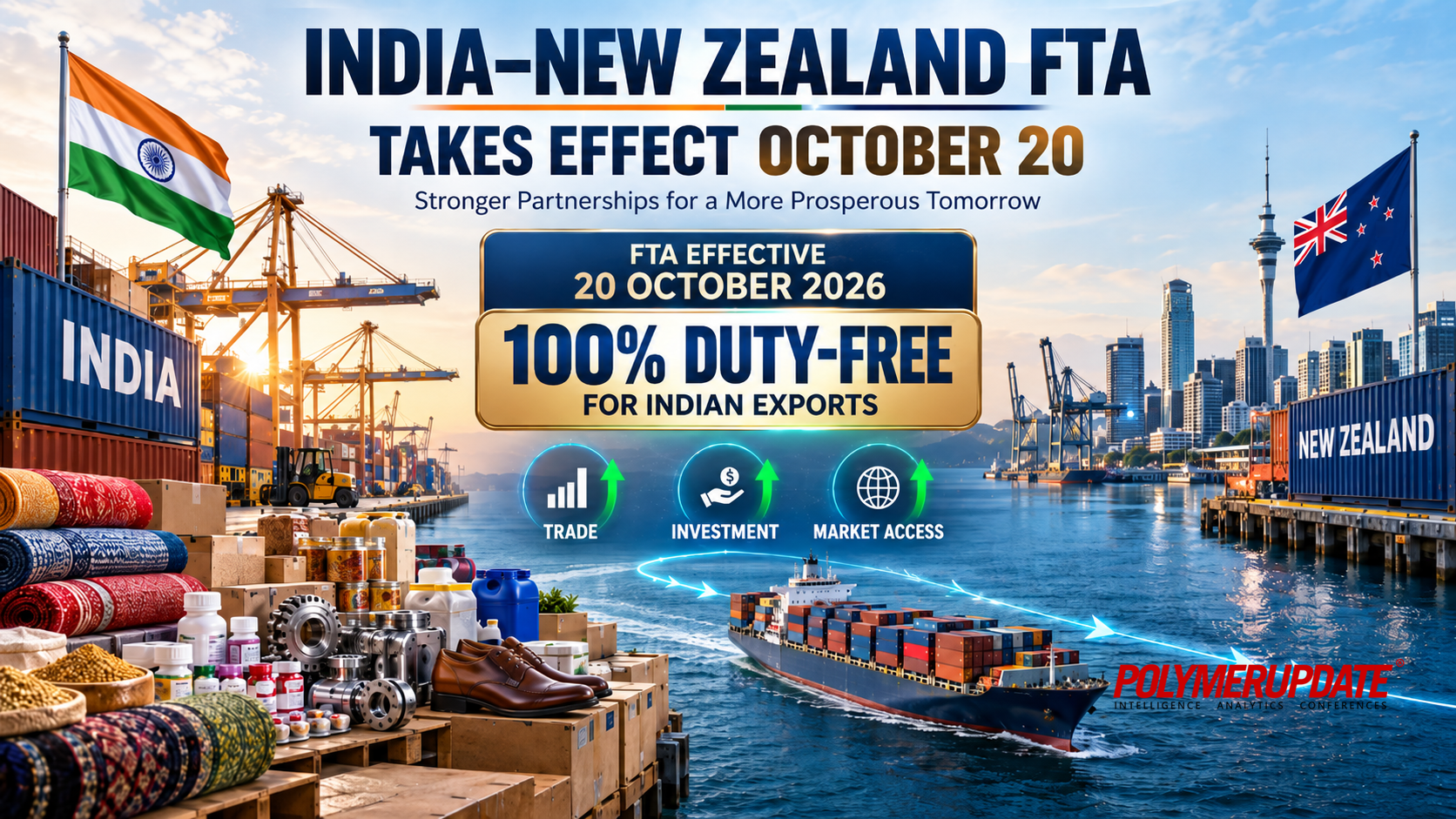
India and New Zealand will formally implement their landmark Free Trade Agreement (FTA) from October 20, coinciding with the festival of Dussehra, Commerce and Industry Minister Piyush Goyal announced on Monday. The agreement is expected to significantly strengthen bilateral trade, expand market access for Indian manufacturers and attract fresh investment into the country.
The FTA, signed on April 27, marks a major milestone in economic relations between the two countries by liberalising trade in goods and services while creating new opportunities for investment, supply chain collaboration and industrial cooperation. Announcing the implementation date, Goyal said the agreement would provide duty-free access for 100 percent of India’s exports to New Zealand, offering Indian exporters unrestricted entry into one of the Asia-Pacific region’s advanced consumer markets.
 Nine-month of negotiations
India has steadily expanded its global trade partnerships to strengthen economic growth, create jobs, and enhance its global standing. In the past few years 9 Free Trade Agreements have been signed spanning 38 developed countries. The latest is a forward-looking FTA signed with New Zealand, marking a historic milestone in bilateral economic relations. It is a comprehensive framework encompassing market access, agricultural productivity, investment, talent mobility, collaboration in sports, tourism, and people-to-people ties. The FTA is designed to benefit manufacturers, farmers, MSMEs, women entrepreneurs, students, and skilled professionals across both nations.
India and New Zealand announced negotiations for a Free Trade Agreement (FTA)on 16 March 2025and concluded in a record 9 months, making this the fastest concluded free trade agreement. The signing of FTA enhances market access and tariff preferences for Indian exports to New Zealand, while serving as a gateway to the wider Oceania and Pacific Island markets. The agreement opens opportunities for India to emerge as a key supplier of skilled workforce, alongside prospects for future cooperation in areas such as AYUSH and services such as yoga instructors, Indian chefs, and music teachers, and services under sector of interests like IT, engineering, healthcare, education, and construction.
Full market access for Indian goodsThe agreement removes tariffs on the entire range of Indian exports to New Zealand, benefiting sectors that have traditionally faced import duties of up to 10 percent. Products expected to gain the most include ceramics, carpets, automobiles and auto components, alongside a wide range of engineering and manufactured goods.
Industry experts believe the elimination of customs duties will improve the price competitiveness of Indian products, enabling exporters to expand their presence in New Zealand while diversifying beyond traditional markets in Europe and North America. The pact is also expected to support India’s broader export strategy by creating greater opportunities for value-added manufacturing and strengthening the country’s position in global supply chains.
Investment commitmentBeyond merchandise trade, New Zealand has committed to invest US$ 20 billion over the next 15 years in India, signalling deeper long-term economic engagement between the two countries. The proposed investments are expected to support infrastructure, advanced manufacturing, technology, sustainable industries and other sectors aligned with India’s economic growth agenda. Officials believe the investment commitment will complement domestic manufacturing initiatives while generating employment and encouraging technology partnerships.
The Free Trade Agreement also aims to deepen cooperation beyond merchandise trade by facilitating easier movement of services and strengthening collaboration in education, innovation, research and professional exchanges. The framework is expected to create new opportunities for businesses, skilled professionals, academic institutions and technology partnerships in both countries, while fostering knowledge sharing and supporting the long-term expansion of bilateral economic and commercial relations.
Boost for manufacturing and MSMEsExport-oriented industries are likely to be among the biggest beneficiaries of the agreement. Indian manufacturers of carpets, ceramics and automotive components have long viewed New Zealand as a niche but high-value market, where tariff elimination could improve margins and increase export volumes. Micro, small and medium enterprises (MSMEs), particularly those engaged in labour-intensive manufacturing, are also expected to benefit from improved market access. Lower trade barriers may encourage smaller exporters to explore opportunities in New Zealand through direct shipments and strategic partnerships.
The India–New Zealand Free Trade Agreement is consistent with India’s broader strategy of expanding its network of comprehensive trade agreements with developed economies and diversifying its export markets. By providing preferential access to New Zealand, the pact is expected to reduce reliance on a limited number of traditional export destinations, strengthen India’s presence in the Indo-Pacific region, and create new opportunities for export-led growth across manufacturing, agriculture and value-added industries.
Strengthening bilateral economic relationsAlthough bilateral trade between India and New Zealand remains modest compared with India’s larger trading partners, both governments see considerable untapped potential across goods, services and investment. The implementation of the agreement reflects growing economic cooperation between the two Indo-Pacific nations and is expected to encourage businesses on both sides to deepen commercial engagement. Improved regulatory certainty and reduced tariff barriers could also stimulate greater participation by companies in cross-border supply chains.
With the agreement set to come into force on October 20, Indian exporters will be able to immediately avail preferential tariff benefits under the FTA, making their products more competitive in the New Zealand market. The elimination of import duties is expected to stimulate bilateral trade, encourage greater participation by manufacturers and exporters, and lay the foundation for stronger economic integration, deeper commercial partnerships and sustained growth in India–New Zealand trade over the coming years.
DILIP KUMAR JHA
Editor
dilip.jha@polymerupdate.com