India’s industrial output measured by the Index of Core Industries (ICI) across eight core infrastructure sectors moderated to 4.8 percent year on year in August 2026, slightly lower than the revised 5.0 percent growth recorded in July, as a high base and supply-side constraints weighed on activity across several segments, data released by the Ministry of Commerce and Industry showed. However, strong growth in cement and electricity, along with continued expansion in iron ore and steel output, provided support to the overall performance. ICI growth in August 2025 stood at 6.2 percent.
Despite the moderation, cumulative growth during April-August 2026 stood at 4.3 percent, substantially higher than the 2.4 percent recorded during the corresponding period of the previous year. The eight core industries—coal, crude oil, natural gas, refinery products, fertilisers, steel, cement and electricity—account for 40.27 percent of the weight of items included in the Index of Industrial Production (IIP) and provide an important indication of underlying industrial activity. While some of these sectors continued to expand, their growth rates moderated from the levels recorded in the previous month or corresponding period.
According to Madan Sabnavis, Chief Economist, Bank of Baroda, the core sector recorded broad-based moderation in August, with eight of the 10 sectors showing weaker growth compared with the corresponding period of the previous year. He noted that coal, natural gas, crude oil and fertilisers remained in contraction, while cement and electricity recorded strong double-digit growth.
 Cement and electricity support
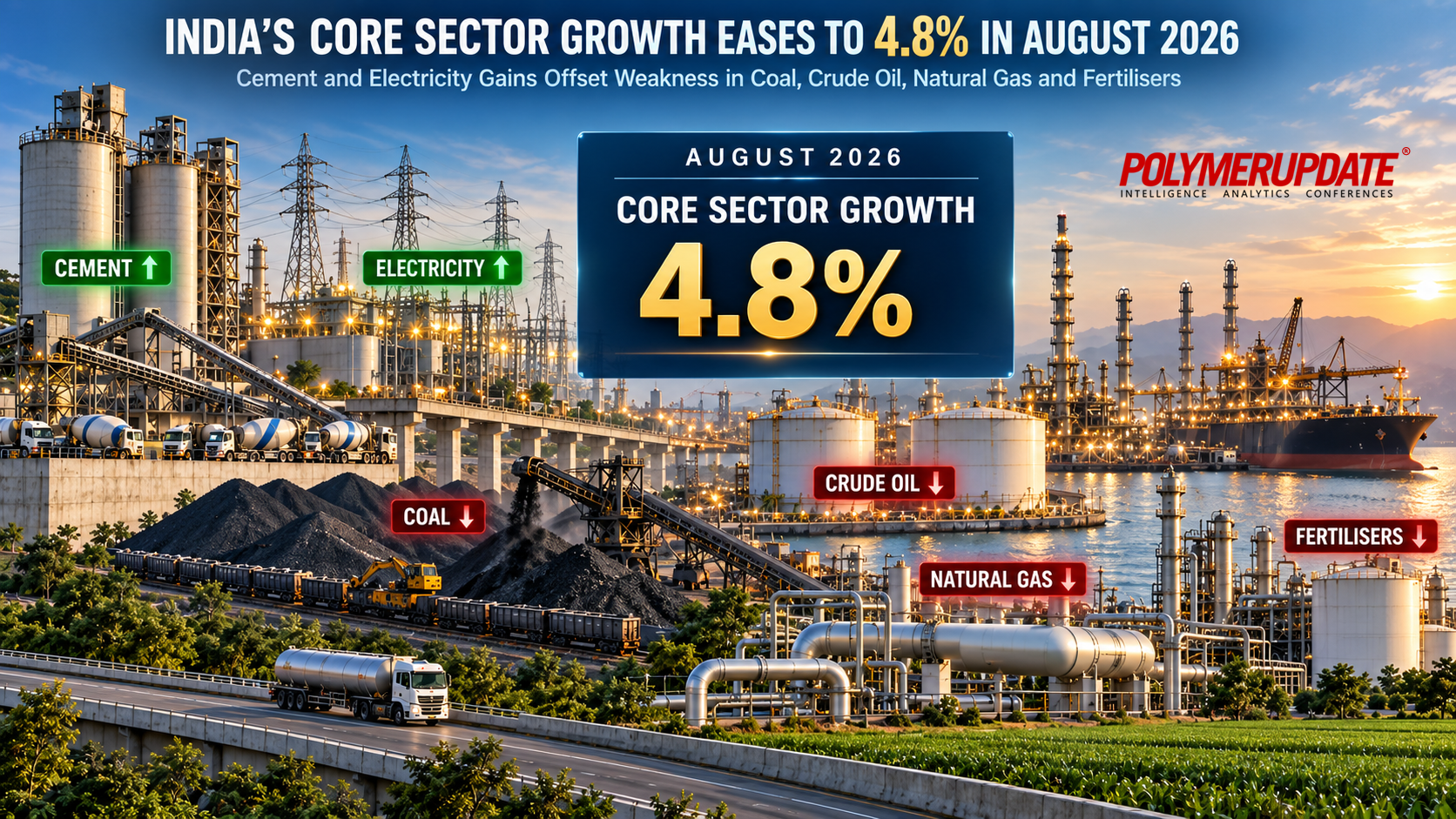
Among the major sectors, cement and electricity emerged as the strongest performers in August, registering double-digit growth. The performance of cement and electricity offered some relief to the overall core-sector numbers. Cement output grew 12.5 percent in August, sharply higher than the 5.4 percent growth recorded in August 2025, while electricity generation increased 11.6 percent compared with 4.2 percent a year earlier. Iron ore output increased 5.5 percent, while steel production expanded 3.4 percent. Refinery products also recorded positive growth of 2.6 percent.
In contrast, coal, natural gas, crude oil and fertiliser production contracted during the month. Coal output declined 3.8 percent year on year, compared with growth of 10.8 percent in August 2025. Natural gas production contracted 4.9 percent, against a 2.2 percent decline a year earlier, while crude oil output fell 3.6 percent compared with a 0.7 percent contraction in August 2025. Fertiliser production registered the sharpest decline, contracting 12.4 percent against growth of 4.5 percent in August 2025.
Cushion to infrastructureThe strong performance of these sectors also points to continued activity in infrastructure and construction. Iron ore, electricity and cement have emerged as important drivers of core-sector growth in recent months, while the increase in steel output provides further evidence of continued demand from infrastructure-related activities.
Devendra Pant, Chief Economist, India Ratings and Research (Ind-Ra), said core-sector growth decelerated further to 4.8 percent in August, in line with the agency’s expectation of growth below 5 percent. According to Pant, the moderation was primarily attributable to the base effect and a slowdown in six of the nine sectors that together account for around 44 percent of the index.
Supply side constraintsSupply-side constraints remain a key concern, particularly for fertiliser production. Ind-Ra said a reduction in gas availability and elevated energy costs continued to adversely affect fertiliser output following the outbreak of the West Asia conflict. Fertiliser production has consequently remained under pressure as manufacturers face constraints related to feedstock availability. The contraction in natural gas production also deepened during August. This has implications beyond the gas sector, as natural gas is an important feedstock and energy source for fertiliser manufacturing and several other industrial activities.
Coal output was another major drag on overall core-sector growth. Ind-Ra attributed the sharp moderation partly to the base effect. Coal production had grown 10.8 percent in August 2025, which represented the second-highest growth rate in the new series beginning April 2024, after 14.7 percent recorded in June 2024. In addition, rainfall affected mining activity during August, further constraining production. Crude oil output also remained in contraction, although the pace of decline was slower than in the previous month. Persistent challenges in domestic production continued to weigh on the sector.
Steel sector on robust growth pathOn the positive side, electricity and steel recorded higher growth compared with the previous month, supporting overall core-sector performance. Continued double-digit growth in cement, together with steady steel production, suggests that infrastructure and construction activity remained relatively resilient during the period. The underlying trend also remains stronger than the annual growth rates recorded in recent years. Core-sector growth during June-August 2026 averaged 5.3 percent, making it the second-highest three-month rolling growth rate under the new series. The highest was 6.5 percent during April-June 2024.
The three-month growth rate of 5.3 percent also compares favourably with average core-sector growth of 4.3 percent in FY2024–25 and 3.0 percent in FY2025–26, indicating that overall momentum in the infrastructure-linked sectors has strengthened despite the recent moderation. Nevertheless, the outlook remains dependent on the resolution of supply-side constraints and geopolitical disruptions. The continuing West Asia crisis has affected energy availability and costs, particularly for gas-intensive industries. Any prolonged disruption could therefore continue to weigh on production in sectors exposed to energy and feedstock availability.
At the same time, the resilience of cement, electricity and steel could help cushion the impact of weakness in energy and fertiliser-related sectors. Continued infrastructure spending and construction activity are likely to remain important drivers of industrial demand in the coming months.
OutlookThe core sector to grow by around 5.0 percent in both September and October 2026. The forecast suggests that while growth is likely to remain moderate, the core-sector performance could remain relatively stable in the near term. For the broader economy, the August numbers present a mixed picture.
Strong cement and electricity growth points to sustained infrastructure activity, while weakness in coal, crude oil, natural gas and fertilisers highlights continuing supply-side and geopolitical challenges. The trajectory of energy availability, global commodity prices and the West Asia situation will therefore remain important factors shaping India’s core-sector performance through the second half of FY2026–27.
DILIP KUMAR JHA
Editor
dilip.jha@polymerupdate.com