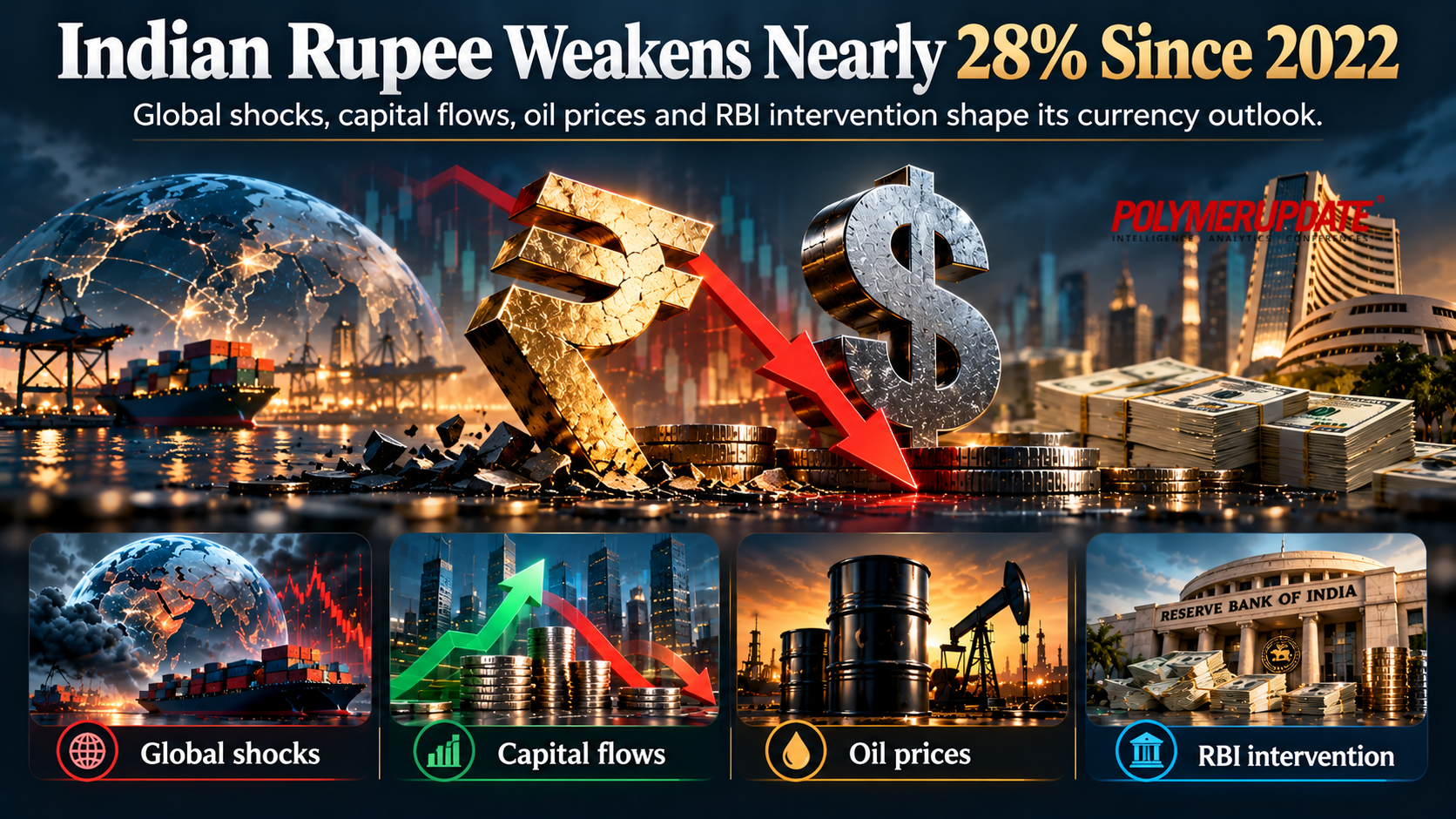
The Indian rupee has become one of the most closely watched emerging market currencies since the outbreak of the Russia-Ukraine war in 2022, with its trajectory increasingly shaped by a complex interplay of economic fundamentals, central bank intervention and global market sentiment. From an average of Rs 74.44 against the US dollar in January 2022, the rupee weakened to Rs 95.47 by August 2026, marking a depreciation of nearly 28 percent over four-and-a-half years.
Yet the decline has not been linear. Periods of external account pressure, surging oil prices and geopolitical tensions have alternated with phases of strong capital inflows, making the currency's movement difficult to predict. The near-term outlook suggests the rupee is likely to trade in the Rs 94.50–96.00 range, with the Reserve Bank of India (RBI) continuing to play a significant role in containing excessive volatility.
 A changing currency narrative
Conventional wisdom has long held that the rupee depreciates by around 3–4 percent annually over the long run, reflecting India's inflation differential and current account dynamics. However, recent years have challenged this assumption. Large inflows through Foreign Currency Non-Resident (FCNR) deposits and External Commercial Borrowings (ECBs) would ordinarily have strengthened the rupee by increasing dollar supply in the domestic market.
Instead, much of these inflows have remained parked with the RBI and added to foreign exchange reserves rather than being released into the market. As a result, the expected appreciation has largely been neutralised. This changing mechanism has altered the relationship between capital inflows and the exchange rate, making reserve management almost as important as the inflows themselves.
Rupee comparisonThe rupee's depreciation has been significant, but it has not been an isolated phenomenon. The dollar strengthened against several major and emerging market currencies during the same period, reflecting aggressive US monetary tightening, safe-haven demand and repeated geopolitical shocks. Among Asian currencies, the Japanese yen weakened by about 38 percent, the Indonesian rupiah by 24 percent and the South Korean won by 17 percent between January 2022 and August 2026.
By contrast, currencies such as the Brazilian real and the Mexican peso appreciated during the period, supported by stronger commodity exports and comparatively favourable capital flows. The euro, meanwhile, lost only about 2.4 percent against the dollar, although its path too was marked by episodes of volatility driven by energy disruptions and changing trade policies. The comparison underscores that the rupee's weakness has been part of a broader global currency realignment rather than a purely domestic phenomenon.
Fundamentals versus sentimentEconomists generally classify exchange rate drivers into two broad categories: fundamentals and sentiment. The fundamental side includes the current account balance, foreign direct investment (FDI), foreign portfolio investment (FPI), NRI deposits, ECB inflows and changes in foreign currency assets. Together, these determine the availability of dollars within the economy and influence the RBI's reserve position.
The RBI also has direct policy tools at its disposal. Spot market interventions through dollar sales can moderate sharp depreciation, while positions in the forward market often signal the central bank's intent to curb excessive volatility. In addition, fluctuations in reserve valuation—caused by changes in the dollar's strength against other reserve currencies—affect reported foreign exchange reserves even without any market transaction. Sentiment, however, operates differently. Expectations surrounding crude oil prices, gold imports, geopolitical conflicts, tariff measures and global dollar strength frequently trigger immediate reactions in currency markets.
A spike in crude oil prices typically raises concerns over India's import bill and puts downward pressure on the rupee. Conversely, signs of diplomatic progress or easing geopolitical tensions often improve investor confidence and support appreciation. Market participants also attempt to anticipate the RBI's likely policy response, amplifying short-term volatility. An illustration of sentiment's influence came with the RBI's announcement of the FCNR swap scheme. Even before underlying economic fundamentals changed materially, the rupee strengthened as markets responded positively to the policy signal.
Data interferencesAn examination of monthly data from January 2022 to June 2026 provides useful insights into the rupee's behaviour, although it stops short of offering a forecasting model. Statistical regressions using changes in foreign currency reserves indicate that external account variables do influence the exchange rate, but none emerges as a dominant determinant. Foreign portfolio investment, often viewed as a key driver of daily currency movements, was also tested separately despite already being reflected in reserve changes.
The results suggest that individual variables explain only a limited share of exchange rate variation. Even when combined, the fundamental indicators account for less than 40 percent of the rupee's movement during the period. This finding reinforces the view that exchange rates cannot be understood solely through balance of payments arithmetic. Financial markets continuously respond to expectations, policy signals and global risk perceptions that are difficult to quantify in conventional economic models.
RBI's stabilising roleOne consistent conclusion is the importance of RBI intervention in reducing excessive volatility. Rather than targeting a fixed exchange rate, the central bank has largely sought to smooth abrupt movements through a combination of spot and forward market operations while simultaneously building foreign exchange reserves. This approach has allowed the rupee to adjust gradually to changing external conditions without experiencing the disorderly swings witnessed in several other emerging market currencies.
As global uncertainties persist—from geopolitical conflicts and energy market disruptions to shifting trade policies and capital flow volatility—the rupee is likely to remain sensitive to both fundamentals and market psychology. The evidence of the past four years suggests that while economic variables provide the underlying direction, sentiment and timely RBI intervention increasingly determine the pace and magnitude of the currency's movement.
DILIP KUMAR JHA
Editor
dilip.jha@polymerupdate.com