The widening gap between the InterContinental (ICE) Brent crude benchmark and the US West Texas Intermediate (WTI) benchmark has emerged as one of the clearest signals of the increasingly fragmented global oil market. The Brent-WTI spread widened on Friday to around US$ 12.59 a barrel, its highest level since May, as concerns over a possible US ban on diesel exports, continuing supply risks in the Middle East, soaring freight costs and changing US control over Venezuelan crude altered the relative value of oil in different regions.
The unusually wide differential reflects a combination of regional factors rather than a simple change in the global supply-demand balance. Brent, which is more exposed to international supply disruptions, has retained a significant geopolitical premium, while WTI has come under pressure from concerns that US refiners could reduce crude processing if restrictions on diesel exports leave more refined product trapped in the domestic market.
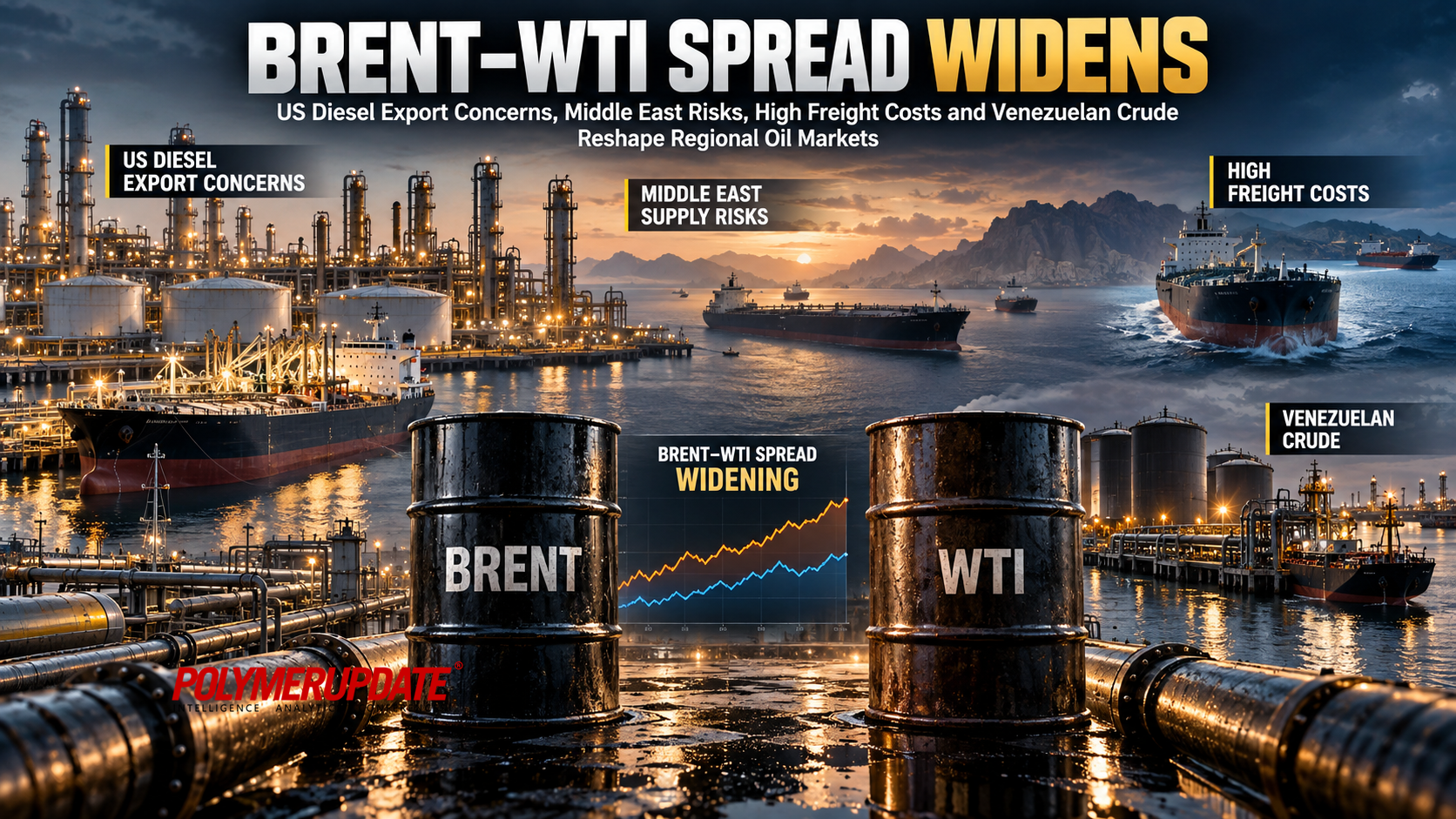 Widening gap
WTI traded as much as US$ 12.02 a barrel below Brent on September 24, the widest discount since May 6, according to London Stock Exchange Group (LSEG) data. Expert believe that the prospect of a US diesel-export ban was a major factor behind the widening differential, as traders anticipated that refiners could cut crude runs if they were unable to economically export surplus diesel.
The issue has gained importance because US diesel prices have surged sharply amid disruptions associated with the conflicts involving Iran, Russia and Ukraine. The New York Harbour Ultra-Low Sulfur No 2 Diesel Spot Price stands currently at US$ 4.98 a gallon, as compared to US$ 2.35 a gallon a year ago. Average retail pump prices in New York is currently quoted at US$ 6.52 a gallon, almost double the level seen a year ago. Analysts attributed the surprise increase in US diesel prices to the spurt in crude oil prices which has gone up by around 50 percent and an increase in regional demand.
Republican lawmakers have urged the administration of President Donald Trump to consider restricting diesel exports in an attempt to ease domestic fuel prices, although the administration has not indicated that it is currently moving ahead with such a ban. A restriction on diesel exports could have a counterintuitive effect on the crude market. While keeping more diesel in the US could initially increase domestic product availability, it could simultaneously weaken refinery margins and encourage refiners to process less crude. Lower refinery demand would put downward pressure on US crude prices and widen the WTI discount to Brent.
Crude-refined divergenceThe market is therefore pricing in a potential divergence between crude and refined-product markets. If diesel cannot be exported freely, refiners could face weaker economics, particularly if domestic inventories rise. Lower refinery utilisation would reduce crude demand and increase supplies available at US storage hubs, putting additional pressure on WTI. The development also highlights the importance of the export channel in determining WTI's relationship with Brent.
Normally, a wider WTI discount encourages traders to purchase US crude and export it to overseas markets, thereby narrowing the differential through arbitrage. However, the current environment is different because the cost and availability of shipping have become significant constraints. Freight rates have risen sharply since the beginning of the US-Iran conflict, while war-risk premiums and limited tanker availability have increased the cost of moving US crude to international markets. Reuters reported that shipping US crude from the Gulf Coast to Asia on a very large crude carrier has become dramatically more expensive than before the conflict. Consequently, a wider paper spread does not necessarily translate into an equally attractive physical arbitrage opportunity.
Changing strategyThis is an important distinction for the global oil market. When transportation costs rise faster than the price differential between two crude benchmarks, traders may be unable to exploit the spread. As a result, crude can remain relatively cheap in one region while staying expensive in another. Brent's strength, meanwhile, reflects the continuing geopolitical and logistical risks surrounding Middle Eastern supply. The International Energy Agency has warned that oil flows through the Strait of Hormuz remain below pre-war levels and that renewed disruptions have again placed upward pressure on benchmark crude prices.
Although producers outside the Gulf have increased output, the IEA cautioned that prolonged constraints on Gulf supplies and declining inventory buffers could require higher prices and weaker demand to rebalance the market. The Middle East factor is particularly important for Brent because the benchmark is more directly exposed to international seaborne trade and the availability of Atlantic Basin and European replacement barrels. Any fresh attack on energy infrastructure, disruption to shipping or deterioration in the security situation around the Strait of Hormuz can therefore increase the scarcity premium embedded in internationally traded crude.
Supply uncertaintyRecent attacks on Saudi Arabian energy infrastructure by Iran-backed Houthi forces have added another layer of uncertainty. At the same time, negotiations between the US and Iran over a possible path towards ending the conflict have introduced the possibility of a sharp reversal in the geopolitical premium. Reports that a phased arrangement could involve the reopening of the Strait of Hormuz have contributed to periodic declines in Brent even as supply risks remain elevated. This divergence between geopolitical risks supporting Brent and domestic US concerns weighing on WTI explains why the spread has become unusually wide.
Venezuela represents another important element in the changing structure of the market. The US has increased its involvement in Venezuela's oil sector following the capture of former President Nicolás Maduro and subsequent efforts to revive the country's petroleum industry. Venezuelan crude exports have consequently become increasingly integrated into international trading flows. However, the ability to increase Venezuelan exports rapidly is being constrained by shipping costs and port congestion.
Importers seek discountReuters reported that Venezuelan crude exports remained around 1.17 million barrels per day in August, while traders Vitol and Trafigura handled almost 600,000 bpd between them. Rising tanker costs have forced traders to seek larger discounts for Venezuelan crude, with freight from Venezuela to the US Gulf Coast substantially more expensive than earlier in the year. The Venezuelan situation could influence regional crude balances in two opposing ways. Greater Venezuelan production and exports could provide additional heavy crude to US and other refiners, potentially easing supply constraints.
But if shipping costs remain elevated and Venezuelan barrels require steep discounts to compensate buyers, the increase in physical supply may not fully translate into lower global prices. For the US market, the availability of Venezuelan crude also has implications for refinery economics. Several US Gulf Coast refineries are configured to process heavier grades, making Venezuelan crude an important potential source of feedstock. Changes in the volume, pricing and destination of Venezuelan barrels could therefore influence refinery margins and crude demand in the US. The widening Brent-WTI spread thus represents more than a conventional benchmark differential. It reflects the growing segmentation of the international oil market, in which crude prices are increasingly determined by regional logistics, refinery configurations, shipping availability, sanctions and geopolitical risk.
US exports to boostFor US producers, a wider WTI discount can eventually provide an incentive to increase exports if shipping economics permit. However, the current surge in freight costs is limiting that mechanism. For international producers, meanwhile, the strength of Brent provides a stronger price signal but also reflects the additional cost and risk associated with transporting crude through vulnerable maritime routes. The differential could remain volatile in the near term. A formal US restriction on diesel exports could put further pressure on WTI by reducing refinery demand for crude, while a relaxation of the proposal could allow some of the discount to narrow.
Conversely, any fresh disruption around the Strait of Hormuz, Saudi infrastructure or other Middle Eastern supply routes could strengthen Brent and widen the differential further. A breakthrough in US-Iran negotiations could have the opposite effect. Greater freedom of navigation through Hormuz, lower war-risk premiums and improved tanker availability would reduce the scarcity premium attached to international crude and could narrow the Brent-WTI gap.
Mirroring policy decisionsThe spread will therefore remain an important indicator of how the oil market is responding to the competing forces of US domestic policy, international supply disruptions and global shipping constraints. Rather than moving solely in response to global inventories or demand, Brent and WTI are increasingly reflecting two different oil markets: one shaped by geopolitical scarcity and international logistics, and the other by US refinery economics, domestic product balances and export policy.
For traders and consumers, the unusually wide differential is a reminder that the headline crude price alone no longer provides a complete picture of the physical oil market. The direction of freight rates, US refinery utilisation, diesel exports, Venezuelan shipments and the security of Middle Eastern supply routes will all be critical in determining whether the Brent-WTI spread narrows or remains elevated in the weeks ahead.
DILIP KUMAR JHA
Editor
dilip.jha@polymerupdate.com