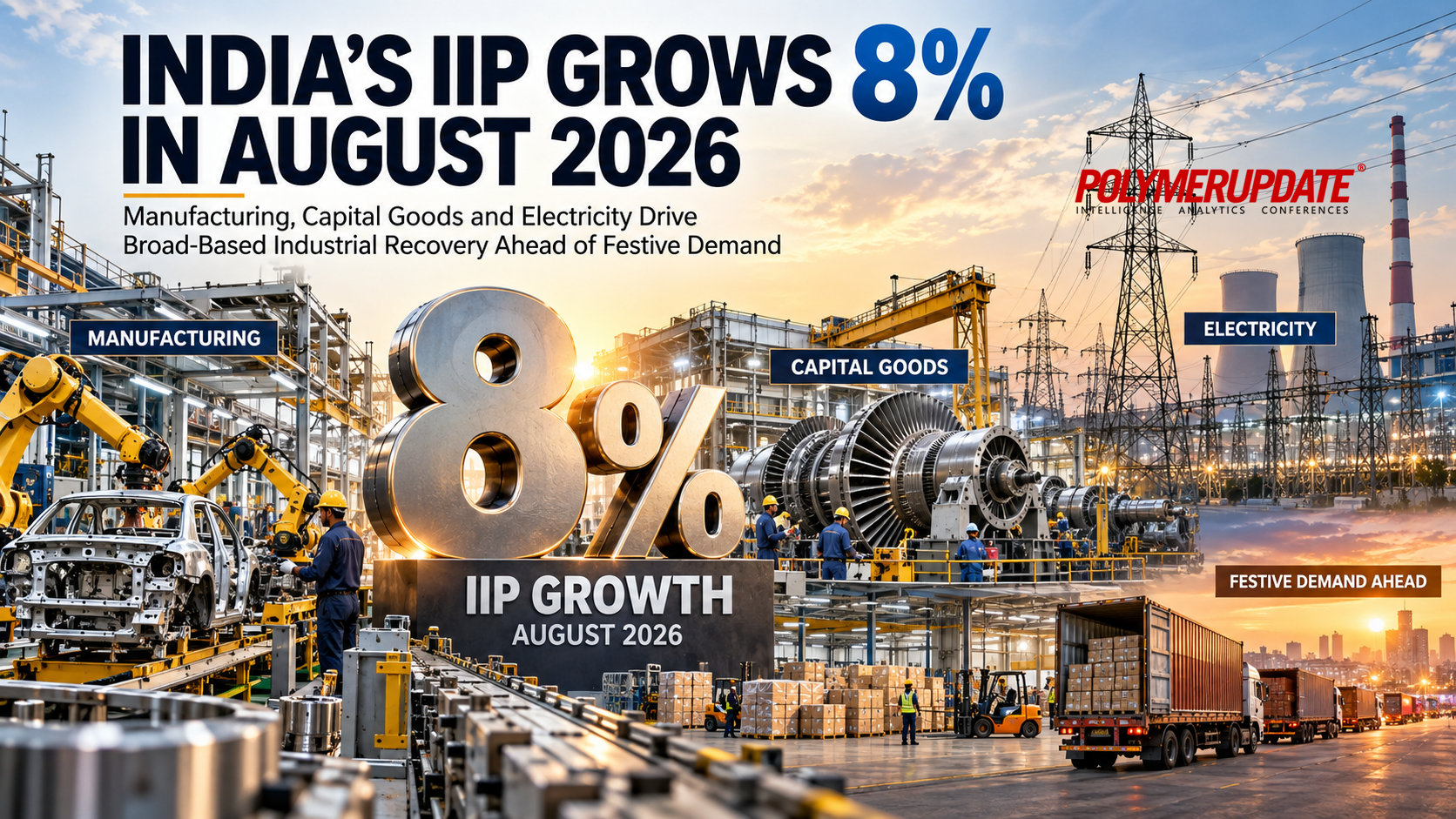
India's industrial activity gathered strong momentum in August 2026, with the Index of Industrial Production (IIP) expanding by 8 percent year-on-year, driven by robust manufacturing, capital goods and electricity generation, signalling a broad-based recovery ahead of the festive demand season, data compiled by the Ministry of Statistics & Programme Implementation (MoSPI) stated. The August growth marks a notable improvement from the revised 6.7 percent expansion recorded in July and takes the overall industrial production index to 123.3, compared with 114.2 in the corresponding month last year.
The latest data also reinforces expectations that industrial activity could remain resilient during the second half of the financial year despite persistent geopolitical and energy-related uncertainties. Manufacturing, which accounts for nearly four-fifths of the IIP, emerged as the principal growth engine, expanding 9 percent in August. Of the 23 manufacturing industry groups, 18 registered positive growth, reflecting widespread improvement across industrial segments rather than gains concentrated in a few sectors. The strongest performers included the manufacture of motor vehicles, trailers and semi-trailers, which grew 25.2 percent, followed by electrical equipment at 30.9 percent, and other transport equipment at 25.3 percent.
 Auto component gears fast
Within the automobile sector, growth was supported by higher production of auto components, passenger cars and commercial vehicles, indicating healthy demand across both personal mobility and commercial transportation segments. The electrical equipment industry benefited from rising output of switchgear, circuit breakers, control panels, optical fibre connectors and uninterruptible power supply (UPS) systems, reflecting sustained investments in power infrastructure and digital connectivity.
The transport equipment segment was lifted by increased production of motorcycles, scooters, railway rolling stock and related components, highlighting continued expansion in both urban mobility and rail infrastructure. Electricity and utility services also recorded a strong performance during the month. Electricity, gas supply and related services grew 12.3 percent, while water supply, sewerage and waste management expanded 6.3 percent. The mining and quarrying sector, however, contracted 5.6 percent, partly offsetting gains made elsewhere in the industrial economy.
Sector-wise growth remarksThe use-based classification of industrial production presents an equally encouraging picture. Capital goods posted the highest growth at 16.9 percent, followed by intermediate goods at 13.7 percent and consumer durables at 11.1 percent. Infrastructure and construction goods rose 6.4 percent, while primary goods increased 3.5 percent. Consumer non-durables, largely representing fast-moving consumer goods (FMCG), grew only 2.1 percent, suggesting that rural and mass-market consumption remains relatively subdued.
Economists said the composition of growth is particularly significant because stronger capital goods production generally indicates rising investment activity and future industrial capacity creation rather than merely short-term consumption. Madan Sabnavis, Chief Economist at Bank of Baroda, said the 8 percent industrial growth was substantially higher than the bank's expectation of 6–6.5 percent and reflected robust expansion across investment-oriented sectors.
"Industrial production for August came in at 8 percent, much higher than our forecast. This was aided by sharp growth in capital goods, intermediate goods, infrastructure and consumer durables. If the current momentum is maintained, India can register 7–8 percent industrial growth during the year, supported by stronger festive demand," Sabnavis said.
Machinery sector drives growthHe noted that manufacturing growth was driven by automobiles, electrical and non-electrical machinery, electronics, textiles, beverages, rubber products and non-metallic mineral products, while infrastructure-related industries also showed healthy expansion. The automobile industry contributed across both entry-level and premium vehicle segments, indicating broad-based consumer demand rather than growth limited to luxury categories.
Not all sectors participated equally in the recovery. Chemical manufacturing remained under pressure as elevated global energy prices continued to increase production costs amid ongoing geopolitical tensions in the Middle East. Export-oriented industries such as apparel and pharmaceuticals also witnessed relatively weaker performance, reflecting softer overseas demand. Interestingly, although overall mining contracted, the production of minerals, including rare earth minerals, recorded positive growth of around 5 percent, suggesting continued strategic investment in critical mineral extraction despite weakness in conventional mining activities.
Bright spotsElectricity generation remained another bright spot, with double-digit growth supported by both renewable energy capacity additions and higher output from conventional thermal power plants to meet rising industrial and seasonal demand. The relatively modest 2.1 percent growth in consumer non-durables, however, indicates that household spending on everyday goods has yet to recover fully. Sabnavis attributed this to higher retail prices and weaker purchasing power, which continue to constrain demand in lower-income consumption categories.
For the first five months of the financial year, industrial production has grown 6.7 percent, providing a solid foundation for stronger annual growth if momentum persists through the crucial October–December festive quarter. The government said the August quick estimates were compiled using an 88.0 percent weighted response rate, while the July figures have been revised using updated information from source agencies, resulting in a higher 93.4 percent response rate for the final estimates.
Analysts believe the sustained improvement in industrial production, combined with robust credit growth to industry and continued public infrastructure spending, points to strengthening investment activity. The performance of capital goods and intermediate goods suggests that businesses are expanding production capacity in anticipation of higher demand, making the third quarter a critical period for determining whether India's industrial sector can sustain its recovery and contribute meaningfully to overall economic growth in 2026–27.
DILIP KUMAR JHA
Editor
dilip.jha@polymerupdate.com