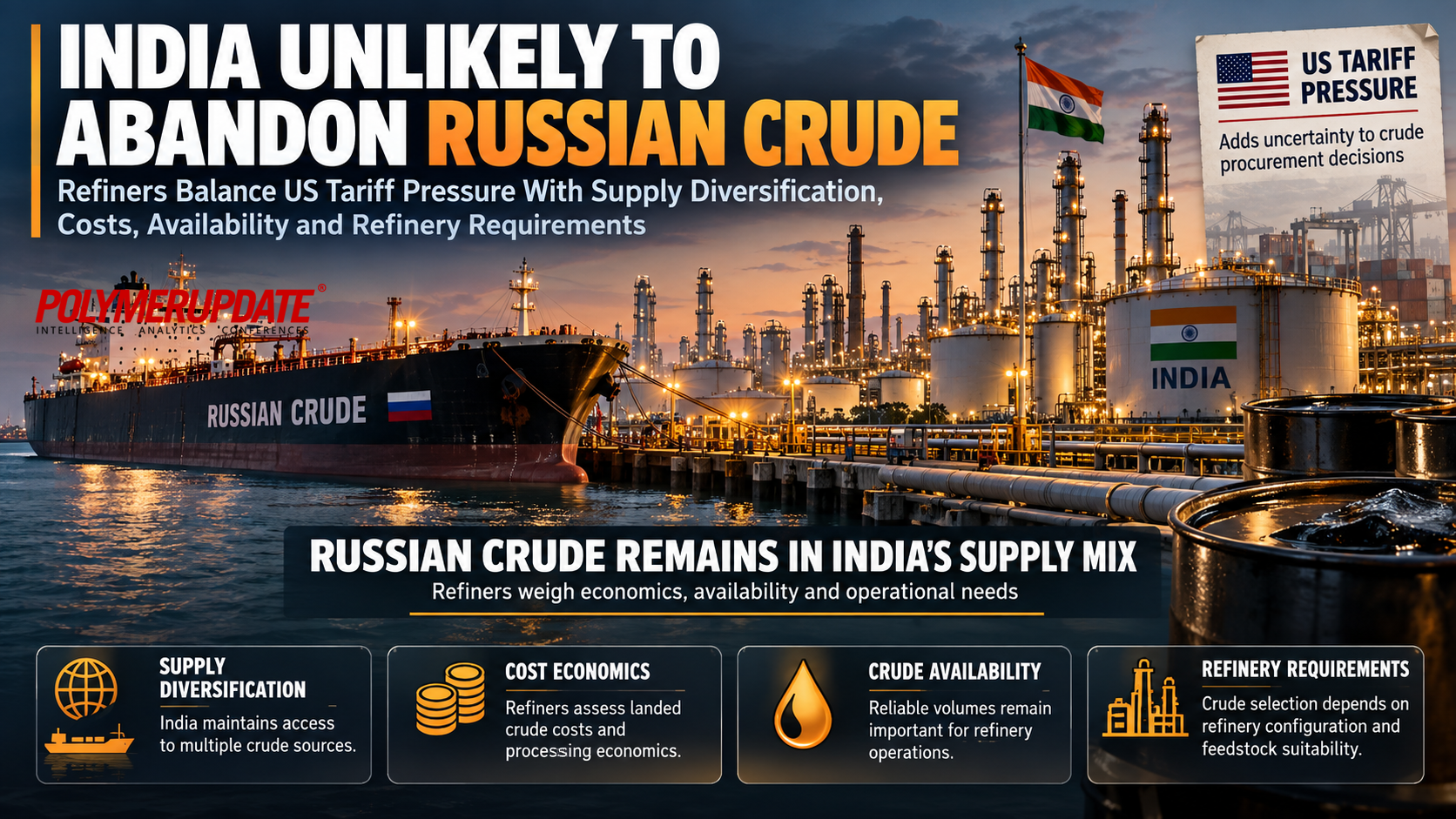
India is unlikely to make a complete break with Russian crude despite a new US law authorising President Donald Trump to impose tariffs of up to 100 percent on countries that are major buyers of Russian oil and gas, on the grounds that such purchases contribute to Moscow’s war against Kyiv. Indian refiners have already begun diversifying their supplies, but the economics of Russian crude, sustained availability, refinery compatibility and the risk of higher global oil prices are likely to prevent a wholesale shift away from Moscow.
The Lindsey O. Graham Sanctioning Russia and Iran Act of 2026, signed into law by President Trump earlier this month, expands statutory sanctions against Russia and gives the US administration the authority to impose tariffs of up to 100 percent on goods from countries that purchase Russian oil and natural gas. The legislation does not, however, automatically impose a 100 percent tariff on India. The US is using such measures to exert additional pressure on major Russian crude buyers, including China and India, to reduce or abandon their energy purchases from Moscow. The threat comes even as the United States itself continues to import a range of goods from Russia.
 Intense US-India trade relations
The threat comes at a sensitive time for India-US trade relations, with the two countries negotiating a bilateral trade agreement. India has already conveyed its concerns to senior US officials, pointing to the potential implications of punitive measures not only for bilateral trade but also for global energy markets. India became a major buyer of Russian crude after Moscow’s invasion of Ukraine in 2022, when Western sanctions and the price-cap regime redirected Russian oil towards Asian markets.
Competitive Russian barrels subsequently became an important component of India’s crude basket, helping refiners manage feedstock costs while diversifying away from traditional Middle Eastern suppliers. India’s External Affairs Minister S Jaishankar said in a recent statement that New Delhi has diversified its crude oil purchases and now sources supplies from more than 40 countries, compared with its earlier reliance on Middle Eastern suppliers. The minister also clarified that India would continue to purchase oil from countries based on its national interests and would, therefore, not come under pressure from any particular supplier or trading partner.
Falling importsRecent import data, however, show that Indian refiners are already reducing their exposure to Russian crude. India imported an average 1.74 million barrels per day (bpd) of Russian crude in September, according to Kpler, down from 2.02 million bpd in August and 2.65 million bpd in July. The September volume was the lowest since April. The decline came despite a sharp increase in India's overall crude imports. Total imports averaged around 5.3 million bpd in September, about 600,000 bpd higher than in August and 700,000 bpd above the year-earlier level.
The shortfall from Russia was partly offset by higher purchases from the Middle East. Iraqi supplies increased to around 575,000 bpd from 163,000 bpd in August, while Saudi Arabian supplies rose to 566,000 bpd from 347,000 bpd. UAE supplies, meanwhile, stood at around 480,000 bpd against 546,000 bpd in August. The shift suggests that Indian refiners retain considerable flexibility in their procurement strategy. They can alter the composition of their crude basket as relative prices, availability, freight costs and geopolitical risks change.
Down, not outAn analyst from a leading international commodities broking and advisory firm said that this diversification should not be confused with a complete withdrawal from Russian oil. “Russia nevertheless remains a major component of India's crude basket, with buying decisions continuing to be driven primarily by economics, availability and refinery compatibility,” said Sumit Ritolia, Senior Manager (Modelling) at Kpler.
According to Ritolia, the September decline in Russian flows does not represent a wholesale shift away from Russian crude. If Washington introduces unilateral punitive measures, Indian refiners could initially reduce Russian purchases while assessing enforcement, possible waivers and the availability of alternative supplies.
Focus on economicsThat approach would allow refiners to retain Russian barrels where the economics remain attractive while increasing purchases from other producers where necessary. Middle Eastern supplies are already recovering. Imports from the region are estimated at around 3 million bpd in September, broadly returning to pre-war levels, supported by higher flows from Iraq, Kuwait and Saudi Arabia. Improving crude movements through the Strait of Hormuz, along with ship-to-ship transfers and other logistical arrangements, have also enabled Indian refiners to rebuild purchases from the region.
African and Venezuelan barrels have added another layer of diversification. The economic argument against a rapid withdrawal from Russian crude is significant. Replacing Russian crude quickly could raise India's import bill and domestic inflation, particularly with Middle Eastern supply and shipping facing disruptions and Brent crude trading above US$ 107 a barrel. The same argument could apply to Washington. Removing several million barrels of Russian crude from the global market by pressuring major Asian buyers could tighten supply and add to international oil prices. That would come at a time when US gasoline prices are rising and diesel prices remain elevated.
Bilateral diplomacy above tariffFor India, therefore, the issue extends beyond bilateral diplomacy. Crude accounts for a substantial portion of the country's import bill, making procurement economics critical for inflation, the current account and the competitiveness of domestic refiners. India's September data also point to strong refinery activity. Higher overall crude imports reflected stronger refinery runs and domestic fuel demand, while export-oriented plants have been operating at elevated rates to benefit from strong international product margins and a tight global refined-products market.
A forced and rapid change in crude sourcing could consequently have implications for both refining margins and domestic fuel costs. The Russia-India energy relationship is also becoming more two-way. Russia, traditionally a major exporter of crude and refined products, has recently imported petroleum products from India after Ukrainian attacks disrupted Russian refinery operations and reduced domestic production of high-octane gasoline.
Russia buys Indian refined oilKpler estimates that seaborne petroleum-product imports from India, which began in July, accounted for around 4 percent of Russian domestic demand for the affected products during the third quarter. The volumes remain relatively small and appear to reflect temporary regional supply disruptions rather than a structural change in the bilateral energy relationship.
For India, the immediate response to the US tariff threat is therefore more likely to be greater diversification than abandonment of Russian crude. Refiners can increase purchases from the Middle East, Africa and other suppliers, but the extent of any shift will depend on relative prices, availability, freight economics and refinery requirements. New Delhi is also likely to seek exemptions or waivers as it engages Washington over the new sanctions framework.
The September import data underline the central dilemma: India has alternatives to Russian crude, but replacing it entirely and rapidly could come at a substantial economic cost. The more likely strategy is to retain Russian supplies where they remain commercially viable while progressively widening the sourcing base to reduce exposure to geopolitical and trade-policy risks.
DILIP KUMAR JHA
Editor
dilip.jha@polymerupdate.com