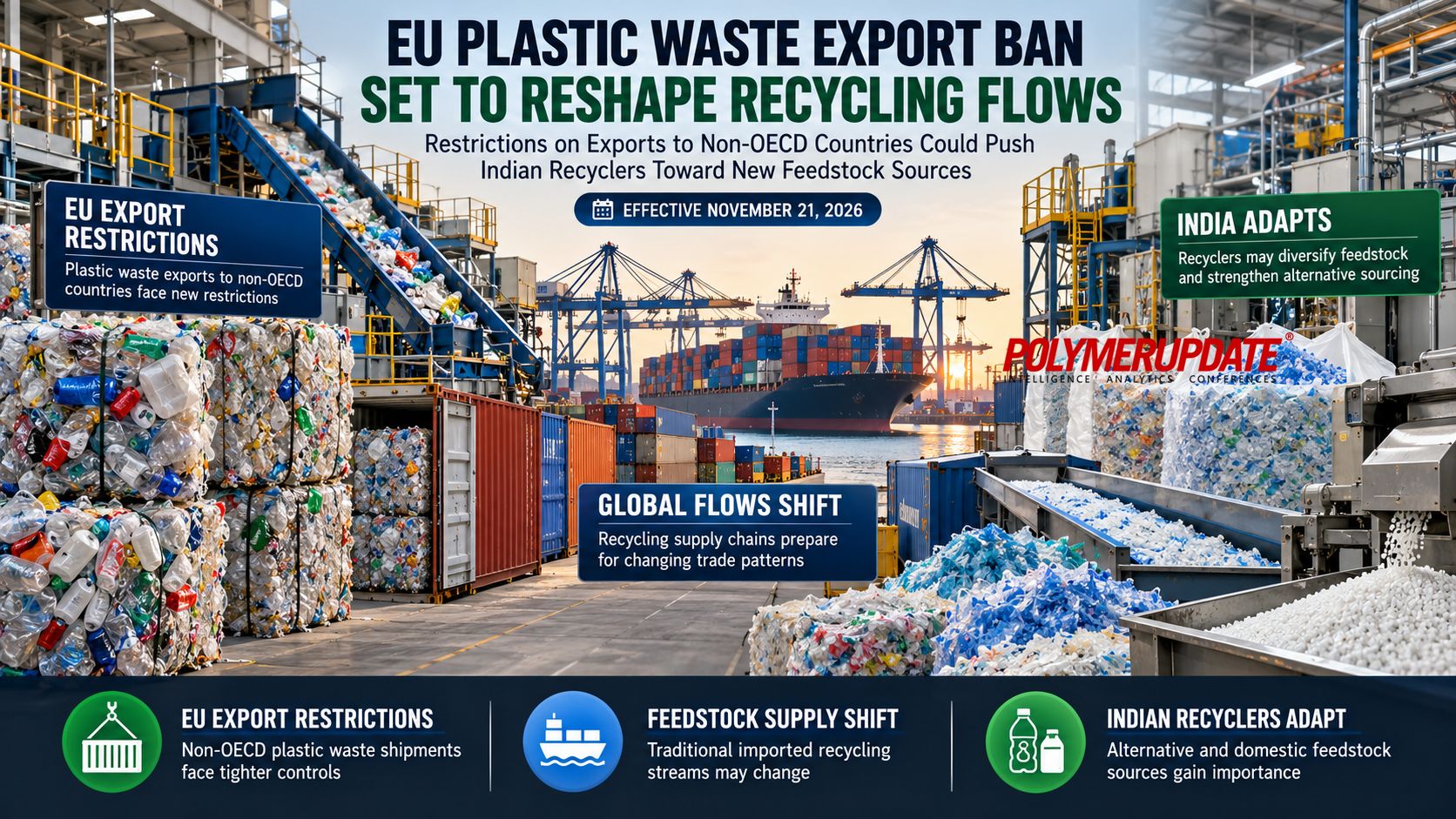
The European Union’s decision to prohibit exports of plastic waste to non-OECD (Organisation for Economic Co-operation and Development) countries from November 21, 2026, is set to further reshape the global trade in secondary plastics and could compel Indian recyclers and processors to diversify their sources of feedstock. The move is significant for India because the country has historically been an important destination for recyclable materials from overseas, although plastic waste imports have already fallen sharply following India's own restrictions introduced in 2019.
The European Commission reaffirmed the November 21 deadline on September 18, saying that exports of plastic waste from the European Union to non-OECD countries (involving 38 advanced countries in and around Europe) will be completely banned from that date, initially until May 21, 2029. India is not an OECD member, but is classified by this group as a Key Partner.
An executive of a leading Gujarat-based plastic waste importer from Europe stated on condition of anonymity, “The restriction is part of the EU Waste Shipment Regulation (EU) 2024/1157, which came into force in May 2024. The regulation is intended to prevent the export of waste to countries where it may not be managed in an environmentally sound manner and to encourage greater recycling within Europe. From November 21, the prohibition will apply specifically to plastic waste, including clean, non-hazardous plastic waste intended for recycling.”
 EU’s negligible exports
According to the European Commission, the EU itself generates around 40 million tonnes of plastic waste annually and exports between 1 million and 1.5 million tonnes. In 2025, it exported around 1.4 million tonnes of plastic waste, with roughly half going to OECD countries and half to non-OECD destinations. Major non-OECD destinations included Malaysia, Indonesia and Vietnam. The European policy is therefore likely to cause a wider restructuring of global plastic-waste flows.
Material that can no longer move to non-OECD markets will increasingly be retained within Europe or redirected to OECD destinations where permitted. The Commission has already introduced tighter controls requiring prior notification and consent for plastic waste exports, while OECD destinations will remain subject to monitoring. For India, the November 21 deadline is therefore less a sudden supply shock than another step in the gradual transition away from imported plastic waste.
With EU-origin material already accounting for only a small proportion of India's current imports, the direct impact should be manageable. The bigger challenge—and opportunity—will be to expand domestic collection and recycling capacity sufficiently to ensure that India's growing plastics-processing industry has reliable access to competitively priced secondary raw materials.
Supply declines to IndiaAvailable UN Comtrade-based data compiled by the Basel Action Network (BAN) indicate that EU plastic waste exports to India have declined dramatically since the beginning of the decade. BAN's data, which cover HS Code 3915 and exclude the United Kingdom, show that EU shipments to India were about 24,000 tonnes in 2021, before falling to roughly 3,500 tonnes in 2022, around 4,900 tonnes in 2023, approximately 3,300 tonnes in 2024 and about 4,000 tonnes in 2025.
Taken together, this indicates that EU plastic waste exports to India totalled roughly 40,000 tonnes during 2021-25. The figure should be treated as an approximate five-year total because the BAN annual chart presents the India series graphically; its underlying data are sourced from UN Comtrade. The latest World Bank WITS data provide a more precise benchmark for 2024, showing EU exports of plastic waste to India at 3,327.75 tonnes, valued at about US$ 1.48 million.
The relatively small current volume is important when assessing the likely impact of the EU ban. The measure will not remove a major share of India's overall plastic-processing feedstock overnight. Instead, its principal impact will be on specific recyclers and processors that depend on particular grades, qualities or relatively clean streams of imported plastic waste. India's overall imports under HS 3915 amounted to about 55,354 tonnes in 2024, according to WITS, indicating that EU material accounted for only a modest share of the country's total imported plastic waste. The United States was by far the largest supplier, followed by Canada, the Netherlands, the UAE and other countries.
India tightens regulationsThe impact also needs to be viewed against India's domestic regulatory framework. In March 2019, India prohibited the import of solid plastic waste, including by Special Economic Zones and Export Oriented Units, as part of efforts to encourage domestic collection and recycling. The policy was subsequently relaxed for certain categories. In November 2021, India permitted imports of PET waste for authorised recycling units to address shortages of domestic PET feedstock. The government said such imports would be allowed only to actual recyclers with valid authorisation and Consent to Operate, and quantities would be restricted to filling gaps in recycling capacity rather than replacing domestically collected waste.
In addition, specific provisions have allowed SEZs and EOUs to import certain post-industrial or pre-consumer polyethylene waste and polymethyl methacrylate (PMMA) under prescribed conditions, with such material not generally permitted for the domestic tariff area. Consequently, the EU ban is unlikely to create a broad-based shortage of plastic waste in India. Its effect will be more concentrated among companies using imported, higher-quality or specialised waste streams.
Alternative sourcesIndian processors have several alternatives. The most important is domestically generated post-industrial and post-consumer plastic waste. India's rapidly expanding packaging, e-commerce, consumer goods, automotive and infrastructure sectors are generating increasing volumes of plastic waste, while the country's Extended Producer Responsibility framework is encouraging formal collection and recycling. Internationally, the United States remains the largest potential alternative source. WITS data show that India imported about 44,296 tonnes of plastic waste from the US in 2024, accounting for the bulk of its total imports under HS 3915. Japan supplied about 13,378 tonnes, Saudi Arabia 7,035 tonnes, Kuwait 7,030 tonnes and Canada about 4,103 tonnes.
The Middle East could therefore become increasingly important for Indian processors, particularly for polyethylene streams, given the availability of industrial scrap and the region's large petrochemical manufacturing base. In 2024, Saudi Arabia and Kuwait were already among India's significant suppliers. The UAE also supplied more than 1,000 tonnes. Japan and North America offer another avenue, particularly for relatively consistent industrial and post-consumer streams. However, processors will need to assess landed costs, contamination levels, polymer composition, bale quality, freight rates and Indian regulatory requirements before replacing European supplies.
Impact on India's plastics industryThe immediate impact of the EU ban is likely to be limited at the industry-wide level but more pronounced for individual recyclers dependent on European material. For processors using European waste, the loss of supply could increase procurement costs as they compete for material from the United States, Japan, Canada and the Gulf. Freight costs and longer shipping distances could further influence landed prices. Competition for imported feedstock could also intensify if other countries affected by European restrictions attempt to source more aggressively from the same alternative markets.
At the same time, the ban could provide an important incentive for India to strengthen its domestic circular plastics economy. Greater investment in collection, segregation, washing, sorting and reprocessing infrastructure would allow Indian recyclers to rely increasingly on domestic waste rather than imported material. This could become particularly relevant as India's recycled-content requirements and EPR obligations expand. A stronger domestic feedstock base would reduce exposure to international regulatory changes and freight disruptions while creating additional value within the country's recycling chain.
There is also a potential opportunity for Indian polymer producers and converters. If recycled feedstock becomes more expensive or less readily available, some processors could temporarily increase their use of virgin polymers. This could support demand for virgin polyethylene, polypropylene and other polymers, although the extent would depend on the specific application and recycled-content requirements.
OutlookIn the medium term, the EU ban could accelerate India's shift from an import-dependent recycler to a more domestically integrated circular plastics economy, provided investment in waste collection, segregation and recycling keeps pace with the country's rapidly growing plastic consumption.
DILIP KUMAR JHA
Editor
dilip.jha@polymerupdate.com