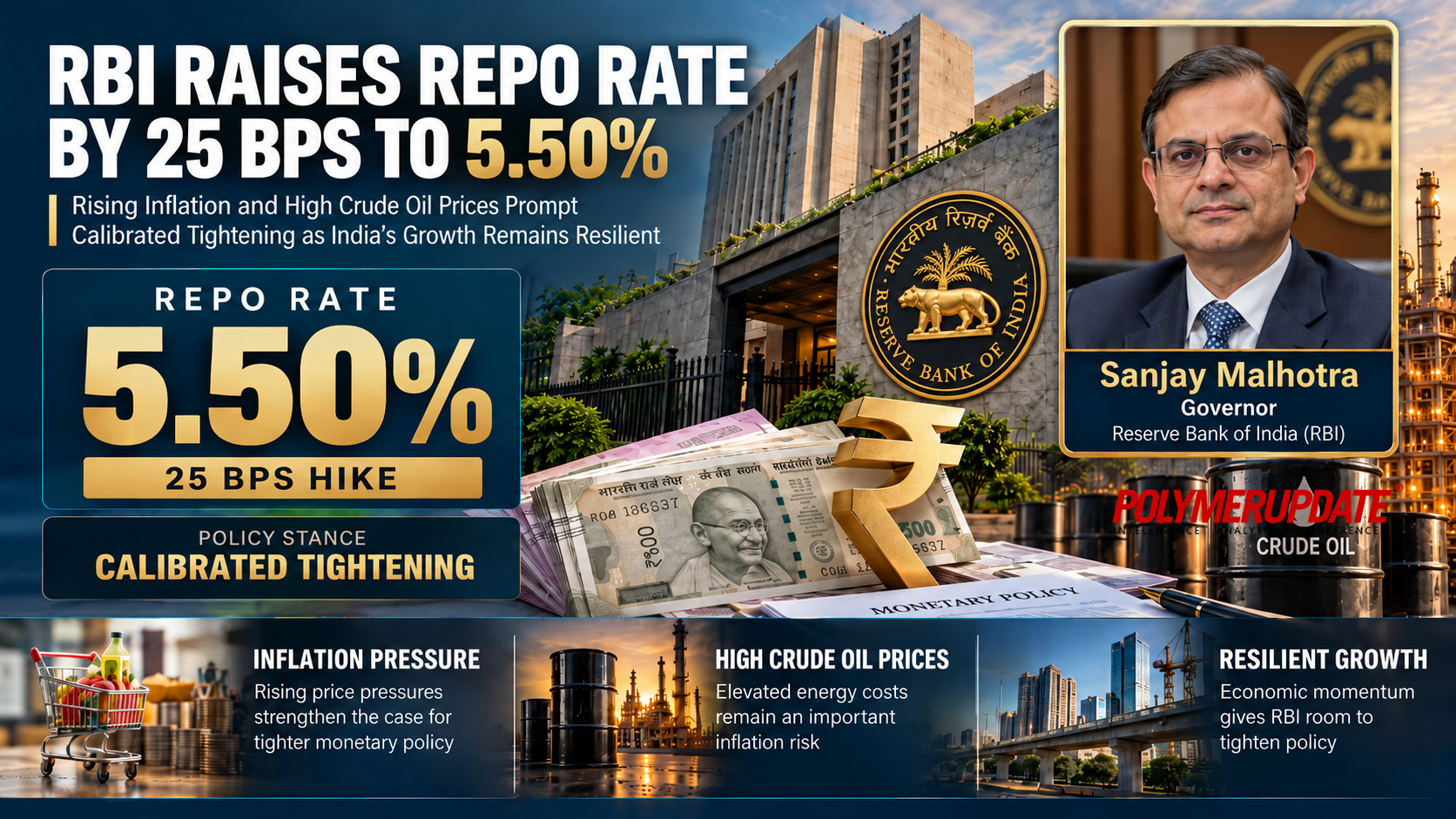
The Reserve Bank of India (RBI) has raised its key repo rate by 25 basis points (bps) to contain the impact of rising retail inflation, driven by persistently high crude oil prices stemming from ongoing geopolitical conflicts in the Middle East, which have included intermittent strikes on the region’s energy infrastructure. The latest increase raised the policy repo rate under the liquidity adjustment facility (LAF) by 25 bps to 5.50 percent. Consequently, the standing deposit facility (SDF) rate stands adjusted at 5.25 percent, while the marginal standing facility (MSF) rate and the Bank Rate have been raised to 5.75 percent. The MPC also decided to change its stance to calibrated tightening.
The decision was taken unanimously at a three-day Monetary Policy Committee (MPC) meeting held from October 5–7, 2026, following a detailed assessment of evolving macroeconomic and financial developments and the outlook. The repo rate hike is likely to make bank borrowing costlier by a similar proportion, directly affecting existing and new customers across various types of loans. The MPC noted that the global environment remains challenging due to geopolitical developments. Nonetheless, the Indian economy has remained resilient, with economic momentum continuing to be broad-based.
“The sudden re-escalation of the West Asia conflict in September and the consequent hardening and volatility in global crude prices soured global economic sentiment and heightened financial market volatility. Although global growth remains resilient, it is projected to decelerate in 2026 from the previous year. Driven by escalating energy costs and rising food prices, global inflation is projected to increase sharply, prompting monetary policy tightening by major central banks. Lingering trade uncertainty, rising bond yields in advanced economies and an appreciating dollar are keeping global financial market sentiment nervous and fragile,” said RBI Governor Sanjay Malhotra while unveiling the outcome of the meeting.
A note from Motilal Oswal Financial Services commented, “RBI delivered a hawkish outcome. Markets were anticipating a stance shift to calibrated rate tightening from neutral, signaling tighter control on liquidity and rates to contain inflation.” The equity and commodity markets broking and advisory services firm expects 100 bps of tightening in this cycle, taking the repo rate to 6.25 percent over the next one year. The agency forecasts retail inflation at 5.2 percent, in line with expectations, and real Gross Domestic Product (GDP) growth at 7.1 percent. Further, the 10-year bond yield is likely to rise to 7.5 percent over the next six months, compared with 7.27 percent currently. The rupee may also face further pressure, potentially weakening to 96.40 against the US dollar, Motilal Oswal’s note further forecasts.
 Only hikes or pause, no cut
Malhotra added that further tightening of global financial conditions, uncertainty over the fair valuation of AI stocks and an elusive resolution to the West Asia conflict pose significant downside risks to the global economic outlook. With regard to supply-side price pressures, monetary policy primarily acts by curtailing second-round effects, such as inflation expectations and firm-level pricing behaviour, which take time to manifest and are difficult to identify from available data. In addition to data on inflation expectations and firm-level pricing behaviour, indicators such as core inflation and diffusion indices are used to assess the broadening of price pressures.
While there is some evidence of elevated inflation expectations and a generalisation of price pressures, there are limited signs of supply-side pressures becoming embedded in pricing behaviour. Similarly, while there is limited evidence of demand-side pressures, risks remain in view of strong growth in monetary and credit aggregates. Considering all these factors, the MPC unanimously voted to increase the policy repo rate, Malhotra added.
The MPC also decided to change its stance to calibrated tightening. It underscored that, given the current conditions, rate cuts are off the table in the near term and that policy action ahead can only be a rate hike or a pause, depending on evolving conditions and the outlook. Meanwhile, the duration and extent of the rate-hike cycle would be contingent on actual growth-price developments and the outlook, particularly underlying price pressures, the extent to which these pressures broaden, the emergence of second-round effects from the supply shock, and the impact of demand impulses.
Resilient economic growthDomestic economic activity exhibited resilience amid global headwinds, as reflected in real GDP growth of 7.8 percent in the April-June 2026 quarter. Growth was driven by resilient private consumption and strong investment activity, while the contribution of net exports also remained positive. High-frequency indicators available so far suggest that economic activity maintained momentum in the July-September 2026 quarter, albeit with some moderation compared with the preceding quarter.
Despite a deficient and uneven southwest monsoon, kharif sowing, although somewhat above its normal level, was marginally lower than last year. Manufacturing activity has held up well despite cost pressures, as indicated by growth in factory output, measured by the Index of Industrial Production (IIP), and the Purchasing Managers’ Index (PMI). Services sector activity remained steady and broad-based, supported by buoyant domestic and external demand.
The RBI projected India’s GDP growth for FY2026-27 at 7.1 percent, with growth in the second (July-September), third (October-December) and fourth (January-March) quarters projected at 7.2 percent, 6.9 percent and 6.8 percent, respectively. The upward revision of 40 bps in the growth forecast further underscores the strength of economic activity despite significant headwinds. Real GDP growth for FY2026-27 is estimated at 7.1 percent.
InflationIndia’s retail inflation, measured by the Consumer Price Index (CPI), increased to 4.8 percent in August 2026 from 4.5 percent in July, largely driven by higher inflation in the food and fuel components. Food price pressures have become more broad-based, with notable increases in items such as sugar and onions. Fuel inflation also edged up in August, primarily due to unfavourable base effects. Core inflation increased to 4.2 percent in August after remaining unchanged at 3.9 percent for three consecutive months. Core inflation, excluding precious metals, rose to 2.9 percent in August.
A broadening of price pressures was evident in the diffusion indices, with the weighted share of items recording inflation above 4 percent increasing to about 37 percent in August 2026. The near-term outlook points to continued supply-side pressures due to the deficient southwest monsoon, El Niño conditions and high volatility in international oil prices. Price pressures are increasingly becoming visible across a range of commodities within the food component, apart from oil.
Considering all the aforementioned factors, CPI inflation for FY2026-27 is projected at 5.2 percent, with inflation in the second, third and fourth quarters projected at 4.9 percent, 6.0 percent and 5.7 percent, respectively. Inflation for the April-June 2027 quarter is projected at 5.6 percent, with risks evenly balanced. Core inflation is projected at 4.4 percent for FY2026-27.
DILIP KUMAR JHA
Editor
dilip.jha@polymerupdate.com