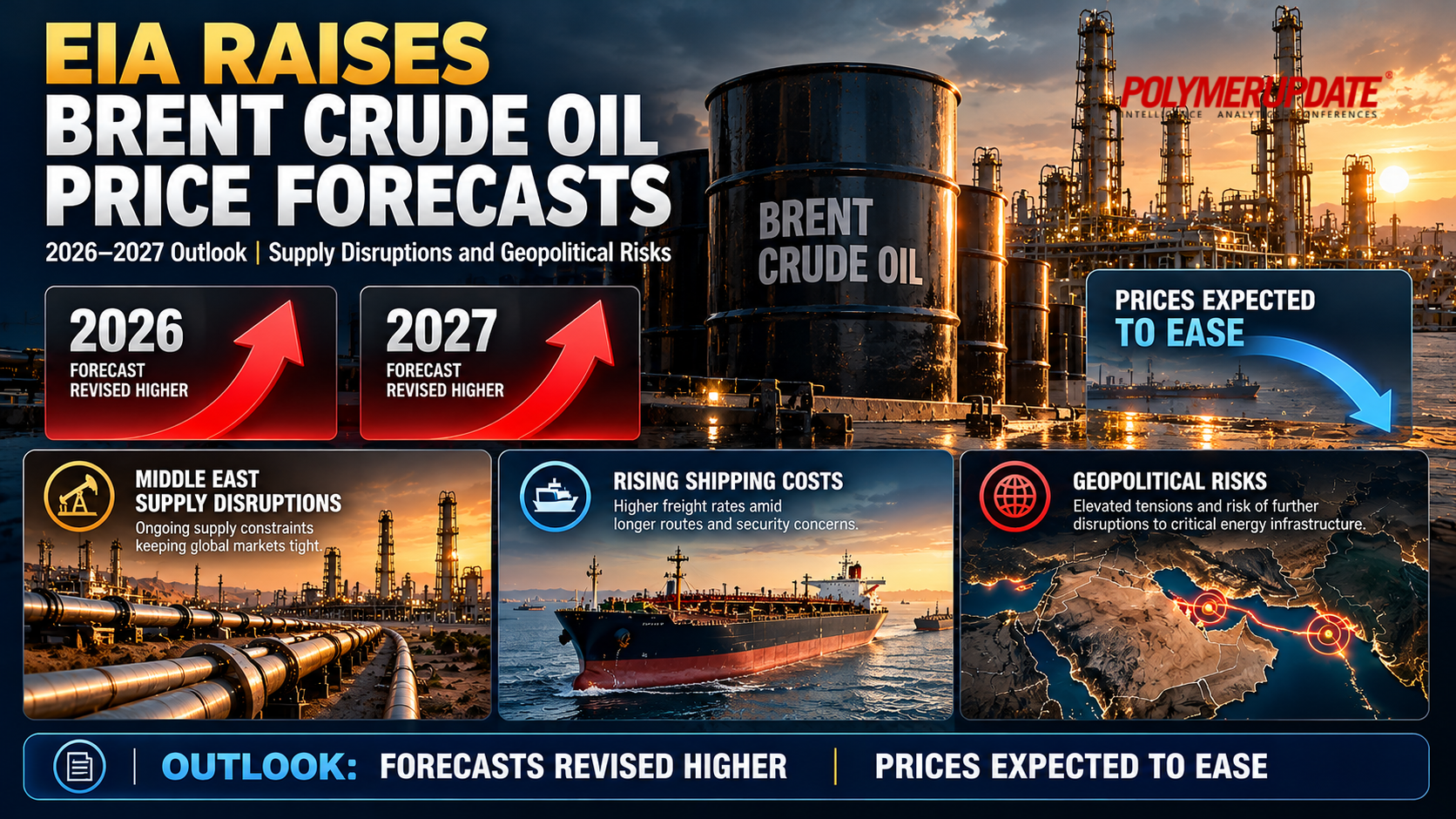
The US Energy Information Administration (EIA) has raised its crude oil price forecasts for 2026 and 2027 for the third consecutive month, citing persistent supply disruptions in the Middle East, elevated shipping costs and the risk of further attacks on critical energy infrastructure. In its latest Short-Term Energy Outlook (STEO), released on October 6, the EIA projected the Brent crude oil spot price to average US$ 96.32 a barrel in 2026 and US$ 83.74 a barrel in 2027.
The projections are higher than its September estimates of US$ 91.01 a barrel and US$ 73.74 a barrel, respectively, reflecting the sustained impact of geopolitical tensions on global oil markets. The latest revisions follow successive increases in the agency's annual price forecasts in July, August and September, highlighting the growing influence of supply-side risks on its outlook. While the EIA expects prices to ease as disrupted production gradually recovers and alternative export routes become more effective, it cautioned that continuing uncertainty over Middle East oil flows could trigger greater short-term volatility than its projections indicate.
The agency has raised its fourth-quarter 2026 Brent price forecast to US$ 105 a barrel, US$ 14 higher than its September estimate. The increase reflects expectations that crude oil flows from the Middle East will remain constrained through December, with production shut-ins averaging 4.5 million barrels per day (bpd) during the quarter. The revised outlook underscores the possibility that crude prices will remain elevated in the coming months, even as producers and shipping companies adapt to disruptions by rerouting supplies and using alternative transportation arrangements.
 Higher prices
Brent crude oil prices averaged US$ 114 a barrel in September, an increase of US$ 23 a barrel from August, following intensified attacks on oil infrastructure and tankers across the Middle East, according to the EIA. A major development was the attack on Saudi Arabia's East-West oil pipeline, a critical export route that enables the kingdom to transport crude to the Red Sea port of Yanbu, bypassing the Strait of Hormuz.
Before the attacks, the pipeline was carrying more than 5 million bpd of oil exports through Yanbu, according to the agency. The temporary disruption reduced the availability of Saudi crude supplies and prompted buyers to secure alternative barrels, pushing the daily Brent spot price to US$ 131 a barrel on September 15. Prices subsequently eased during the final week of September after repairs enabled the pipeline to partially resume operations from September 22.
Some of the reduction in Red Sea exports was offset by a shift in shipments back through the Strait of Hormuz. Ship-tracking data from Vortexa also indicated a slight increase in oil movements through the strait during September, with Saudi Arabia making greater use of ship-to-ship transfers along Oman's coast. Despite the attacks, Middle East oil exports increased in September compared with August, while production shut-ins declined.
The EIA estimated that crude oil production shut-ins averaged 4.8 million bpd in September, down from 5.8 million bpd in August and substantially below the peak of 10.9 million bpd recorded in May. The improvement indicates that producers have found ways to maintain some exports despite security threats. However, the recovery remains uneven, and the continued vulnerability of infrastructure and shipping routes leaves the market exposed to sudden supply losses.
Shipping costsBeyond direct production losses, higher transportation costs and insurance premiums are adding to the delivered cost of crude oil for refiners. The EIA noted that tanker rates reached record levels in September as heightened security risks increased insurance costs. Ships are also taking longer routes to avoid conflict zones, reducing the effective availability of vessels and increasing the time and expense required to deliver crude to buyers.
These logistical constraints are reinforcing the geopolitical risk premium embedded in oil prices. Even when production and export volumes improve, higher freight costs and longer shipping times can prevent supplies from returning quickly to their normal commercial patterns. The pressure is compounded by declining global oil inventories. The EIA estimated that global oil stocks fell by an average of 1.9 million bpd in the third quarter of 2026 and expects a further decline of 0.7 million bpd on average in the fourth quarter.
Continued inventory withdrawals reduce the buffer available to absorb additional supply disruptions. Consequently, any fresh attack on energy infrastructure, interruption to shipping or deterioration in regional security could trigger a disproportionate price response. The agency expects prices to remain elevated until Middle East supply constraints ease and global inventories can begin to recover.
Prices may declineDespite raising its forecasts, the EIA expects crude oil prices to generally decline from their early October averages as alternative export arrangements gradually mitigate the effects of disrupted production. These arrangements include pipeline and overland bypass routes, ship-to-ship transfers and additional bypass pipeline capacity expected to become available in the United Arab Emirates in 2027. The EIA expects shut-in production volumes to decline gradually over the forecast period, with the majority of regional production returning to pre-conflict averages by the end of the second quarter of 2027.
On this basis, the agency forecasts Brent crude oil prices to average US$ 87 a barrel in the second quarter of 2027. As production recovers and depleted global inventories begin to build, prices are expected to decline further, reaching an average of US$ 74 a barrel in the fourth quarter of 2027. The projected decline suggests that the EIA views the current price surge primarily as a supply-driven shock rather than a permanent shift towards structurally higher crude oil prices.
However, the timing of the recovery remains uncertain. Alternative export routes can reduce dependence on the Strait of Hormuz, but they cannot necessarily replace all disrupted volumes or eliminate the risks associated with regional instability. The EIA warned that the conflict could continue to cause volatility in crude oil movements through both the Strait of Hormuz and alternative routes, potentially resulting in sharper short-term price movements than those reflected in its forecast.
Upside risks continueThe EIA's cautious outlook is broadly consistent with expectations that crude oil prices will remain elevated and volatile even as the market adjusts to disrupted trade routes. Standard Chartered Bank's energy research team expects crude prices to remain high, with risks skewed to the upside, while acknowledging that market participants are becoming increasingly effective at adapting to interruptions in trade. Emily Ashford, the bank's head of energy research, cautioned that recovering oil flows should not be interpreted as a return to normal market conditions. High logistics costs, tight refined-product markets and depleted strategic and commercial inventories continue to constrain the market.
The bank expects the geopolitical risk premium to fluctuate in response to developments on the ground, with prices particularly sensitive to evidence of actual supply losses rather than geopolitical headlines alone. Improving transportation arrangements or diplomatic progress could trigger sharp price corrections. However, rebuilding inventories and restoring normal trade economics are likely to take considerable time, keeping the medium-term price floor above pre-conflict levels, Ashford indicated.
Standard Chartered expects the ICE Brent nearby futures price to average US$ 92 a barrel in 2026 and US$ 89.50 a barrel in 2027. Its quarterly projections place Brent at US$ 101 a barrel in the fourth quarter of 2026, before easing to US$ 96 a barrel in the first quarter of 2027, US$ 91 a barrel in the second quarter, US$ 87 a barrel in the third quarter and US$ 84 a barrel in the final quarter. The bank's projections are lower than the EIA's fourth-quarter estimate but point to a similarly gradual easing in prices as supply conditions improve.
Geopolitical risksThe crude oil market's direction over the coming months will depend largely on the pace of recovery in Middle East production, the reliability of alternative export routes and the extent to which shipping costs and insurance premiums moderate. A sustained recovery in Saudi Arabia's East-West pipeline operations, greater use of alternative routes and progress towards de-escalation could reduce supply concerns and encourage prices to retreat. Conversely, renewed attacks on pipelines, tankers or other energy infrastructure, or prolonged restrictions on movements through the Strait of Hormuz, could tighten supplies again and push prices above current projections.
For now, the EIA's latest outlook points to a market facing competing forces: persistent near-term supply constraints and inventory depletion on one side, and the prospect of recovering production and improving export logistics on the other. Although the agency anticipates a gradual decline in Brent prices through 2027, the recovery is likely to remain vulnerable to geopolitical developments. The extent to which Middle East oil flows normalise will therefore be crucial in determining whether the recent price surge gives way to sustained easing or continues to generate episodes of renewed volatility.
DILIP KUMAR JHA
Editor
dilip.jha@polymerupdate.com