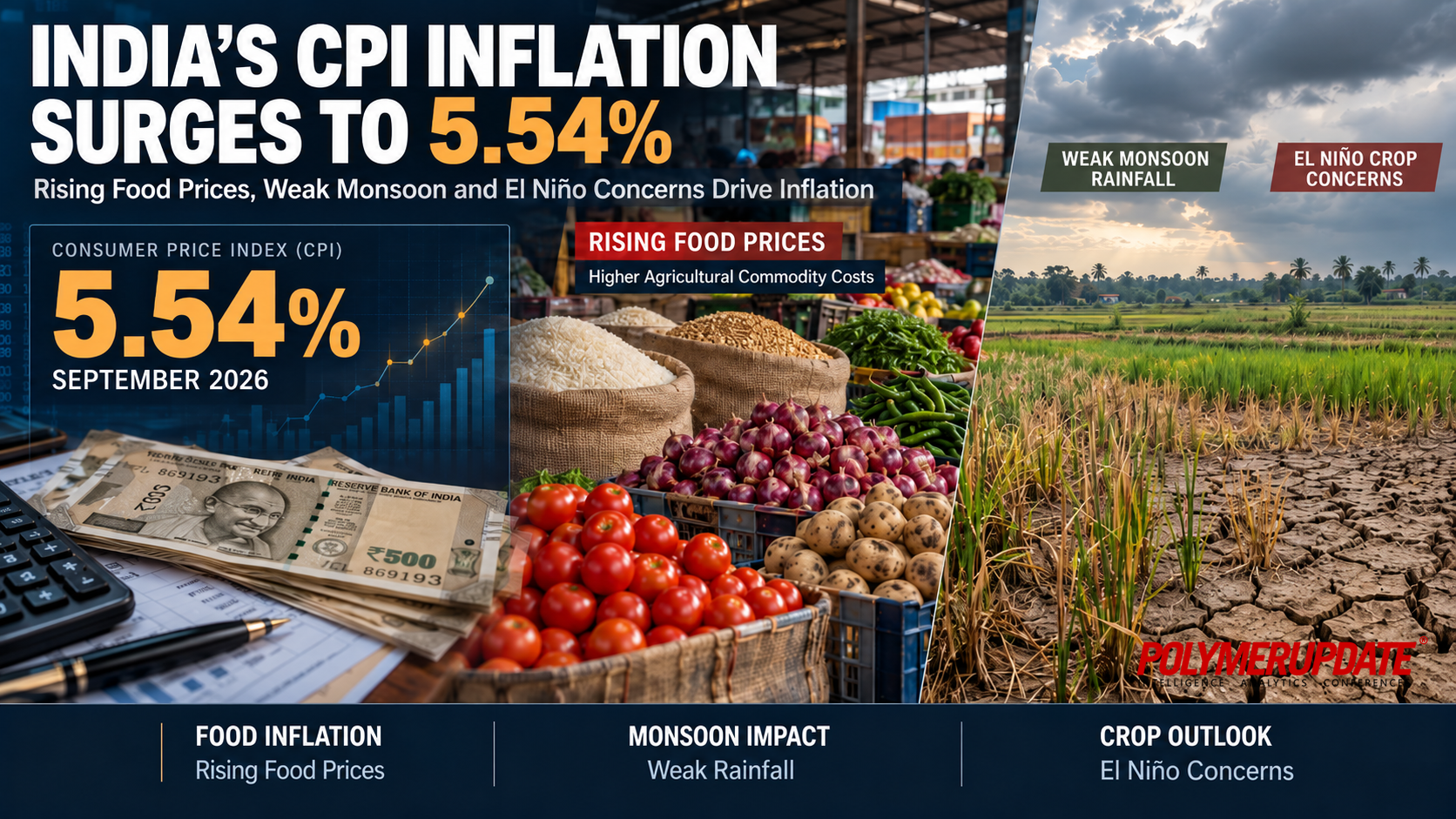
India’s retail inflation measured by the Consumer Price Index (CPI) surged to 5.54 percent year-on-year (yoy) in September, its highest level since the new series was launched in January this year, and also substantially higher than the Reserve Bank of India’s (RBI’s) tolerance band of 4 percent (+/- 2 percent), due to a substantial increase in food prices. The September inflation works out to substantially higher than 4.83 percent reported in August, but almost double than 2.74 percent posted in January this year, data compiled by the Ministry of Statistics & Programme Implementation (MoSPI) showed.
A statement from MoSPI reads, “Year-on-year inflation rate based on All India Consumer Price Index (CPI) with base year 2024 for the month of September 2026 over September 2025 is 5.54 percent (provisional). Corresponding inflation rates for rural and urban are 6.08 percent and 4.88 percent, respectively. Year-on-year inflation rate based on All India Consumer Food Price Index (CFPI) for the month of September 2026 over September 2025 stood at 7.74 percent (provisional). Corresponding inflation rates for rural and urban are 8.06 percent and 7.18 percent, respectively.”
Madan Sabnavis, Chief Economist, Bank of Baroda, stated, “Inflation for September is at 5.5 percent which stands lower than our projection of 5.7 percent. For the quarter inflation would be 4.9 percent which is same as what RBI has projected. The challenge will be the October-December 2026 quarter where inflation will peak at 6 percent. Therefore, our view still holds that December will warrant another rate hike. There are basically three categories that are driving inflation. The first is the food basket with 7.7 percent and the other two are more institutional and external.”
 Food inflation peaks
India’s retail food inflation surged to a peak of 7.74 per cent in September 2026, up sharply from 5.97 per cent in the previous month, marking the highest level in the new series. The acceleration in food prices was primarily attributed to expectations of lower output during the ensuing kharif harvesting season and concerns over rabi crop production amid deficient monsoon rainfall. Inadequate precipitation during the monsoon season has reduced soil moisture levels in several agricultural regions, potentially affecting the timely sowing and early growth of winter crops.
The India Meteorological Department (IMD) projected a below-normal southwest monsoon season for 2026, driven by the intensification of El Niño conditions in the equatorial Pacific Ocean. IMD in its pre-monsoon forecast projected on April 13, 2026, a 92 percent of Long Period Average (LPA) rainfalls this year with 5 percent errors either side with initial warning of below-normal rainfall due to expected El Nino development. In May, this forecast was revised to 90 percent of LPA as El Niño signals strengthened heading into summer and further to 87 percent on September 30, 2026, a staggering 13 percent below the normal monsoon season.
Lower agricultural output forecastsThe current June-September 2026 southwest rainfall season concluded as the fourth driest monsoon since 2001, recording 759 mm against a normal of 869 mm. Worryingly, strong/super El Niño is expected to persist and peak through late 2026, leading to drier and warmer conditions during the October-December 2026 season, cumulatively leading to lower agricultural output during the kharif and rabi seasons this year. For the 2026–27 crop year, India has set a total foodgrain production target of 373.93 million tonnes, which is lower than the actual output of 376.56 million tonnes recorded in 2025-26. This reduction reflects a conservative outlook driven by weather risks such as El Niño conditions and uneven monsoon distribution.
The sharp rise in food inflation is likely to intensify concerns over the near-term inflation outlook, as higher food prices could put additional pressure on household budgets and overall retail inflation. Expectations of lower kharif output, coupled with inadequate soil moisture for rabi sowing, have heightened the risk of supply-side constraints in the coming months. The extent to which food inflation persists will depend on actual crop arrivals, the progress of rabi sowing, and subsequent weather conditions. Any sustained increase in food prices could also complicate the Reserve Bank of India’s efforts to contain inflation while balancing economic growth considerations.
Devendra Pant, Chief Economist, India Ratings and Research said, “September 2026 CPI inflation surpassed 5 percent as expected, thereby maintaining its upward trajectory and remaining above RBI’s benchmark inflation rate of 4 percent. This resulted in July-September 2026 inflation at 4.9 percent, same as RBI’s forecast. Food inflation recorded a 21-month high growth of 7.74 percent yoy (August 2026: 5.97 percent; July 2026: 5.52 percent). Items of mass consumption like ginger, garlic and lemon recorded high double-digit growth, while onion recorded triple digit growth. Rise in food inflation was due to a combination of a) seasonal increase in food inflation during this period, b) adverse base effect (food inflation in September 2025 was (-)2.33 percent) and c) El Nino.”
Category-wise inflationThe restaurants group has inflation of 9.4 percent which is mainly due to the raising of prices due to higher energy costs. In case of personal care where inflation was 13.8 percent, it is mainly due to silver and gold where prices are determined externally. These three categories will continue to exert pressure.
In case of vehicles used for transport of both owners and goods, inflation is high at 7.5 percent and 14.7 percent due to the hike in petrol and diesel prices. The effect of higher gas price is also seen in the furniture and furnishing category of glass which witnessed higher inflation of 6 percent. These prices will not go lower and hence the inflation rates will remain higher for longer.
The heartening part is low inflation in other categories like health, housing etc, information and communication, recreation and education. Rural inflation tended to be higher given the higher weight to food items at 6.1 percent. The southern states of AP, Karnataka, TN and Maharashtra and Odisha had higher food inflation relative to others.
Adverse fuel impactFuel impact was evident on user groups – transport prices increased 5 percent (August 2026: 4.6 percent; July 2026: 4.44 percent), while restaurant & accommodation services grew 9.36 percent (August 2026: 8.38 percent; July: 7.72 percent) underlining the impact of the ongoing West Asia conflict on commercial liquefied petroleum gas.
Overall, 11/12 sub-groups recorded an increase in inflation except personal care group, indicating generalization of inflation. The latter is classified as discretionary spending. While it remained slow, inflation in the other discretionary spending group of restaurants and accommodation grew 9.36 percent in September 2026 (August 2026: 8.38 percent, July 2026: 7.72 percent).
“We are yet to see the transmission of higher WPI in the CPI indices as costs have gone up. Industries like durables, FMCG, automobile have announced an increase in prices and should get reflected in the CPI over the next few months. The state of kharif crop is important too as food inflation will be largely driven by them. As of now higher inflation is mainly due to depletion of earlier stocks as we head to the new season. Crop arrivals are hence important,” Sabnavis added.
DILIP KUMAR JHA
Editor
dilip.jha@polymerupdate.com