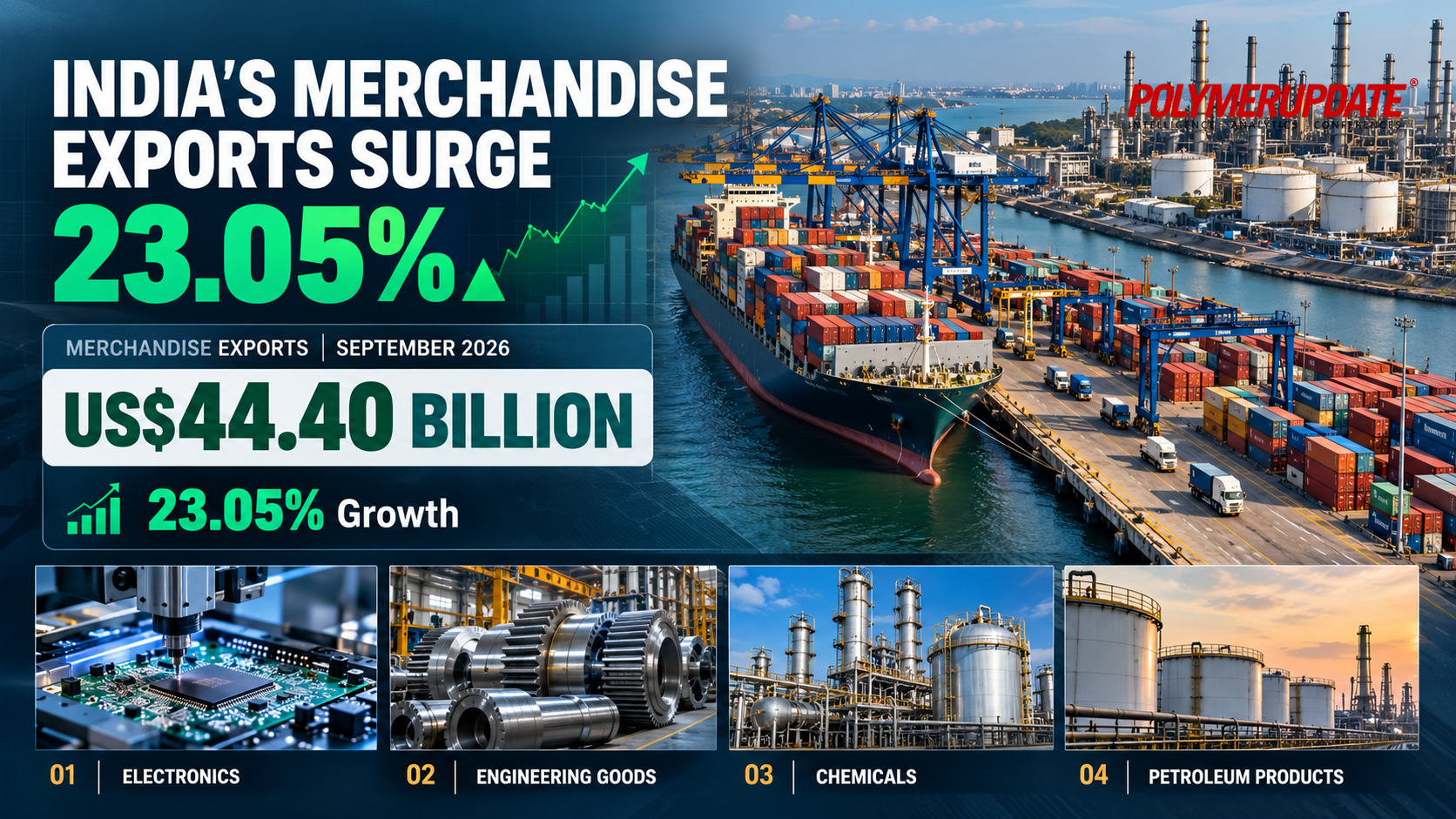
India’s merchandise exports rose 23.05 percent year-on-year to US$ 44.40 billion in September 2026, supported by strong growth in electronic goods, engineering products, petroleum products and chemicals, providing a boost to the country’s external trade performance amid global economic and geopolitical uncertainties. Merchandise exports stood at US$ 36.08 billion in September 2025. However, services exports marginally declined to US$ 36.35 billion in September 2026 versus US$ 36.67 billion in the similar month of the previous year.
However, imports continued to outpace exports in absolute value, keeping the merchandise trade deficit elevated. Merchandise imports rose 8.01 percent to US$ 74.61 billion in September from US$ 69.08 billion a year earlier. The merchandise trade deficit consequently narrowed to US$ 30.21 billion in September 2026 from US$ 33.00 billion in September 2025, as export growth outpaced import growth. Services imports valued US$ 19.44 billion in September 2026 reported an increase from US$ 17.84 billion in the comparable month of the previous year.
S C Ralhan, President, Federation of Indian Export Organisations (FIEO), said, “September’s strong export growth is an encouraging affirmation of India’s competitiveness in a challenging global trading environment. Our exporters continue to respond to uncertainty with agility, strengthening their presence across markets and product categories. The broad-based contribution of traditional and emerging sectors adds depth to this performance. The strength of the first-half performance lies in the diversity of its growth drivers. Technology-intensive exports are adding momentum alongside established sectors such as engineering, chemicals, and agriculture. Sustaining this balance, while expanding our market reach, will be crucial in the second half of the financial year.
 Cumulative exports
The latest growth also lifted cumulative merchandise exports during April-September 2026-27 to US$ 259.89 billion, an increase of 18.51 percent from US$ 219.30 billion in the corresponding period of the previous financial year, according to data released by the Ministry of Commerce and Industry. Higher shipments of electronic goods, engineering goods, petroleum products, chemicals, and agricultural products supported this expansion.
The performance of the export sector contributed to an increase in India’s combined merchandise and services exports. Total exports during September are estimated at US$ 80.75 billion, registering growth of 10.99 percent from the year-earlier period. Cumulative exports during the first six months of 2026-27 reached an estimated US$ 476.20 billion, up 13.84 percent from US$ 418.31 billion a year earlier.
Electronics and engineering goodsElectronic goods emerged as the strongest-performing major export category in September, with shipments surging 70.44 percent to US$ 5.31 billion from US$ 3.11 billion a year earlier. The sharp increase highlights the growing contribution of electronics manufacturing to India’s export basket. Petroleum products exports increased 31.90 percent to US$ 6.22 billion from US$ 4.71 billion, while exports of organic and inorganic chemicals rose 24.21 percent to US$ 2.94 billion from US$ 2.37 billion.
Engineering goods, one of India’s key manufacturing export categories, recorded growth of 20.91 percent, with shipments increasing to US$ 12.17 billion from US$ 10.06 billion. Exports of cotton yarn, fabrics, made-ups and handloom products also performed well, rising 20.76 percent to US$ 1.12 billion from US$ 930 million. The performance of these sectors indicates that export growth was supported by a combination of technology-intensive manufacturing, industrial products, petroleum-based shipments and traditional textile-related goods.
The strong expansion in electronic goods is particularly significant as India seeks to increase domestic manufacturing capacity, attract investment into electronics production and strengthen its position in international supply chains. Engineering goods continue to benefit from the country’s established industrial base, while chemicals and petroleum products remain important contributors to merchandise export earnings.
Non-petroleum exports maintain momentumThe export performance remained encouraging even after excluding petroleum products. Non-petroleum exports during April-September 2026-27 reached US$ 218.70 billion, an increase of 15.56 percent from US$ 189.26 billion in the corresponding period of the previous year. Non-petroleum and non-gems and jewellery exports rose to US$ 203.41 billion during the first half of the financial year from US$ 175.06 billion a year earlier. In September alone, exports under this category increased to US$ 34.81 billion from US$ 28.53 billion.
The growth in these categories suggests that the expansion in India’s export earnings was not driven exclusively by petroleum shipments. A wider range of manufactured and other non-petroleum products contributed to the increase, providing some diversification in the country’s export performance. Sustained growth in these segments will be important for improving the resilience of merchandise exports against fluctuations in international crude oil prices and changes in demand for individual commodities.
Rising imports keep trade gap elevatedDespite the strong export performance, India’s merchandise imports continued to rise. Cumulative imports during April-September 2026-27 increased to US$ 437.53 billion from US$ 376.17 billion in the corresponding period of 2025-26, representing growth of 16.31 percent. Consequently, the merchandise trade deficit widened to US$ 177.64 billion from US$ 156.88 billion a year earlier.
Imports excluding petroleum and gems and jewellery, including gold, silver and precious metals, increased to US$ 292.88 billion during April-September from US$ 244.67 billion in the year-earlier period. In September, imports under this category rose to US$ 51.64 billion from US$ 42.33 billion. The rise in imports indicates that export growth alone has not been sufficient to prevent a widening of the cumulative merchandise trade deficit. The increase in the value of imported goods could reflect a combination of domestic demand, industrial requirements and changes in international commodity prices, although the aggregate figures alone do not establish the contribution of each factor.
Ralhan added, “The combined merchandise and services trade deficit in September narrowed to US$ 13.30 billion, against US$ 14.17 billion a year earlier, even as combined imports increased to US$ 94.05 billion from US$ 86.93 billion. The improvement as a positive development as stronger exports were helping contain the overall trade gap despite rising imports.”
For an import-dependent economy such as India, the composition of imports remains important in assessing the implications for the external balance. Imports of energy, industrial inputs and capital goods have different economic implications from those of finished consumer products, making a detailed breakdown necessary to assess the broader impact.
Combined exports cross US$ 476 billionIndia’s combined merchandise and services exports are estimated to have reached US$ 476.20 billion during April-September 2026-27, compared with US$ 418.31 billion in the corresponding period of the previous year, registering growth of 13.84 percent. Combined imports during the first half rose 15.68 percent to US$ 551.13 billion. The difference between the estimated combined exports and imports indicates a trade gap of US$ 74.93 billion for the period.
In September, combined imports were estimated at US$ 94.05 billion, up 8.19 percent from US$ 86.93 billion a year earlier. With combined exports rising 10.99 percent to US$ 80.75 billion, the overall monthly trade deficit narrowed to US$ 13.30 billion from approximately US$ 14.17 billion in September 2025. The improvement in the monthly combined trade balance offers a positive signal, although the first-half figures show that imports continued to grow faster than exports in aggregate terms.
Services exports remain an important component of India’s overall external trade performance, supplementing merchandise shipments and helping broaden the country’s sources of export earnings. However, the figures for combined trade are estimates, particularly for services, and may be revised as more complete data become available.
Sustaining export growth remains the priorityThe September figures provide evidence of strong export momentum during the first half of the current financial year. The expansion in electronics, engineering goods, chemicals, petroleum products and textiles demonstrates the contribution of multiple sectors to the increase in merchandise shipments. At the same time, the widening cumulative merchandise trade deficit highlights the need to sustain export growth while managing the expansion in imports. Improving manufacturing competitiveness, diversifying export destinations, increasing the domestic value addition in exported products and strengthening logistics infrastructure will remain important for maintaining momentum.
The outlook will also depend on external conditions, including global demand, geopolitical developments, shipping costs, trade policies and movements in commodity prices. Uncertainty in international markets can affect both the competitiveness of Indian products and the cost of imported inputs. For the remainder of 2026-27, the challenge will be to translate the strong first-half performance into sustained export orders while reducing vulnerabilities arising from the widening merchandise trade gap. Continued expansion in higher-value manufactured products and services could help strengthen India’s position in global trade and support its longer-term export ambitions.
DILIP KUMAR JHA
Editor
dilip.jha@polymerupdate.com