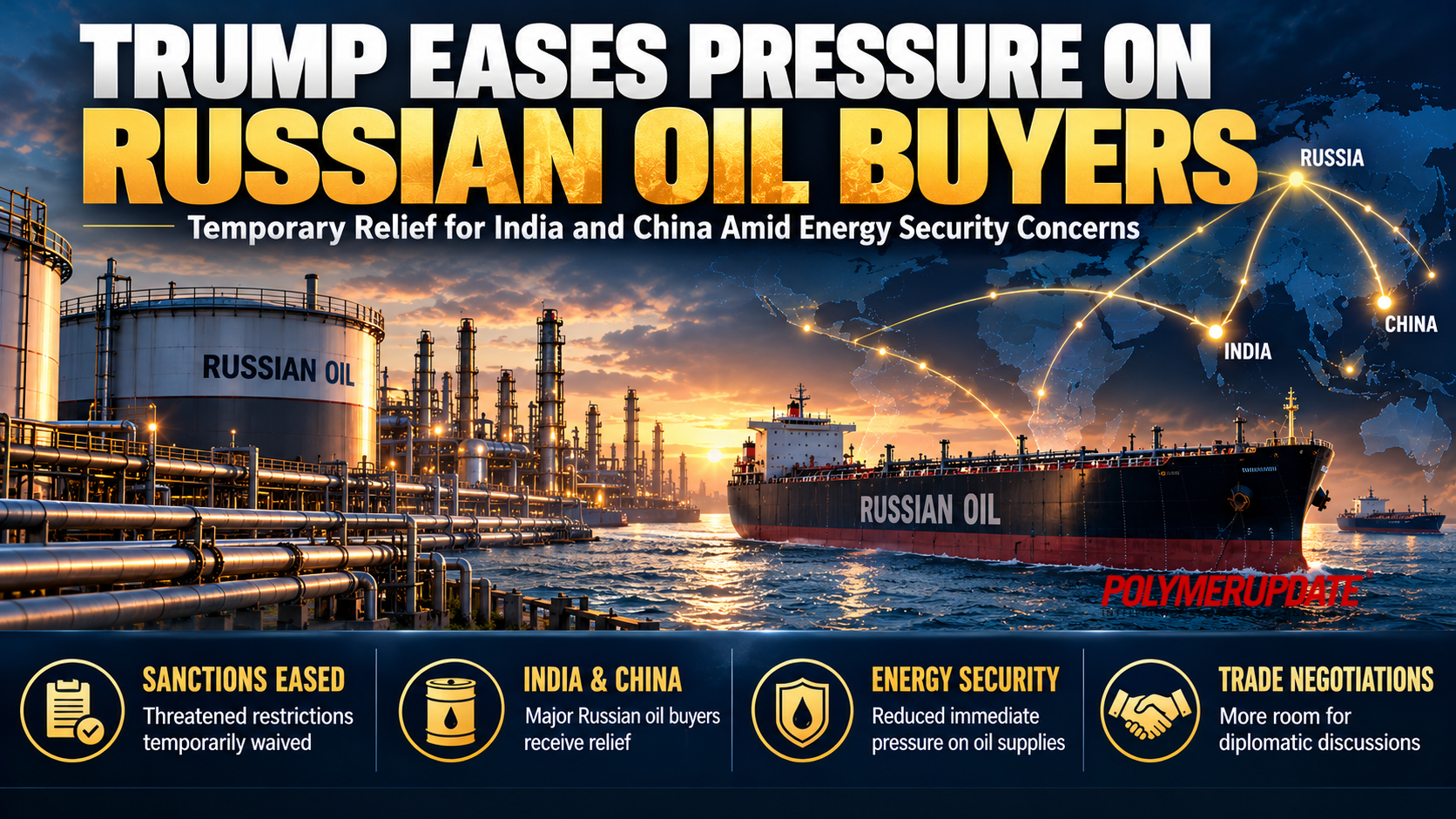
US President Donald Trump’s decision to waive the implementation of sanctions, restrictions and tariffs targeting purchases of Russian oil and gas has offered significant relief to India and China. The decision eased the immediate threat of punitive trade measures that could have disrupted energy supplies and complicated bilateral trade negotiations. The waiver temporarily removes the immediate threat of tariffs of up to 100 percent on goods imported into the US from major buyers of Russian oil and gas, including India and China. However, it does not necessarily represent a permanent reversal of Washington’s sanctions policy, as the administration retains the option of applying the measures at a later stage.
In an executive order issued late Friday, Trump said he was waiving the application of sanctions, restrictions and duties provided for under the Lindsey O. Graham Sanctioning Russia and Iran Act of 2026, citing the national interest of the United States. The decision came just days before the legislation’s provisions were due to take effect, with the 30-day deadline set to expire on October 18. The decision is particularly significant for India, which remains heavily dependent on imported crude oil and has relied on Russian supplies to diversify its energy sources amid continuing disruptions in the Middle East.
Trump’s Order dated October 16 reads, “Graham Act provides for the imposition of certain sanctions with respect to foreign persons, restrictions with respect to persons, and duties with respect to goods imported into the United States from the Russian Federation and certain other countries. It also authorizes the President to waive the application of any sanctions provision in the national interests, subject to the submission to the Congress. I am hereby waiving the application of such sanctions, restrictions, and duties provided for in the Graham Act.”
 Rationale behind Trump’s move
The Trump administration’s decision to ease restrictions on Russian oil and gas may also reflect growing domestic pressure from elevated fuel prices and concerns over energy availability ahead of the November 3 mid-term elections. The all-time high for U.S. diesel prices reached US$ 6.51-6.53 a gallon on September 21, 2026, driven by global supply crunches and geopolitical conflicts, and is currently hovering at around US$ 6.34 a gallon.
With diesel prices reportedly climbing to historic highs amid disruptions to global energy supplies, allowing additional Russian barrels to reach international markets could help ease supply tightness and moderate upward pressure on crude and refined-product prices. Diesel is particularly important to the US economy because it powers freight transportation, agriculture, construction and industrial activity, making sustained price increases a potential source of broader inflationary pressure.
The pressure has been compounded by the drawdown of the US Strategic Petroleum Reserve (SPR), which has reduced the government's emergency buffer to cushion supply disruptions. With the November 3 mid-term elections approaching, high fuel costs have become an economic and political concern for the administration, particularly because diesel prices affect farmers, truckers and businesses across the supply chain. Easing sanctions on Russian diesel and allowing additional supplies into global markets could therefore help contain price pressures, although analysts have cautioned that the volumes involved may be insufficient to produce a sustained decline in prices. The timing suggests that domestic energy affordability has become an important consideration in Washington's decision-making, alongside its broader geopolitical objectives.
Trump’s Russian diesel import pactThe move comes as Washington seeks to ease fuel costs ahead of the November 3 US midterm elections, although the extent of its impact on domestic diesel prices remains uncertain. US President Donald Trump announced the agreement following a telephone conversation with Russian President Vladimir Putin, saying Russia would immediately supply more than 300,000 tonnes of diesel to the US and global markets, followed by another 500,000 tonnes in November and 1 million tonnes thereafter.
Russia has indicated that its diesel exports could exceed the volumes outlined in Trump’s announcement. Russian Deputy Prime Minister Alexander Novak said Moscow could raise diesel exports to around 3 million to 3.5 million tonnes per month by the end of 2026, potentially restoring shipments to pre-crisis levels. Following the agreement, the US Treasury Department issued a temporary licence allowing certain Russian diesel shipments to enter the global market without facing US sanctions until April 2027. It was important for the United States to lift sanctions ahead of raising imports.
Sanctions threat lifted, for nowThe legislation, signed by Trump in September, was designed to restrict the financial resources available to Moscow to sustain its war against Ukraine. It authorised the US administration to impose broad sanctions on Russian officials, banks and energy interests, while also providing for punitive tariffs against countries continuing to purchase Russian oil and gas. The proposed measures included tariffs of up to 100 percent on goods entering the US from the five largest importers of Russian crude oil or gas. Countries knowingly purchasing Russian oil or gas after the stipulated period, as well as those identified among the leading facilitators of sanctions evasion, could also face restrictions.
India and China were among the countries most exposed to the potential consequences. Slovakia, Hungary and Azerbaijan were also identified among the major buyers of Russian crude. In his executive order, Trump said he had submitted a certification to Congress stating that granting the waiver at this stage was in the national interest of the United States. The immediate suspension gives major importing countries additional room to maintain energy procurement arrangements without facing the threatened new tariffs on their exports to the American market.
Implications for India’s energy securityRussia has emerged as India's largest crude oil supplier since Moscow launched its war against Ukraine in February 2022. European restrictions and the withdrawal of several Western buyers from Russian energy markets prompted Moscow to offer crude at attractive discounts, encouraging Indian refiners to increase purchases. The availability of competitively priced Russian oil helped Indian refiners diversify their procurement and manage import costs. The supplies have become particularly important as tensions in the Middle East have disrupted traditional energy flows and increased uncertainty over shipments through the Strait of Hormuz.
The strategic importance of Russian crude has grown because India imports the bulk of its oil requirements. Any significant reduction in Russian supplies could force refiners to compete for alternative cargoes from the Middle East, Africa and the Americas, potentially increasing procurement costs. The situation is complicated by disruptions to crude oil, liquefied petroleum gas (LPG) and liquefied natural gas (LNG) shipments through the Strait of Hormuz, a critical route for global energy trade. With the availability of some Middle Eastern supplies constrained, India has been seeking to diversify its sources of energy more aggressively.
India’s trade negotiations with WashingtonThe waiver also removes an immediate source of uncertainty for India-US trade negotiations, which have been complicated by disagreements over New Delhi's purchases of Russian oil. Last year, the Trump administration imposed an additional 25 percent tariff on Indian imports in response to India's continued purchases of Russian crude, on top of a 25 percent reciprocal tariff. These additional duties were removed in February 2026, when Washington reduced the reciprocal tariff to 18 percent under a bilateral trade framework.
Trump had subsequently claimed that India would stop buying Russian oil. However, the Indian government did not make any such commitment publicly, maintaining instead that its energy procurement decisions would be guided by national interests and market conditions. Before the impact of the February tariff changes on Russian crude purchases could be fully assessed, the conflict in the Middle East intensified, increasing the importance of alternative supply sources.
The latest waiver could help improve the atmosphere surrounding trade negotiations by removing the immediate threat of another round of punitive tariffs. India's Commerce Minister Piyush Goyal has recently indicated that a draft trade agreement is almost ready, raising expectations of progress towards a broader bilateral understanding.
Energy diversification remains criticalThe waiver provides immediate relief but does not eliminate India's exposure to geopolitical developments. Continued disruptions in the Middle East, competition from China and the possibility of renewed US restrictions remain significant risks for the country's energy sector. India will therefore need to balance Russian crude purchases against supplies from other producers, while evaluating prices, shipping availability and the reliability of delivery routes. Diversification across suppliers and transport corridors remains essential to reducing the impact of disruptions in any single region.
For refiners, the central consideration will be the availability of crude at competitive landed prices rather than the nationality of the supplier alone. For policymakers, the priority will be to safeguard energy security without allowing external trade measures to undermine India's export competitiveness. Trump's latest decision has removed an immediate threat that could have affected both India's oil procurement and its exports to the US. But with the waiver potentially reversible and Russian crude supplies subject to intensifying competition, the relief may prove temporary.
OutlookIt will be interesting to see whether the US administration maintains the suspension, whether India-US trade negotiations advance and whether Russian exports can meet the competing requirements of Indian and Chinese refiners. Until greater clarity emerges, India is likely to continue pursuing a pragmatic approach that combines diversified energy sourcing with efforts to protect its wider trade and economic interests.
DILIP KUMAR JHA
Editor
dilip.jha@polymerupdate.com