Click the icon to add a specified price to your Dashboard list. This makes it easy to keep track on the prices that matter most to you.

| China’s mechanism for non-dollar fuel imports | ||
| Mechanism | Description | Key suppliers |
| Yuan-Denominated Settlements | Direct payment in RMB rather than U.S. dollars to bypass Western financial networks and currency conversion costs | Russia, Angola, and select Gulf Cooperation Council (GCC) nations |
| Cross-Border Interbank Payment System (CIPS) | China's proprietary financial messaging and clearing network used as an alternative to SWIFT for settling commodity trades | Bilateral trade channels with Russia and participating Asian/Middle Eastern buyers |
| Digital Yuan (e-CNY) Settlements | Utilization of central bank digital currency for cross-border crude and fuel transactions | PetroChina International pilot transactions (e.g., purchasing 1 million barrels of crude) |
| Discounted Spot & Alternative Routing | Purchasing heavily discounted non-standard or sanctioned-origin crude/fuel using multi-currency arrangements | Iran, Malaysia, and Russia |
Sources: Reports
India’s increasing imports from Russia
India’s imports of Russian crude oil rose sharply after the Russia-Ukraine war began in February 2022, when Western sanctions and the withdrawal of European buyers forced Moscow to offer its oil at competitive discounts. Indian refiners, including state-owned and private companies, capitalised on the opportunity to reduce feedstock costs while meeting the country’s growing energy requirements. Russia’s share of India’s crude oil imports increased from less than 1 percent before the war to around 36 percent in the financial years 2023-24 and 2024-25, occasionally rising to more than 45 percent.
The trade was supported by established commercial relationships, alternative shipping arrangements, insurance and payment mechanisms, and the ability of Indian refineries to process Russian crude and sell refined petroleum products in domestic and overseas markets. India maintained that its purchases were guided by energy security, affordability and the need to protect consumers from higher fuel costs.
Despite pressure from US President Donald Trump, including an additional 25 percent tariff on Indian goods imposed in August 2025 over purchases of Russian oil, India’s imports rebounded in 2026 as disruptions to Middle Eastern supplies during the Iran war and restricted shipments through the Strait of Hormuz made alternative sources essential. Indian refiners initially reduced Russian purchases amid tariff concerns but subsequently increased procurement as Gulf supplies tightened and Russian crude again became competitively priced.
According to trade data, Russian oil accounted for 50.83 percent of India’s total crude oil imports in July 2026, equivalent to around 2.47 million barrels per day (bpd). Discounts of about US$2–5 a barrel, along with the settlement of some transactions in Indian currency, also helped attract buyers as refiners sought to secure supplies. The increase therefore reflected not only price advantages but also an urgent need to diversify supply routes during a geopolitical crisis. However, the prospect of further US sanctions and legislation authorising tariffs of up to 100 percent on major purchasers of Russian energy continues to create uncertainty for Indian refiners and New Delhi’s energy diplomacy.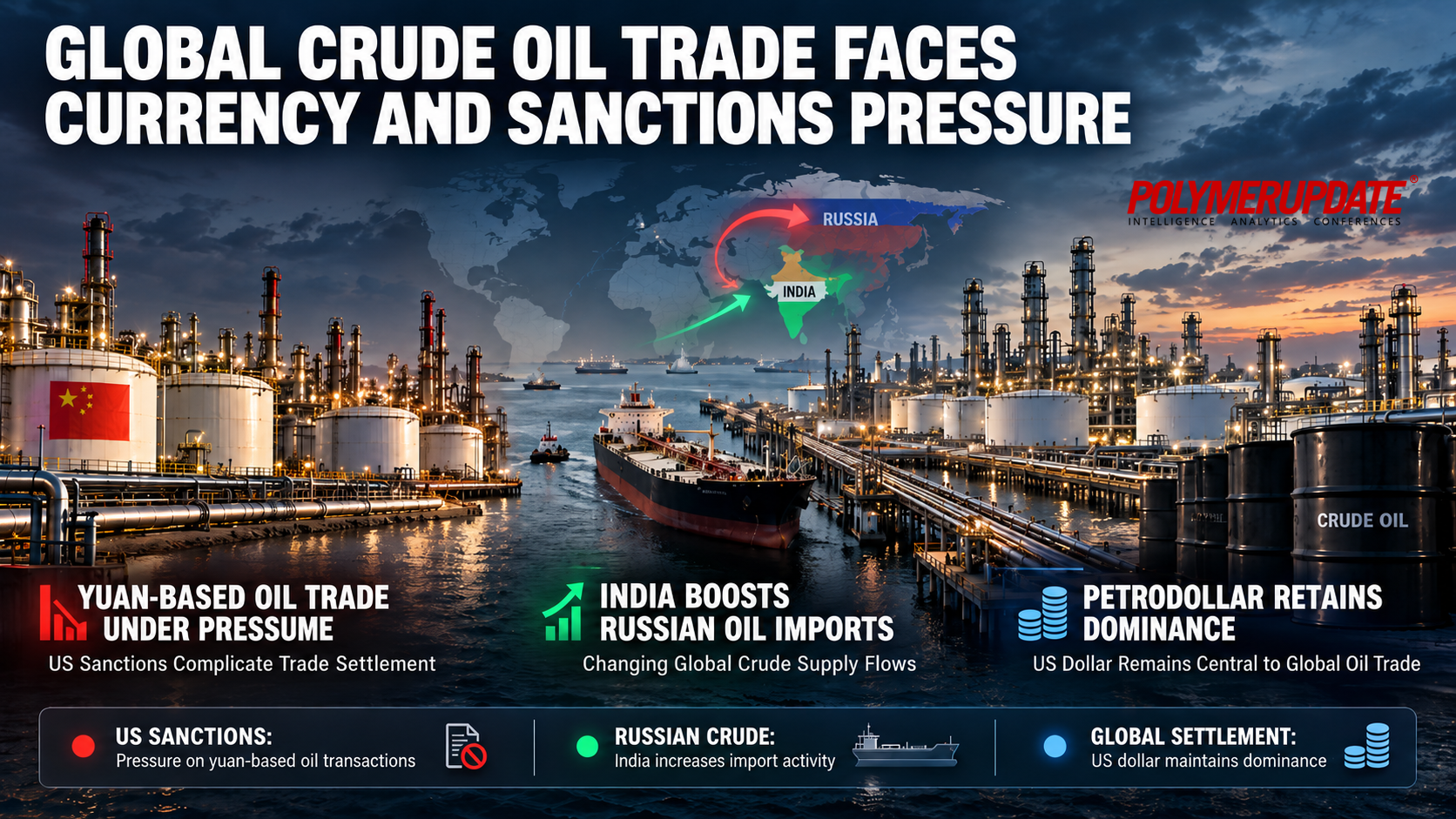
Oil diplomacy at BRICS Summit
Efforts by the BRICS grouping, comprising Brazil, Russia, India, China and South Africa, along with 16 other members, to expand trade settlements in national currencies gained greater importance following the 17th BRICS Summit in Rio de Janeiro, Brazil, in July 2025, and the 18th summit in New Delhi in September 2026. The New Delhi Declaration supported efforts to facilitate cross-border payments in local currencies and improve the interoperability of national payment systems. However, the initiative stopped short of establishing a common BRICS currency, reflecting differences among member countries in their economic priorities, financial systems and approaches to international trade.
For the energy and petrochemical industries, the implications extend beyond currency choice. The ability to secure competitively priced feedstock, maintain reliable shipping arrangements and access trade finance has become increasingly important as geopolitical developments alter traditional crude supply routes.
China’s alternative payment channels
Although the US dollar remains the dominant currency for global oil trade, China’s growing use of the yuan in commodity transactions with Russia and other partners is creating alternative payment channels and raising questions about the long-term structure of international energy commerce. US President Donald Trump’s trade and energy policies have therefore increased the risks associated with China’s purchases of crude oil from countries facing American sanctions. Washington has targeted Iranian and Venezuelan oil shipments, shipping networks and intermediaries, while tariff tensions have disrupted direct crude oil trade between the United States and China.
Notably, China halted direct imports of US crude oil amid escalating bilateral trade tensions in 2025. Chinese buyers subsequently relied more heavily on alternative suppliers, including Russia, Brazil and Middle Eastern producers, depending on price competitiveness and crude quality. The sanctions-related risks have been particularly significant for independent Chinese refiners, commonly known as teapots and concentrated in Shandong province. These processors have historically purchased discounted crude oil from Iran and Venezuela to improve feedstock economics. However, restrictions on shipping, insurance, financial services and intermediary trading have increased the cost and complexity of such transactions.
The distinction between sanctions on oil shipments and restrictions on currency settlement remains important. Using the yuan does not automatically make a transaction immune to US sanctions if the cargo, supplier, vessel or intermediary is subject to restrictions. Chinese companies must therefore assess both the commercial benefits of discounted crude oil and the potential consequences of sanctions enforcement. Despite these efforts, RMB-settled crude oil imports accounted for only a single-digit share of China’s overall energy imports.
China’s RMB-settled trades ease
US President Donald Trump sought to weaken China’s renminbi (RMB)-settled crude oil trade primarily by tightening US sanctions on oil suppliers such as Iran and Venezuela, targeting the intermediaries and independent Chinese refineries that handled these transactions, and threatening tariffs against countries purchasing Venezuelan oil. The strategy aimed to disrupt the supply chains and financial channels that allowed China to buy discounted crude oil outside conventional dollar-based trading networks. In April 2026, the US Treasury Department warned financial institutions about the sanctions risks associated with Chinese independent ‘teapot’ refineries, which account for a major share of China’s Iranian crude oil imports.
Washington also targeted entities involved in transporting and facilitating Iranian oil sales, increasing compliance risks for banks, traders, shipping companies and refiners. These measures placed additional pressure on China’s alternative oil-trading network, even though they did not amount to a blanket prohibition on all RMB-settled crude oil transactions. Trump’s approach also weakened the practical advantages of RMB settlement by threatening access to the US market and the dollar-based financial system while disrupting supplies from countries that had increasingly relied on non-dollar payments.
The US intervention in Venezuela and the redirection of its oil sales towards channels controlled by Washington reduced China’s access to some discounted Venezuelan crude oil, while sanctions enforcement raised the cost and complexity of sourcing Iranian oil. However, the strategy did not eliminate China’s RMB-based oil trade. Chinese buyers continued to use the yuan and other non-dollar currencies for certain transactions, particularly with Russia and Iran, while China maintained efforts to expand alternative payment infrastructure. The broader challenge for Beijing remains that using the yuan can reduce direct exposure to dollar settlement, but it cannot, by itself, shield buyers, shipping operators or financial intermediaries from US sanctions, nor does it remove the dollar’s dominant role in global commodity pricing and international finance.
Petrodollar retains its structural advantage
Despite the growth of yuan-denominated transactions, the US dollar continues to dominate international oil pricing, trade finance and hedging. Dollar-denominated benchmarks remain central to crude oil contracts, while major producers and financial institutions continue to operate within established dollar-based markets. China has sought to strengthen the yuan’s international role through domestic commodity exchanges, including Shanghai crude oil futures, and the development of alternative payment infrastructure. These mechanisms can provide additional settlement options and help trading partners manage currency exposure.
Nevertheless, restrictions on capital movements and the yuan’s limited convertibility constrain its wider international adoption. Major Middle Eastern oil exporters also have established commercial and financial relationships closely tied to the dollar, reinforcing its position in global energy transactions. Consequently, the expansion of yuan settlement is more likely to proceed through selected bilateral arrangements than through an immediate replacement of the dollar. BRICS members have diverse economic interests, and their support for local-currency payments does not necessarily imply agreement on a common currency or a coordinated withdrawal from dollar-based trade.
Falling China’s inventories
Currency diversification is unfolding alongside pressure on China’s crude oil inventories following prolonged disruptions to Middle Eastern supplies. Analytics firm Vortexa estimated that China’s crude oil inventories had declined by approximately 147 million barrels since the Middle East conflict began, leaving stocks at around 1.09 billion barrels. Kayrros LNG Intelligence separately estimated inventories at 1.18 billion barrels as of October 11, 2026, the lowest level in 16 months, according to the firm’s assessment. Chinese President Xi Jinping’s recent visit to Washington and subsequent meeting with US President Donald Trump reportedly did not yield a favourable result.
Although national inventories remain substantial, independent refiners face tighter supply conditions than the aggregate figures may suggest. Delays in incoming cargoes and uncertainty surrounding shipping through the Strait of Hormuz have increased the importance of securing alternative feedstock.
DILIP KUMAR JHA
Editor
dilip.jha@polymerupdate.com