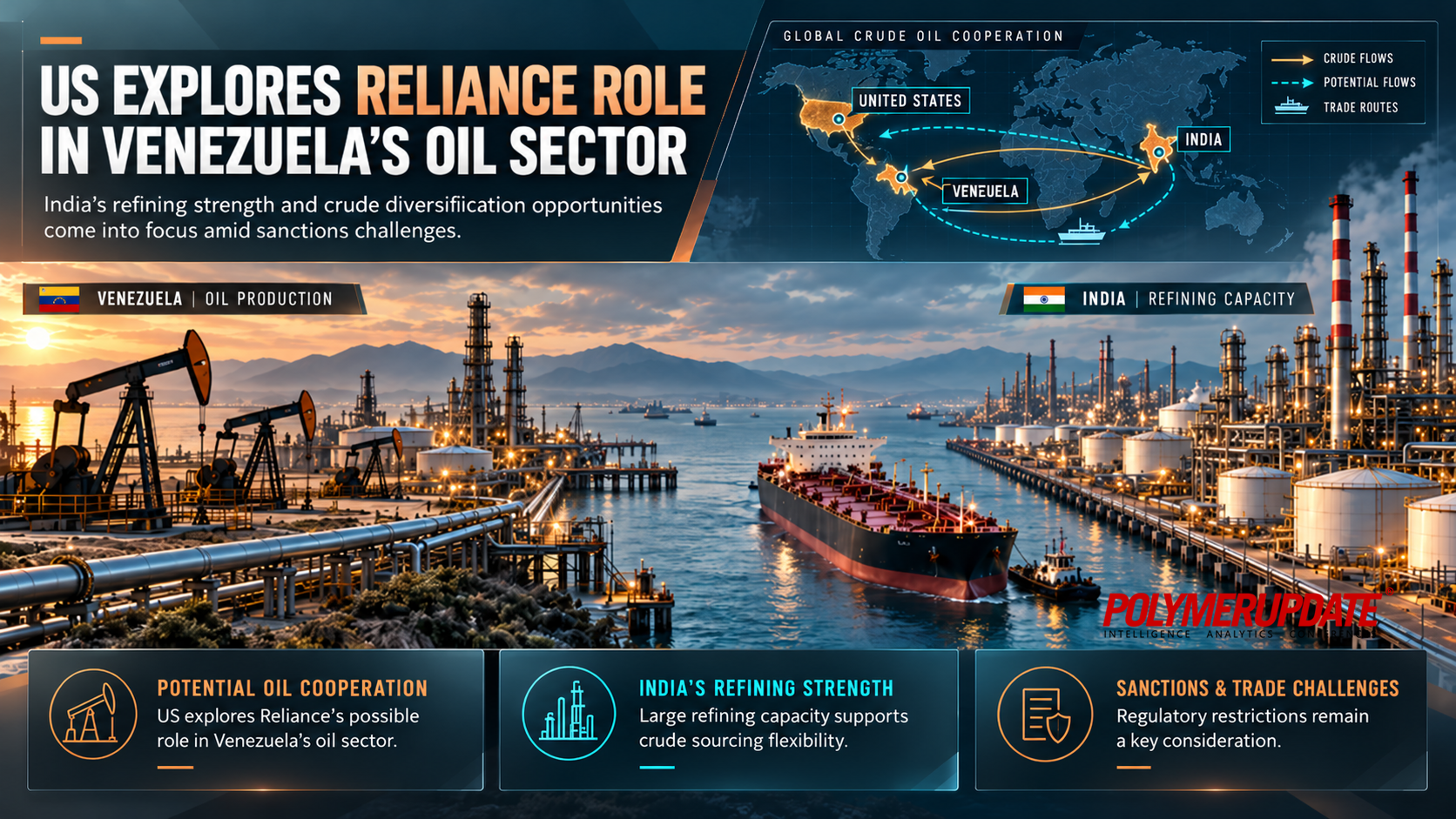
US Secretary of State Marco Rubio has identified Reliance Industries as a potential partner in efforts to increase Venezuela’s oil production, describing India as a “refining superpower” with the technological capabilities to process the South American country’s heavy crude. The proposal highlights India’s growing importance in global energy markets and Washington’s interest in leveraging Indian refining expertise to bring additional Venezuelan oil supplies to the international market.
Speaking to reporters in Mumbai on Tuesday after arriving for a three-day visit to India, Rubio said US officials would discuss opportunities for Indian companies to participate in Venezuela’s oil sector. He noted that Indian refiners had previously processed Venezuelan heavy crude and possessed the infrastructure required to handle additional supplies as production increased. “India is a refining superpower. They have the capability to refine heavy crude. They’ve done so in the past, and I think as more and more Venezuelan oil comes online, it’s something they can do,” Rubio said.
He also pointed to Indian companies’ existing oil concessions in Venezuela, suggesting that these assets could be used to increase production. “They also, by the way, have pre-existing oil concessions in Venezuela that can produce more themselves,” he said, describing the prospects as positive. Reliance Industries, which operates the world’s largest single-site refining complex at Jamnagar in Gujarat, is central to the potential cooperation because of its ability to process a wide range of crude grades, including heavier and more complex feedstocks. Rubio is scheduled to visit the Jamnagar refinery on Wednesday.
 Sanctions remain a key hurdle
Rubio acknowledged that additional Venezuelan production alone would not be sufficient to offset potential disruptions to global oil supplies, although it could provide some relief in the short term and make a larger contribution over time. Washington has previously discussed the proposal with New Delhi, and Rubio indicated that India was willing to explore opportunities. However, he cautioned that sanctions and other regulatory obstacles would need to be addressed before the plans could advance. He said the two countries would discuss the matter during his visit, adding that India appeared prepared to participate despite certain impediments that needed to be resolved.
The comments indicate that US-India energy cooperation could extend beyond crude procurement to include investment, production and refining. However, the commercial viability of any expansion would depend on the terms of existing concessions, the condition of Venezuelan oil infrastructure, the availability of investment and the regulatory framework governing international participation. Venezuela possesses some of the world’s largest proven crude oil reserves, much of which consists of heavy and extra-heavy grades. Such crude requires specialised processing and blending, making access to technically advanced refineries particularly important for expanding exports.
Indian refiners have historically processed Venezuelan crude, but the scale of future purchases and investment would depend on the applicable sanctions regime, payment arrangements, shipping availability and the economics of competing crude grades. For Reliance, access to additional Venezuelan supplies could provide another option for diversifying its crude basket. For Washington, Indian participation could help mobilise capital and refining expertise while supporting efforts to increase the availability of oil in international markets.
India diversifies crude procurementRubio also praised India’s efforts to diversify its oil purchases, describing the progress as “substantial” and calling diversification a “smart thing to do”. India, the world’s third-largest oil consumer, depends heavily on imported crude to meet its refinery requirements. Its growing demand and substantial refining capacity make the country an important participant in global crude trade, while diversification helps refiners manage price volatility, supply disruptions and geopolitical risks. The potential Venezuelan opportunity comes as energy security has gained importance amid geopolitical tensions and uncertainty surrounding major oil-producing regions and shipping routes. Expanding access to alternative suppliers could help Indian refiners retain operational flexibility and manage changes in crude availability.
Nevertheless, Venezuelan crude would need to compete with supplies from Russia, the Middle East, the United States and other producers. Refiners would assess delivered costs, crude quality, freight rates, payment conditions and the compatibility of each grade with their processing facilities before committing to sustained purchases. Any increase in Venezuelan output would also require investment to maintain and upgrade production facilities, improve operational reliability and strengthen export infrastructure. Consequently, additional supply would not necessarily translate into an immediate or substantial increase in global oil availability.
Refining capacity set to rise 20%India’s expanding refining industry provides a strong foundation for potential cooperation with Venezuela and other crude-producing countries. Union Minister for Petroleum and Natural Gas Hardeep Singh Puri said India’s crude oil refining capacity was expected to increase by around 20 percent over the next five years, supported by rising domestic energy consumption and growing export opportunities. Addressing the inaugural session of the Energy Technology Meet in Hyderabad, Puri said India’s energy development reflected progress driven by policy initiatives, technological innovation and sustained investment across refining, biofuels and green energy.
India currently has refining capacity of approximately 258 million metric tonnes per annum (MMTPA), which is expected to rise to around 310 MMTPA by 2030. The government’s longer-term ambition is to increase capacity to 400-450 MMTPA, although a specific timeline for reaching the upper end of that range has not been established. Public-sector and private-sector refiners have announced capacity expansion plans to meet the country’s growing fuel requirements and strengthen its position in international petroleum product markets. The expansion is particularly significant because global refining capacity is expected to undergo structural changes, with ageing and less competitive facilities facing the possibility of closure. India, by contrast, is investing in modern, large-scale complexes designed to serve both domestic and overseas customers.
India - a global refining hubIndia is already the world’s fourth-largest refining nation and among the leading exporters of petroleum products. Its refineries supply markets across more than 50 countries, with petroleum product exports valued at over $45 billion in the financial year 2024-25. The sector contributes nearly one-fifth of the country’s revenue, while public-sector and private-sector companies continue to invest in operational efficiency, technological improvements and capacity expansion. India is also expected to account for approximately 30-33 percent of global energy demand growth in the coming decades, according to the outlook cited in the industry assessment. This combination of rising domestic consumption and export potential is strengthening the economic case for additional refining capacity.
Domestic petroleum consumption has increased from approximately 5 million barrels per day in 2021 to around 5.6 million bpd currently and is expected to reach 6 million bpd in the near future. Economic expansion, urbanisation, industrial activity and rising per capita income are expected to underpin further growth in fuel demand. The industry assessment also indicates that around 20 percent of existing global refining capacity, representing more than 100 refineries, could face closure by 2035. If these projections materialise, India’s investments in modern facilities could help it capture a larger share of international refining and petroleum product trade.
Strategic opportunity for RelianceReliance’s Jamnagar complex offers a particularly important link between India’s refining expansion and the proposed Venezuelan oil initiative. Its scale and complex processing capabilities allow the company to handle a broad range of crude grades and manufacture a diverse portfolio of petroleum products. Potential cooperation could involve increased processing of Venezuelan crude, expanded utilisation of existing upstream interests or additional investment in production, subject to regulatory approvals and commercially viable arrangements. However, the opportunity should be viewed as a potential avenue for cooperation rather than a confirmed agreement. Rubio’s remarks establish Washington’s interest in engaging Indian companies, but the outcome will depend on the discussions, the applicable sanctions framework and the willingness of businesses to commit capital.
For India, the initiative could reinforce its position as a major refining centre and provide access to a wider range of crude supplies. For Venezuela, participation by experienced international companies could help unlock production potential, provided financing, infrastructure and regulatory challenges are resolved. Ultimately, the proposed engagement underscores India’s growing role in the global energy system. Its expanding refining capacity, established export network and ability to process complex crude grades make it an attractive partner for producers seeking additional markets and investment. Whether the Venezuelan initiative translates into higher output and sustained commercial flows will depend on how effectively the two countries address the regulatory and operational barriers standing in the way.
DILIP KUMAR JHA
Editor
dilip.jha@polymerupdate.com