The Indian chemical industry needs to focus on research and development (R&D) to produce quality materials without compromising the safety of its workers, neighbourhoods and the environment, said J P Nadda, Union Minister of Chemicals and Fertilizers and Health and Family Welfare, in Mumbai on Thursday. He emphasised that chemical production must be handled holistically, with a focus on safety and the proper management of hazardous aspects to enhance handlers’ awareness and sensitivity.
Nadda inaugurated the 14th edition of India Chem 2026 in Mumbai, bringing together policymakers, global industry leaders, investors and technology providers to explore investment and business opportunities in India's chemicals and petrochemicals sector. The three-day biennial exhibition and conference, being held from October 22 to 24 at the Bombay Exhibition Centre, NESCO, is organised by the Department of Chemicals and Petrochemicals, Ministry of Chemicals and Fertilizers, in partnership with the Federation of Indian Chambers of Commerce and Industry (FICCI).
Union Minister of State for Chemicals and Fertilizers and Health and Family Welfare Anupriya Patel, along with the chief ministers of Maharashtra, Madhya Pradesh and Odisha, senior Central and state government officials and industry representatives, attended the inaugural event. Being held under the theme “Advantage Bharat: An Emerging Global Chemicals Hub”, India Chem 2026 seeks to showcase India's industrial capabilities, technological advancements and investment potential while strengthening its position as a global manufacturing and sourcing destination. Japan is participating as a partner country, underscoring the importance of bilateral economic cooperation and industrial collaboration.
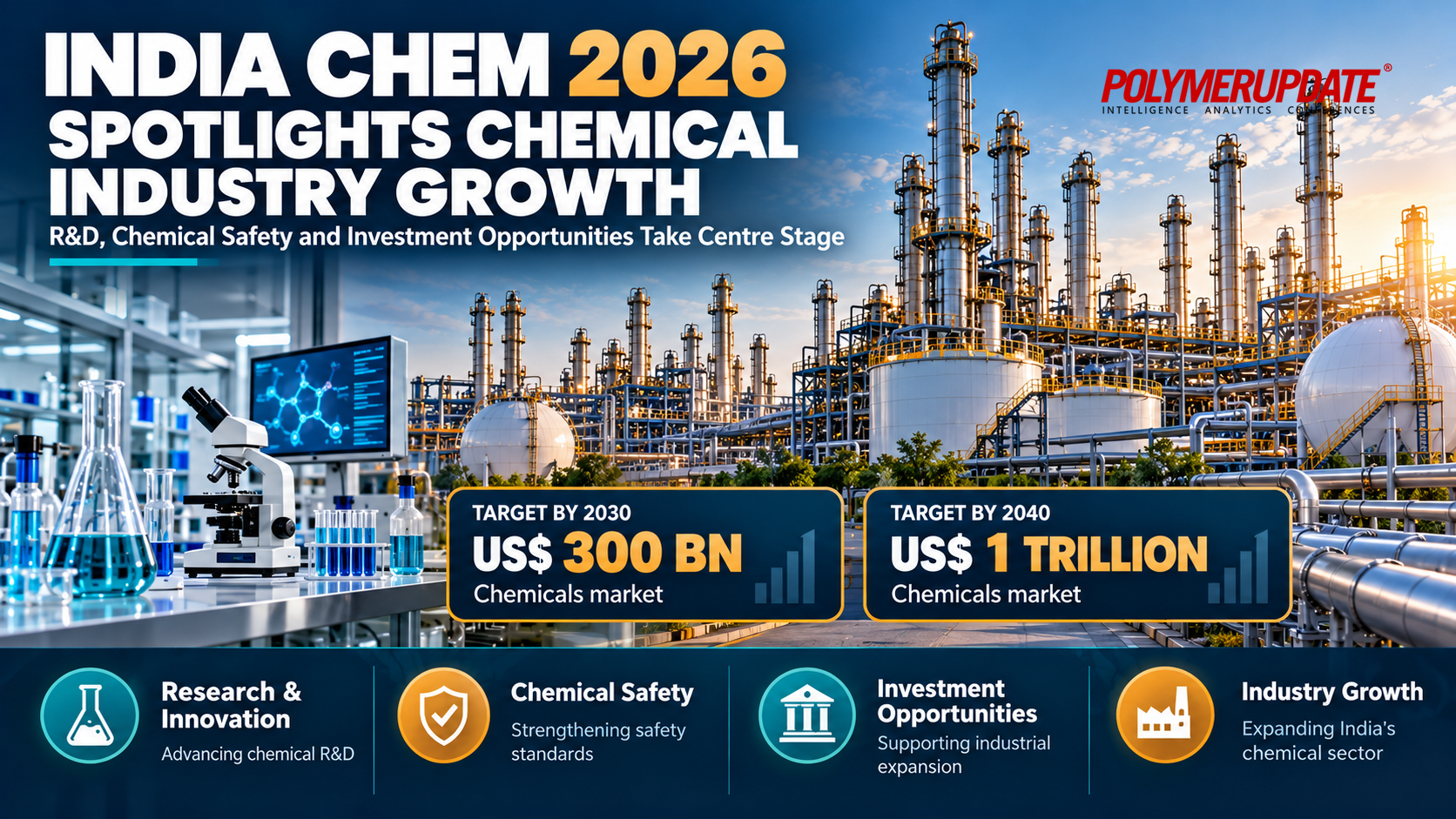 US$1 trillion market by 2040
India aims to build a US$ 1 trillion chemicals market by 2040, following its target of reaching US$ 300 billion by 2030, reflecting the sector’s growing importance to the country’s manufacturing ambitions and long-term economic growth. Achieving this scale will depend on rising domestic demand, expanding exports, greater investment in manufacturing capacity, technological advancement and a shift towards high-value specialty chemicals and advanced materials.
Government policy support, infrastructure development and stronger integration into global value chains are expected to create fresh opportunities for domestic and international investors. The expansion of sustainable and bio-based chemicals, recycling and circular-economy solutions could further strengthen the industry's competitiveness, while reducing import dependence in selected segments and positioning India as a preferred global destination for chemical manufacturing and sourcing.
He further added, “Out of Rs 100,000 crore, now we have to decide how we can dedicate ourselves to research and development; we must remain committed to that effort. In this regard, I would also like to congratulate my department. They worked very hard, working day in and day out. As a result, on October 8th, the Department of Chemicals and Petrochemicals was finally integrated into our innovation scheme, allowing us to utilize it effectively. This is a major achievement for us. Similarly, we have advanced in incorporating the broader research, development, and innovation framework.”
Holistic approachSpeaking at the inaugural session Nadda said, “What I mean to say is that production should also be addressed in a holistic manner. It is not just about production, along with production, we must ensure that it is healthy production. When I say healthy production, we need to focus on safety, especially when dealing with chemicals so that hazardous aspects are properly managed. From that standpoint, we need to enhance our sensitivity as well as the awareness of the people working here. This is my request to all of you.”
He announced the proposed Bhavya Rasayan scheme, under which the Centre plans to provide financial assistance of up to Rs 1,000 crore for each chemical park, while the respective state government would be required to contribute up to Rs 500 crore. The initiative aims to accelerate the development of world-class chemical manufacturing infrastructure, attract domestic and foreign investment, and strengthen the competitiveness of India's chemicals and petrochemicals industry. By facilitating the development of integrated chemical parks, the scheme is also expected to improve access to common infrastructure, streamline industrial operations, promote economies of scale and support the creation of a stronger domestic chemical manufacturing ecosystem.
Chemical industry eyes US$ 300 billion valuationThe event comes at a time when India's chemicals industry is seeking to expand its global footprint amid growing demand for specialty chemicals, advanced materials and sustainable industrial solutions. India is the world's sixth-largest chemicals producer and the fourth-largest in Asia. The domestic chemical industry is projected to reach US$ 300 billion by 2030 and US$ 1 trillion by 2040, supported by rising domestic consumption, export opportunities, relatively low per capita chemical consumption and a large domestic market.
The sector supplies essential raw materials and intermediates to a wide range of industries, including agriculture, pharmaceuticals, textiles, automotive, construction, electronics and consumer goods. Its expansion is therefore closely linked to India's manufacturing ambitions and efforts to strengthen domestic supply chains. Government initiatives, infrastructure development, regulatory reforms and investment facilitation are expected to support the industry's growth.
The availability of skilled labour at competitive costs and the country's expanding manufacturing base could further improve India's attractiveness as a destination for global chemical companies seeking to diversify their production and sourcing networks. India Chem 2026 provides a platform for industry stakeholders to assess these opportunities, establish commercial partnerships and explore investments in domestic manufacturing capacity.
International participationThe 14th edition is expected to attract participants from more than 100 countries, including Japan, the United States, Canada, the United Kingdom, European Union nations, Latin America, Vietnam, South Korea and ASEAN countries. More than 200 Indian and international exhibitors are expected to participate, alongside over 8,000 business visitors and more than 50 leading Indian and international chief executive officers at the Global CEOs Forum.
Buyer delegations from South America, the United States, the European Union, Commonwealth of Independent States countries, Western Europe, the Middle East and South and Southeast Asia are also expected to explore sourcing and investment opportunities. States with Petroleum, Chemicals and Petrochemicals Investment Regions (PCPIRs) and established chemical clusters, including Gujarat, Odisha, Andhra Pradesh, Tamil Nadu, Madhya Pradesh, Rajasthan and Maharashtra, will showcase their industrial infrastructure, investment policies and opportunities for new projects.
The participation of Japan as partner country is expected to provide an additional avenue for cooperation in technology, manufacturing, trade and investment, strengthening economic links between the two countries. The exhibition covers the chemicals and petrochemicals value chains, alongside process plant machinery, engineering and industrial equipment.
Focus on advanced technologiesThe chemicals segment includes basic, fine and specialty chemicals, agrochemicals, fertilisers, dyes and pigments, pharmaceutical ingredients, water-treatment chemicals, construction chemicals and sustainable chemical solutions. The petrochemicals segment features polymers, engineering plastics, olefins, synthetic fibres, elastomers, aromatics and their derivatives, recycled and bio-based petrochemicals, composite materials and specialty polymers used in automotive, aerospace and electronics applications.
Process equipment and technology providers are showcasing automation, digitalisation, smart manufacturing, robotics, artificial intelligence-based solutions, environmental protection systems, filtration and separation technologies, laboratory equipment and analytical instruments. Growing emphasis on sustainability is expected to create opportunities in recycling, circular-economy solutions, biodegradable polymers, bio-based chemicals and environmentally responsible manufacturing. Advanced materials, including nanomaterials, semiconductor-related materials and high-performance composites, are also emerging as potential areas for collaboration and investment.
Platform for business partnershipsIndia Chem 2026 aims to facilitate technology transfers, joint ventures, contract research and manufacturing, custom synthesis, global sourcing and investments in chemical parks and PCPIRs. The event is also expected to promote collaboration in supply-chain management, logistics, start-up incubation, skill development and digital business-to-business platforms.
Such partnerships could help Indian companies gain access to advanced technologies, expand production capabilities and improve their competitiveness in international markets. Greater investment in specialty and high-performance chemicals could also help the country move towards higher-value products and reduce dependence on imported materials in selected segments.
OutlookAs India pursues its ambition of becoming a major global chemicals manufacturing hub, events like this offer an opportunity to translate the country's market potential into concrete investment, technology and export partnerships. The extent to which these engagements lead to new projects and expanded manufacturing capacity will be important in determining the sector's contribution to India's long-term industrial growth.
DILIP KUMAR JHA
Editor
dilip.jha@polymerupdate.com