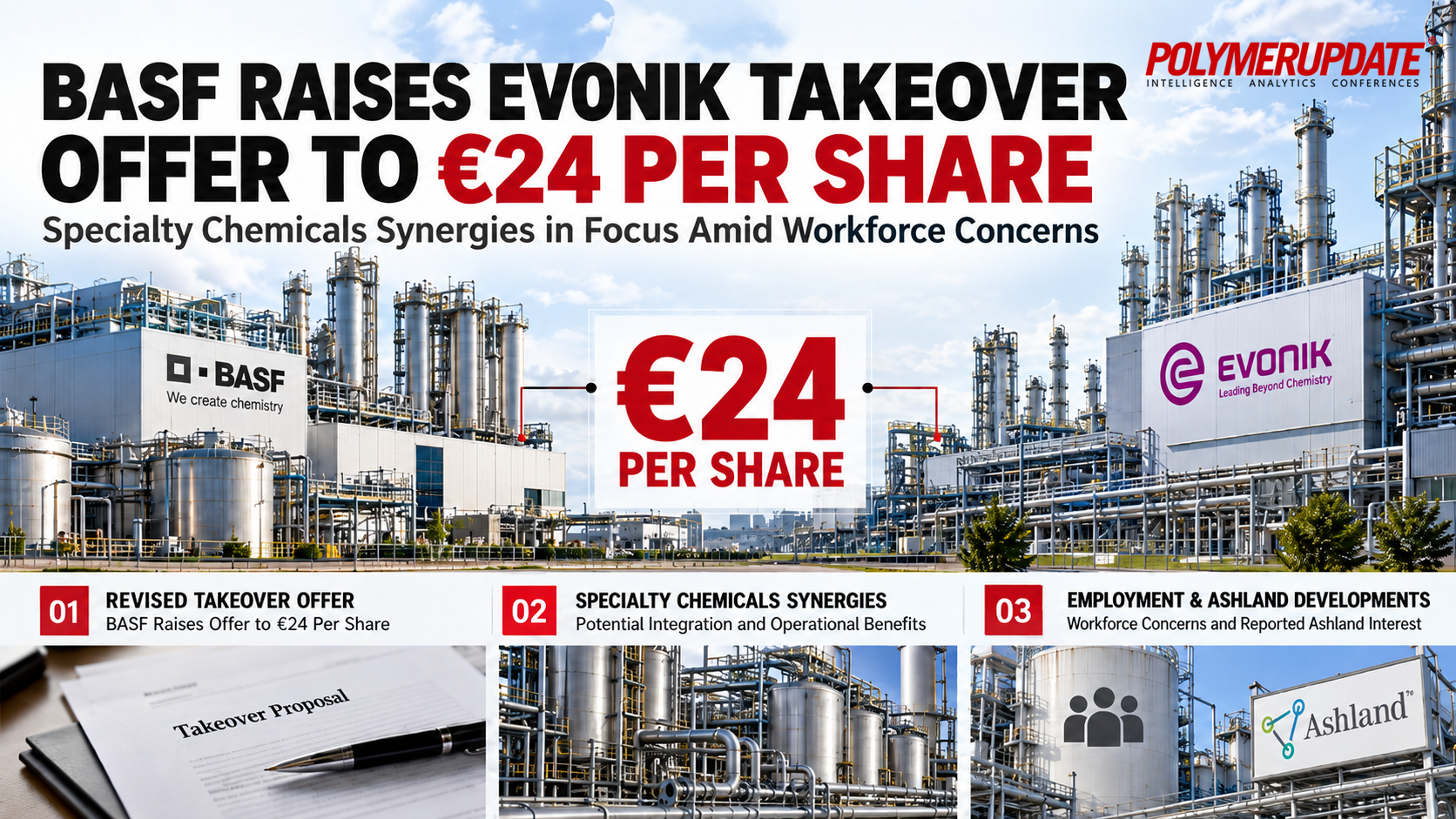
BASF SE has raised its takeover offer for German specialty chemicals manufacturer Evonik Industries AG to approximately €24 per share from an initial bid of €22.15 per share, with aim to strengthen its specialty chemicals portfolio and integrate production as Evonik weighs a potential US acquisition. The revised proposal values Evonik at around €11.18 billion, signalling BASF’s determination to advance a transaction that could reshape Germany’s chemicals industry.
Evonik rejected BASF’s initial offer, valued at approximately €10.3 billion, in September, considering the proposed price too low. The revised offer was confirmed neither by Evonik nor by its largest shareholder, the RAG Foundation, which holds a 43 percent stake in the company, commented on the reported increase. However, reports confirmed the news citing sources familiar with the development.
The proposed merger would bring together two major German chemicals producers with complementary businesses. However, its prospects will depend on the financial terms, the industrial benefits of combining their operations and the ability to address concerns over employment and investment in Germany’s chemicals manufacturing centres.
 BASF highlights industrial synergies
BASF chief executive officer Markus Kamieth has intensified efforts to explain the strategic rationale for the proposed transaction, including through a video message to employees. He has emphasised the potential to integrate production operations and feedstock supplies more closely while maintaining the importance of existing manufacturing locations.
A central element of BASF’s strategy is its integrated Verbund model, which connects chemical production facilities through shared infrastructure, energy systems and interconnected manufacturing processes. Bringing Evonik’s operations into a broader network could create opportunities to optimise raw-material consumption, improve production efficiency and coordinate logistics.
Evonik manufactures high-performance plastics, feed additives and ingredients used in coatings, household products and other industrial applications. BASF’s portfolio includes engineering plastics, superabsorbent polymers, vitamins and chemicals for industrial customers. A combination could strengthen BASF’s presence in selected specialty chemicals and performance materials while expanding opportunities for collaboration across production and research.
However, the extent of potential synergies, integration costs and financial returns has not been disclosed in the information available about the proposal. BASF has indicated that it is prepared to enter discussions but will not pursue a merger at any price. This suggests that the company is seeking to balance its strategic ambitions against the acquisition cost and the financial risks of integrating another major industrial business.
Employment and investment commitmentsEmployment protection has become a key consideration in the takeover discussions. Kamieth has indicated that BASF would honour Evonik’s existing site agreements, with compulsory redundancies ruled out until 2032. The company has also highlighted the continued importance of Essen and North Rhine-Westphalia, including investment in research and development and youth training.
These assurances address concerns that a merger could lead to plant closures, workforce reductions or lower investment in the Ruhr region, a traditional centre of German industry. Sinischa Horvat, chairman of BASF’s works council, said any potential takeover should be assessed on the basis of the opportunities it creates for the companies, their operating sites and, above all, their employees.
Horvat also stressed that BASF’s existing site agreement must remain in force and should not be undermined by the financing of a potential acquisition or the costs arising from it. The German state of North Rhine-Westphalia has similarly maintained that Evonik’s jobs and its ability to develop independently must not be jeopardised by a takeover.
For BASF, these commitments could help secure support from employees and regional stakeholders. They would also require the combined business to pursue efficiency gains while respecting existing employment arrangements, potentially limiting the pace or scale of certain restructuring measures. The challenge will be to translate the proposed industrial synergies into sustainable commercial benefits without weakening the manufacturing and technical capabilities that underpin both companies.
Evonik’s Ashland interest adds complexityBASF’s revised offer comes amid reports that Evonik is evaluating a potential acquisition of US-based specialty chemicals company Ashland, valued at approximately US$ 3.3 billion. People familiar with the matter told Reuters that Evonik’s interest in Ashland predates BASF’s takeover approach. Nevertheless, the possibility of a separate acquisition adds complexity to the discussions, particularly because of the capital required and the risks associated with integrating another business.
A source close to BASF said the company considers an Evonik acquisition of Ashland too risky. The concern highlights the potential financial implications of Evonik committing resources to another major transaction while its own ownership prospects remain uncertain. For Evonik, Ashland could provide an opportunity to expand its specialty chemicals portfolio and strengthen its presence in the US market. The company would, however, need to weigh the benefits against the financial commitments and integration challenges involved.
The two potential transactions offer different strategic outcomes. A combination with BASF could give Evonik access to a larger industrial network, interconnected production facilities and a broader customer base. Acquiring Ashland, by contrast, could allow Evonik to expand independently and pursue its own portfolio priorities. There is no indication that Evonik has abandoned its interest in Ashland. Its next steps could therefore influence how the company evaluates BASF’s revised proposal, although the precise implications for the negotiations remain unclear.
RAG Foundation’s roleThe RAG Foundation’s 43 percent shareholding makes it a pivotal stakeholder in any potential change of control at Evonik. Its position could significantly influence the prospects of BASF’s offer. The increase to €24 per share represents an attempt to address objections to the initial bid. However, a higher price alone may not be sufficient to secure an agreement if stakeholders remain concerned about employment, investment and Evonik’s long-term industrial development.
BASF must demonstrate that the acquisition price is justified by the benefits it expects from combining the businesses. These include more efficient feedstock use, better coordination of manufacturing operations and a stronger portfolio in specialty chemicals and performance materials. For Evonik’s shareholders, the decision will involve comparing the value offered by BASF with the potential returns from continued independence and alternative expansion opportunities.
Wider implications for Germany’s chemicals sectorThe proposed transaction comes as European chemical manufacturers face pressure from energy and raw-material costs, international competition and the need to improve operational efficiency. Consolidation could help companies strengthen their market positions, optimise infrastructure and improve the utilisation of existing production assets. A BASF-Evonik combination could create a larger German chemicals group with broader capabilities across industrial chemicals, performance materials and specialty applications.
It could also reinforce Germany’s established chemicals manufacturing clusters if research, production and workforce development remain integral to the combined company’s strategy. However, the transaction would also involve operational complexity. Integrating production systems, commercial operations and organisational structures while honouring employment commitments could prove challenging. The benefits would depend on effective execution rather than the scale of the combined business alone. For Germany’s industrial regions, the central question is whether consolidation can preserve domestic manufacturing capabilities while improving competitiveness.
BASF’s commitments on jobs and investment will therefore be an important part of the assessment alongside the financial terms. BASF’s reported increase to €24 per share marks a renewed effort to secure Evonik, not a concluded agreement. The next stage will depend on Evonik’s response, the position of the RAG Foundation and the ability of both sides to reconcile commercial objectives with employment and investment priorities. Evonik’s interest in Ashland provides an additional strategic consideration as the negotiations develop.
DILIP KUMAR JHA
Editor
dilip.jha@polymerupdate.com