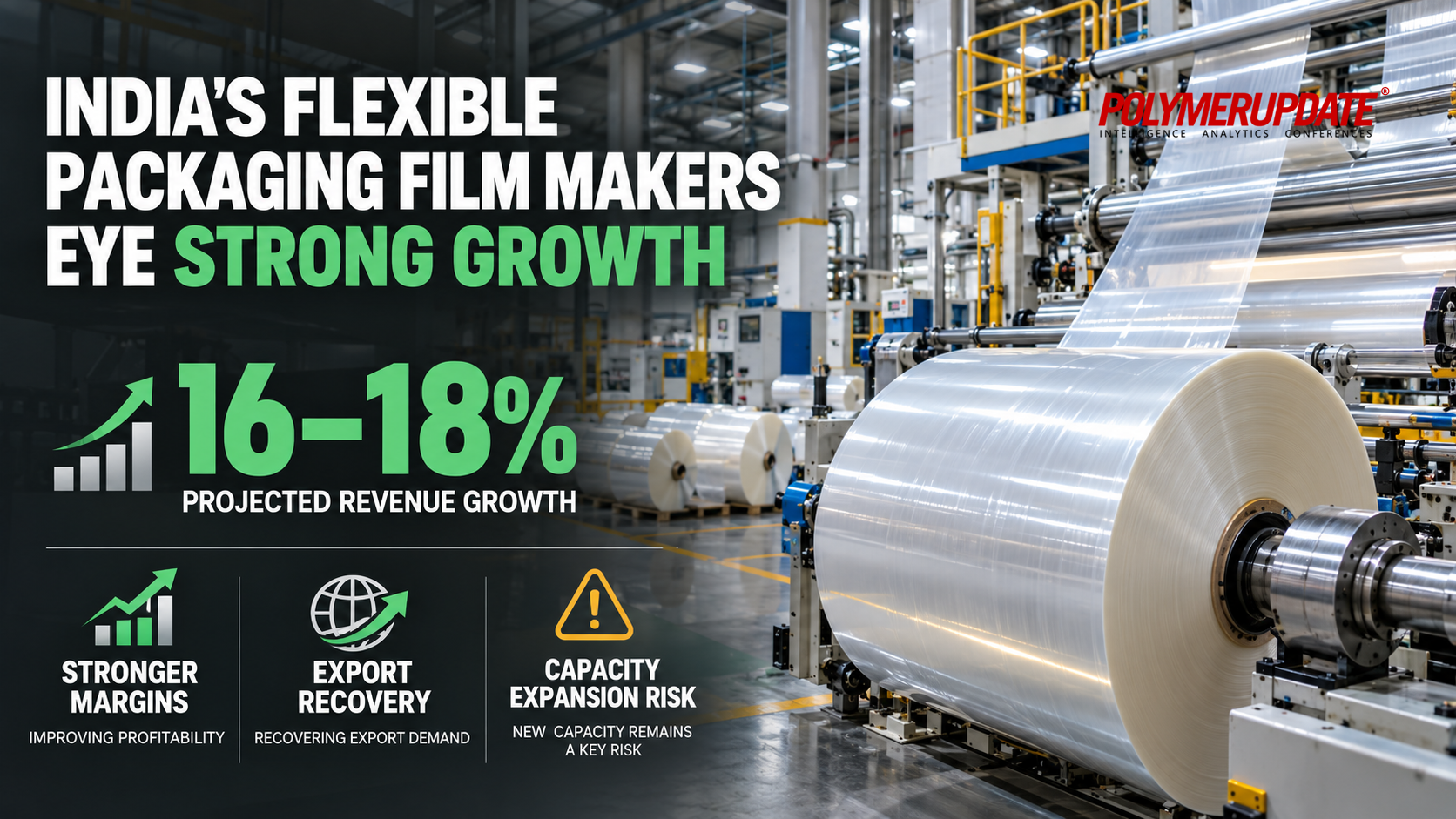
India's flexible packaging film manufacturers are expected to register revenue growth of 16-18 percent in the current fiscal, supported by improved realisations, recovering export demand and a better demand-supply balance, India’s leading credit rating agency Crisil projected in its periodical industry analysis. The report added that their operating margins may also expand as manufacturers pass on crude-linked raw material cost movements more effectively amid easing import competition and improved capacity utilisation.
The industry's recovery follows a prolonged downturn triggered by substantial capacity additions in fiscals 2022 and 2023, which resulted in oversupply and mounting pressure on product prices and profitability. However, limited capacity additions over the past two fiscals, coupled with an 8 percent net reduction in capacity following a major fire last fiscal, have helped restore market equilibrium. Capacity utilisation has consequently risen above 80 percent and is expected to remain at these levels during the current fiscal, supporting operating leverage and profitability.
Industry volumes are projected to grow 4-6 percent, while operating margins are expected to expand by 150-200 basis points to 11.5-12 percent. The analysis of eight flexible film manufacturers, accounting for more than 60 percent of domestic capacity, further elaborates that a broad-based improvement in the industry's financial performance. Although manufacturers are stepping up capital expenditure to pursue growth opportunities, stronger cash generation and prudent funding are expected to keep their credit profiles stable.
 Lower imports strengthen pricing power
A combination of higher landed costs for imported films, tighter domestic supply and improved cost pass-through has strengthened the pricing environment for domestic manufacturers. Rupee depreciation and elevated freight rates have made imports more expensive, reducing competitive pressure on local producers.
Mohit Makhija, Senior Director at Crisil Ratings, said, “A rare convergence of lower imports, tighter domestic supply and cost pass-through is restoring pricing power for flexible film manufacturers. Rupee depreciation and elevated freight rates have raised the landed cost of imported films, driving a 20-25 percent on-year decline in import volumes during April-July 2026. With competitive pressure easing, manufacturers can pass through crude-linked input cost movements more quickly and protect spreads.”
Flexible packaging films are closely linked to crude oil prices through their dependence on petrochemical feedstocks. Changes in crude-linked raw material costs can influence manufacturers' production expenses and selling prices. The ability to pass on these movements to customers, however, depends on market conditions, import competition and the balance between supply and demand. The recent improvement in domestic market conditions has allowed manufacturers to adjust prices more effectively, supporting spreads and operating profitability.
The decline in imports has further eased competitive pressure, creating a more favourable environment for domestic producers. Sustaining this pricing power will remain important as raw material costs fluctuate and additional domestic capacity enters the market.
Exports to drive volume growthDemand conditions are expected to remain supportive, although the recovery is likely to be uneven across domestic and overseas markets. Domestic sales account for nearly three-fourths of industry revenue and are expected to remain broadly stable. More than 80 percent of domestic demand is linked to the fast-moving consumer goods (FMCG) sector, which provides a relatively resilient consumption base for flexible packaging films. Exports, which contribute approximately a quarter of industry revenue, are expected to provide the principal impetus for volume growth.
Export volumes are projected to increase by 15-16 percent this fiscal as the US market recovers from tariff-related disruptions experienced last fiscal. The anticipated improvement in overseas demand should help manufacturers achieve better capacity utilisation while absorbing higher selling prices. Consequently, industry volumes are expected to expand by 4-6 percent during the year, despite largely flat domestic demand. The combination of improved realisations and steady volume growth is expected to strengthen operating leverage.
With fixed costs spread across higher production volumes and selling prices reflecting raw material cost movements more effectively, manufacturers should be able to improve margins and generate stronger cash flows. Operating profitability is projected to reach 11.5-12 percent this fiscal, providing companies with greater financial flexibility to meet their investment requirements and service debt.
Capital expenditure enters a new cycleThe improved earnings outlook is encouraging flexible film manufacturers to increase investments in capacity expansion. Industry capital expenditure is expected to rise by around 30 percent year on year, with planned projects potentially expanding overall capacity by approximately 20 percent over the current and next fiscals. More than half of the anticipated capacity additions are scheduled for the next fiscal, making the timing of project commissioning a key factor for the industry's outlook.
Rucha Narkar, Associate Director at Crisil Ratings, said, “The next test is not funding the expansion, but calibrating it. Capital expenditure is rising by about 30 percent on-year and could expand industry capacity by around a fifth over this and next fiscals, with more than half of the additions due next fiscal. Even so, healthier accruals, prudent funding and scheduled repayments should strengthen debt protection metrics: interest coverage is expected at 3.2-3.5 times and debt to Ebitda at 3.6-4.0 times, compared with 2.25 times and 5.3 times, respectively, last fiscal.”
The expected improvement in credit metrics reflects stronger operating earnings and cash accruals, which should enhance manufacturers' ability to meet interest obligations and manage debt. Interest coverage is projected to increase to 3.2-3.5 times from 2.25 times last fiscal, while debt to Ebitda is expected to improve to 3.6-4.0 times from 5.3 times. Healthy internal accruals, prudent funding strategies and scheduled debt repayments are expected to support these improvements, even as capital expenditure increases. Nevertheless, the scale of the planned expansion warrants close monitoring, given the industry's experience with earlier investment cycles.
Capacity discipline critical to sustaining recoveryHistorically, periods of strong profitability have encouraged flexible film manufacturers to add capacity aggressively. When new facilities have come on stream faster than demand has grown, the resulting oversupply has weakened pricing power and compressed margins. The industry now faces a similar challenge as manufacturers seek to capitalise on improved market conditions. Although higher demand and stronger realisations provide a favourable starting point, a concentration of capacity additions within a short period could disrupt the recently restored demand-supply balance.
The pace of commissioning will therefore be crucial. If new capacity comes on stream in line with demand growth, manufacturers could sustain healthy utilisation levels and protect margins. However, delays in demand growth or a bunching of new capacities could revive competitive pressures and trigger another period of oversupply. Import competition will also remain an important determinant of domestic pricing. Any easing in freight rates or strengthening of the rupee could improve the competitiveness of imported films, potentially limiting the ability of domestic manufacturers to pass on raw material cost increases.
At the same time, volatility in crude oil and petrochemical feedstock prices could affect production costs and realisations. Manufacturers' ability to adjust selling prices promptly will be essential to preserving profitability. Overall, India's flexible packaging film industry is poised for a stronger financial performance this fiscal, with revenue growth of 16-18 percent, volume expansion of 4-6 percent and operating margins of 11.5-12 percent. Improved pricing power, recovering exports and capacity utilisation above 80 percent are expected to support the upcycle.
However, the sustainability of the recovery will depend on disciplined capacity expansion, continued cost pass-through and the evolution of import competition. While stronger earnings should improve debt protection and support planned investments, avoiding another round of supply-led margin pressure will be critical to maintaining the industry's financial stability.
DILIP KUMAR JHA
Editor
dilip.jha@polymerupdate.com