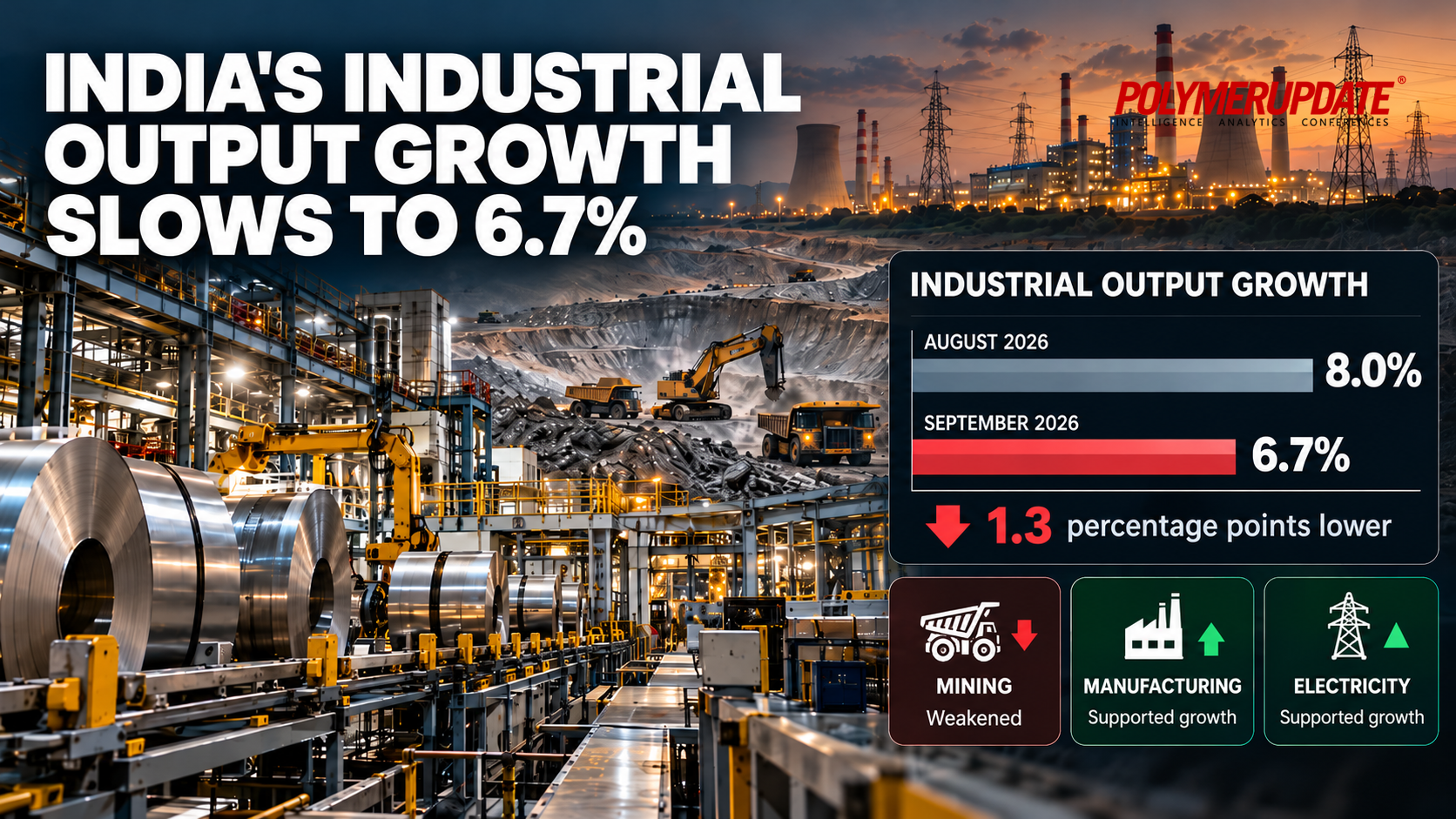
India’s factory output growth, measured by the Index of Industrial Production (IIP), slowed to 6.7 percent in September due to a moderation in the expansion of some segments, including mining, according to data compiled by the Ministry of Statistics & Programme Implementation (MoSPI). This marked a sharp decline from the 8 percent growth recorded in August but was higher than the 6.1 percent reported in September 2025. For the first half of the financial year (FY) 2026-27 (April-September 2026), overall IIP growth was registered at 6.8 percent, as against 4.4 percent reported during the corresponding period of the previous year.
A MoSPI statement reads, “In September 2026, IIP recorded a 6.7 percent year-on-year growth, which was 8.0 percent in August 2026, supported by 7.6 percent growth in the manufacturing sector and strong growth of 11.2 percent in the electricity and gas supply sector. The index is compiled with data received from source agencies, which, in turn, receive the data from the producing factories/establishments. These Quick Estimates will undergo revision in subsequent releases as per the revision policy of IIP.”
Madan Sabnavis, Chief Economist at Bank of Baroda, commented, “IIP growth for September was 6.7 percent, which is lower than our forecast of 8 percent, with moderation seen in some segments. However, this was higher than the 6.1 percent recorded last year. For the first half of the year, growth was 6.8 percent this year, against 4.4 percent last year. Growth has been driven by manufacturing and electricity, while mining, with negative growth due to the ongoing monsoon season, pulled the number down. The non-metallic mineral segment brought growth down, even as fuel minerals (coal) had a positive growth rate.”
 Sector-wise performance
The growth rates of the mining and quarrying, manufacturing, electricity and gas supply, and water supply, sewerage and waste management sectors for September 2026 were (-) 6.2 percent, 7.6 percent, 11.2 percent and 5.8 percent, respectively. The Quick Estimate of the IIP stands at 124.3, compared with 116.5 in September 2025. The indices of industrial production for mining and quarrying, manufacturing, electricity and gas supply, and water supply, sewerage and waste management for September 2026 stood at 90.4, 128.0, 128.6 and 146.4, respectively.
Within the manufacturing sector, 17 out of 23 industry groups recorded positive growth in September 2026 over September 2025. The top three positive contributors for September 2026 were ‘Manufacture of motor vehicles, trailers and semi-trailers’ (19 percent), ‘Manufacture of electrical equipment’ (33.9 percent) and ‘Manufacture of rubber and plastics products’ (19.9 percent). Within the ‘Manufacture of motor vehicles, trailers and semi-trailers’ industry group, the item groups ‘Auto Components, Spares and Accessories’, ‘Passenger Cars’ and ‘Commercial Vehicles’ made significant contributions to growth.
Devendra Pant, Chief Economist at India Ratings and Research, attributed the slowdown in September IIP growth to the base effect and negative growth in the mining sector, which pulled down overall performance. “September marked the fourth consecutive month of manufacturing sector growth of more than 7.5 percent and the second consecutive month of double-digit growth in electricity generation due to high temperatures. Additionally, double-digit growth was recorded in capital goods production during April-September 2026, which augurs well for investment activity in the economy. Barring consumer non-durables, all other five use-based groups recorded a sequential year-on-year decline in growth. Consumer non-durables grew in September 2026 after two months of contraction.”
Growth driversManufacturing growth has been driven by the auto segment and electrical machinery, with support from rubber products, computers, electronics and non-metallic machinery. Growth declined in the wearing apparel, chemicals and pharmaceuticals sectors. Export markets were affected by global disruptions.
Higher growth in electricity can be attributed to high temperatures in some regions. In addition, the pickup in business activity in the manufacturing and services sectors led to higher demand for electricity. In terms of use-based classification, capital goods performed well, growing by 10.4 percent, reflecting higher investment activity in the country. Intermediate goods grew by 12.2 percent and infrastructure goods by 7.2 percent, while base metals recorded a lower growth rate.
In the consumer segment, durable goods growth was lower at 6 percent, with demand remaining subdued due to religious reasons. This segment is expected to gain momentum in October. The FMCG segment grew by 0.8 percent, which, although low, marks a shift from the negative growth recorded in previous months.
Festive cheersSabnavis further added, “The coming months will see the festival and wedding season, which should boost demand and, in turn, support higher demand for non-consumer goods as well. A headwind will be the drought affecting some states, which could result in lower crop production and, consequently, affect rural incomes. The interplay of these two forces will determine the future growth trajectory. We expect IIP growth for the year to be in the range of 7–8 percent, with a downside risk of 0.5 percentage points if the rural economy fails to keep pace.”
Echoing a similar sentiment, Pant quipped that IIP growth could improve in October 2026 in the range of 8-9 percent due to base effect in the overall index and especially for manufacturing and electricity sector.
DILIP KUMAR JHA
Editor
dilip.jha@polymerupdate.com