Click the icon to add a specified price to your Dashboard list. This makes it easy to keep track on the prices that matter most to you.

By Professor Dr. Sajjid Mitha
India’s petrochemical opportunity is becoming increasingly difficult for global investors to ignore. But converting a rapidly expanding domestic market into a globally competitive industry will require more than building crackers and adding polymer capacity. It will require India to overcome its feedstock disadvantage, develop genuinely integrated manufacturing clusters and move decisively towards higher-value chemicals and materials.
India is approaching an industrial inflection point.
The economy is expanding rapidly, manufacturing investment is gathering pace and demand for plastics, chemicals and advanced materials is rising. Yet domestic production has not kept pace with the requirements of a population approaching 1.5 billion.
That imbalance is beginning to look less like a weakness than an investment opportunity.
The question is whether India can use it to build a globally competitive petrochemical industry — or whether it will remain primarily a large and growing importer.
The distinction matters. Petrochemicals are capital-intensive, cyclical and heavily exposed to feedstock economics. India cannot realistically compete with every producer in the world on commodity molecules alone. Its opportunity lies in combining scale at home with integration, technology and increasing value addition.
A demand story that is still in its early stages
India’s plastics consumption remains relatively low by international standards.
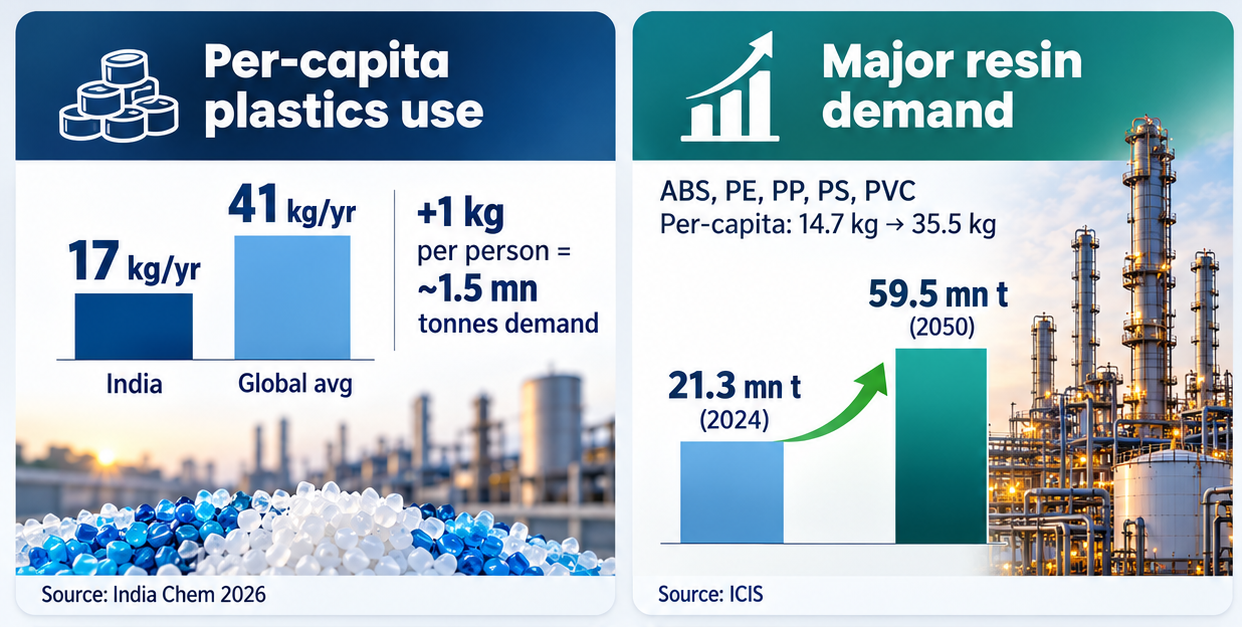
Data presented at India Chem 2026 put per-capita plastics consumption at roughly 17 kilograms a year, compared with a global average of about 41 kilograms. With a population of approximately 1.48 billion, an additional kilogram of annual consumption per person would represent roughly 1.5 million tonnes of incremental demand.
That is an extraordinary demand lever.
ICIS estimates demand for five major resins — ABS, PE, PP, PS and PVC — at around 21.3 million tonnes in 2024, rising to 59.5 million tonnes by 2050 as per-capita consumption increases from 14.7 kilograms to 35.5 kilograms.
The drivers are not difficult to identify.
Urbanisation, rising incomes, infrastructure spending, housing, water distribution, automotive production, consumer goods and electronics are all increasing the use of polymers and engineered materials. Government programmes such as PM Awas Yojana, Jal Jeevan Mission and PM Gati Shakti add further demand for pipes, insulation, coatings and other polymer-intensive products.
India’s broader industrial cycle provides an important macroeconomic backdrop. The Economic Survey 2025–26 reported manufacturing growth of 8.4% during the first half of FY26, while overall industrial-sector growth was 7%.
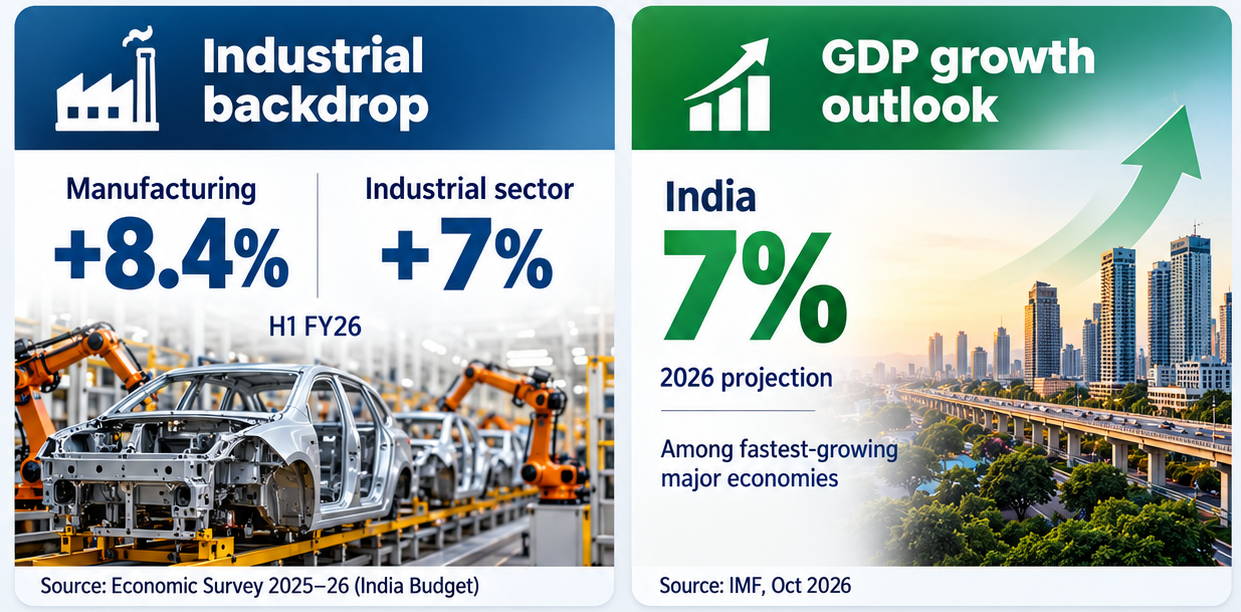
The IMF’s October 2026 assessment is equally significant. India remains among the fastest-growing major economies, with growth projected at 7% in 2026.
For petrochemicals, that combination of economic expansion and low per-capita consumption creates a particularly powerful demand proposition.
But demand alone does not create a globally competitive petrochemical industry.
The import bill is the signal
India’s central challenge is the widening gap between what it consumes and what it produces.
Data presented at India Chem suggest that the deficit across building blocks, polymers, aromatics, elastomers and synthetic fibres increased from about 1.1 million tonnes in 2010 to 6.2 million tonnes in 2025. Even after taking committed capacity additions into account, the deficit could approach 40 million tonnes by 2040.
The scale of the opportunity is reflected in capital spending plans. Industry estimates presented at India Chem put committed and prospective petrochemical investment in India at more than $69 billion.
That is significant. But the more revealing number may be the import bill.
India imported roughly $101 billion of products across chemicals, plastics and allied categories covered by HS chapters 28–40 in FY26. The figure encompasses a broad range of products, including pharmaceuticals, fertilisers, plastics and rubber, and should therefore not be treated as a pure petrochemical deficit. But it illustrates the scale of the country’s dependence on imported chemical products.
There is, however, another number that puts this dependence into a very different macroeconomic perspective.
During the 2008–09 commodity supercycle, India’s oil import bill was equivalent to roughly 8–8.5% of GDP. Today, that burden is closer to 4–4.5%.
The significance is larger than the headline suggests. India remains heavily dependent on imported crude, but the economy has grown faster than its oil-import burden. In other words, the country has not eliminated its dependence on imported oil; it has materially reduced the economic weight of that dependence.
That represents a structural change in India’s macroeconomic vulnerability to global oil shocks.
A sharp rise in crude prices can still widen the trade deficit, pressure the rupee and add to inflationary risks. But an equivalent oil-price shock today represents a considerably smaller claim on national income than it did during the last commodity supercycle.
This matters for petrochemicals.
India is entering its next phase of industrialisation with a much larger economic cushion against oil-price volatility. The opportunity is therefore no longer simply to build an industry despite India’s dependence on imported crude. It is to use a larger and more resilient economy, together with refining scale and a vast domestic market, to build a more integrated petrochemical and manufacturing base.
An investment executive at a global energy-infrastructure fund described the distinction bluntly:
“Treating India’s import bill simply as a trade deficit misses the investment signal. In North America and Europe, capital is largely rationalising or replacing ageing assets against relatively mature demand. India is one of the few major markets where new integrated capacity can be built against a large, growing domestic customer base.”
That is the heart of the India thesis.
The opportunity is not simply to replace imports. It is to create domestic industrial ecosystems around those imports.
The barrel is changing
India’s petrochemical ambitions are arriving at an important moment for the global oil industry.
The economics of the barrel are changing as transportation becomes progressively less oil-intensive. Electric vehicles, improving fuel efficiency and alternative fuels are beginning to constrain the long-term growth prospects of gasoline and diesel.
Petrochemicals are moving in the opposite direction.
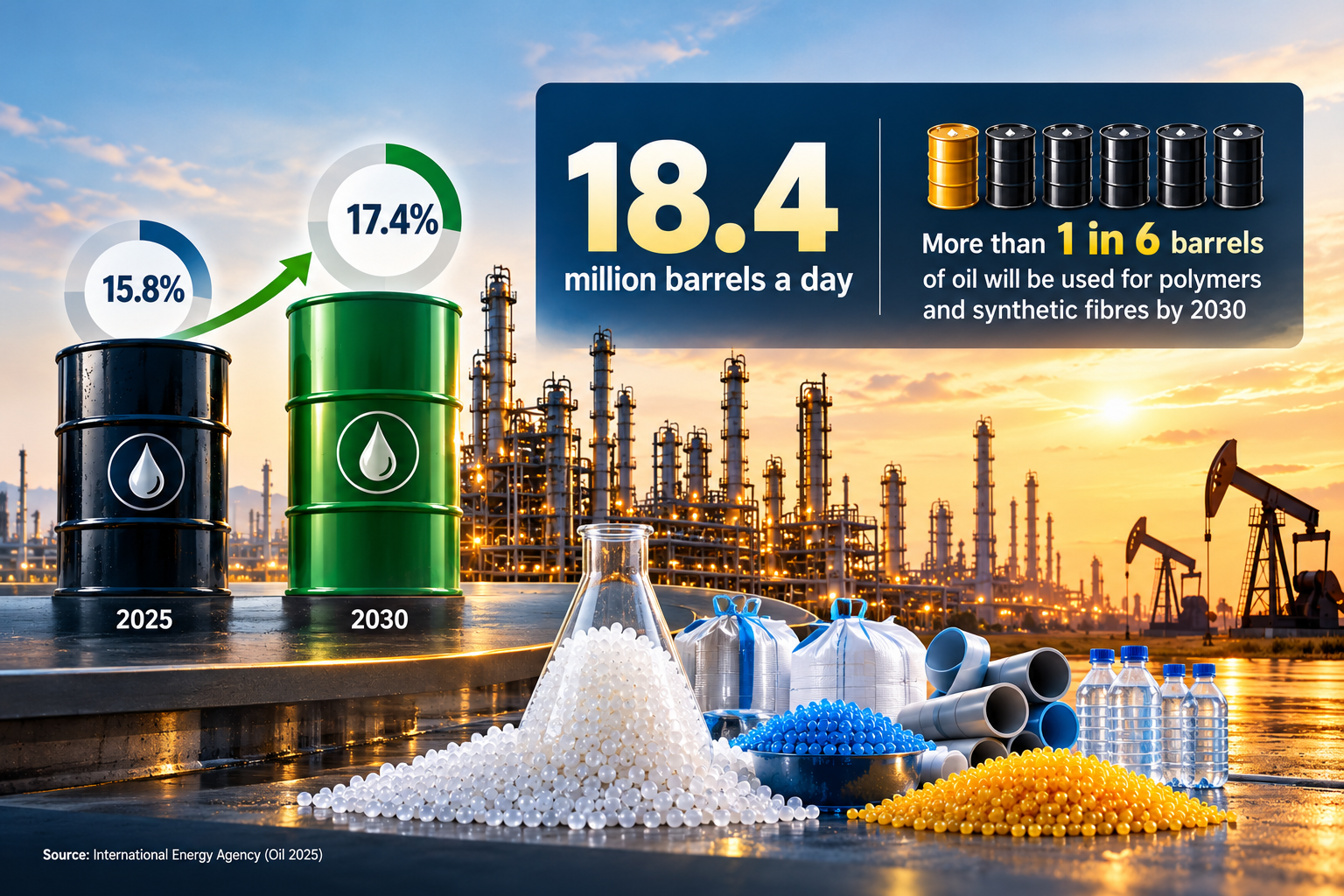
The International Energy Agency expects petrochemical feedstocks to become the dominant source of global oil-demand growth from 2026 onwards. Its Oil 2025 outlook projects the share of petrochemical feedstocks in total oil consumption to rise from 15.8% to 17.4% by 2030. By then, oil demand associated with polymers and synthetic fibres is expected to reach about 18.4 million barrels a day — more than one in every six barrels.
The implication for refiners is profound.
The refinery of the future cannot be designed simply around transportation fuels. Increasingly, the ability to convert crude and associated feedstocks into petrochemicals will determine the economics of large, integrated complexes.
For India, that is particularly relevant.
The country is one of the world’s largest oil importers, but its refineries are strategically positioned along the coast, relatively close to Middle Eastern crude suppliers and the major consuming markets of Asia.
A refining strategist familiar with the economics of new projects put it this way:
“The refinery of 2030 cannot survive on transport fuels alone. The projects being designed today increasingly need higher chemical yields. India’s coastal position gives it an opportunity to link Middle Eastern feedstock with a large domestic market and, beyond that, the wider Asian market.”
The distinction between a refinery and a petrochemical complex is therefore becoming increasingly blurred.
For India, integrating petrochemicals into large refining systems is not merely an efficiency measure. It could become a defence against the longer-term risk of declining transport-fuel demand.
But India cannot out-China China
This is where the investment story becomes more complicated.
India’s domestic market may be exceptional, but the global petrochemical industry is already characterised by enormous scale and periodic overcapacity.
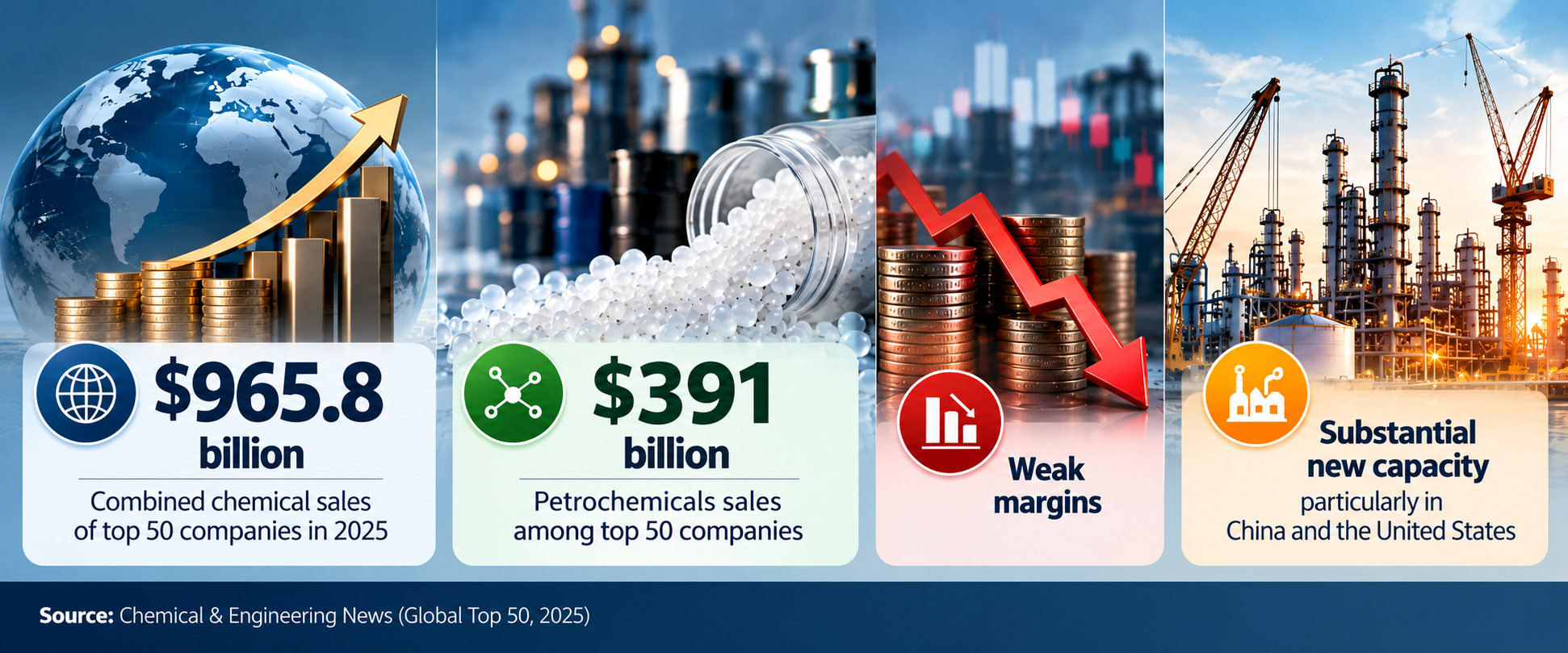
C&EN’s latest Global Top 50 chemical-company ranking puts combined chemical sales of the 50 companies at $965.8 billion in 2025. Petrochemicals alone accounted for $391 billion. The industry is simultaneously dealing with weak margins and substantial new capacity, particularly in China and the United States.
China remains the benchmark for industrial scale.
Its chemical industry has been built around huge integrated complexes, deep domestic supply chains, infrastructure and access to capital. India will not replicate that model simply by announcing more capacity.
Nor can it reproduce the US Gulf Coast’s structural advantage in cheap ethane, or the Middle East’s access to advantaged oil and gas feedstocks.
An Asian petrochemical trader familiar with the market put the problem more starkly:
“India cannot out-subsidise China, nor can it compete with the cheapest US ethane. If it tries to compete purely in merchant ethylene or standard polyethylene, it will be exposed whenever the global market moves into oversupply. The strategy has to be integration, specialised grades and captive domestic conversion.”
That may be the most important strategic lesson.
India should not attempt to win the commodity petrochemical race on somebody else’s terms.
It should change the race.
From molecules to materials
The next phase of India’s petrochemical development should therefore be measured not only in tonnes, but in value per tonne.
Commodity resins can generate enormous volumes but remain vulnerable to global cycles, dumping and feedstock spreads. Higher-performance polymers, electronic chemicals, fluoropolymers, specialty polyolefins and advanced chemical intermediates can offer greater margins, stronger customer relationships and more defensible intellectual property.
This is where India’s engineering base, pharmaceutical expertise and expanding electronics manufacturing ecosystem could become strategically important.
The country’s chemicals industry is already the sixth largest globally and the third largest in Asia, according to IBEF. The organisation estimates that the broader chemicals and petrochemicals market could reach $1 trillion by 2040.
The opportunity, however, is not guaranteed.
India will need to address at least six structural issues.
First, feedstock flexibility. New crackers and downstream facilities will need to respond to changing economics across naphtha, LPG and ethane rather than being locked into a single feedstock.
Second, genuine industrial integration. India’s PCPIRs will need to evolve from designated industrial areas into fully integrated ecosystems, with common utilities, logistics, storage, waste treatment, pipelines and downstream conversion. Singapore’s Jurong Island remains an obvious benchmark.
Third, policy stability. Petrochemical investments have multi-decade lives. Investors need confidence that tariff structures, trade remedies, environmental rules and taxation will not change unpredictably.
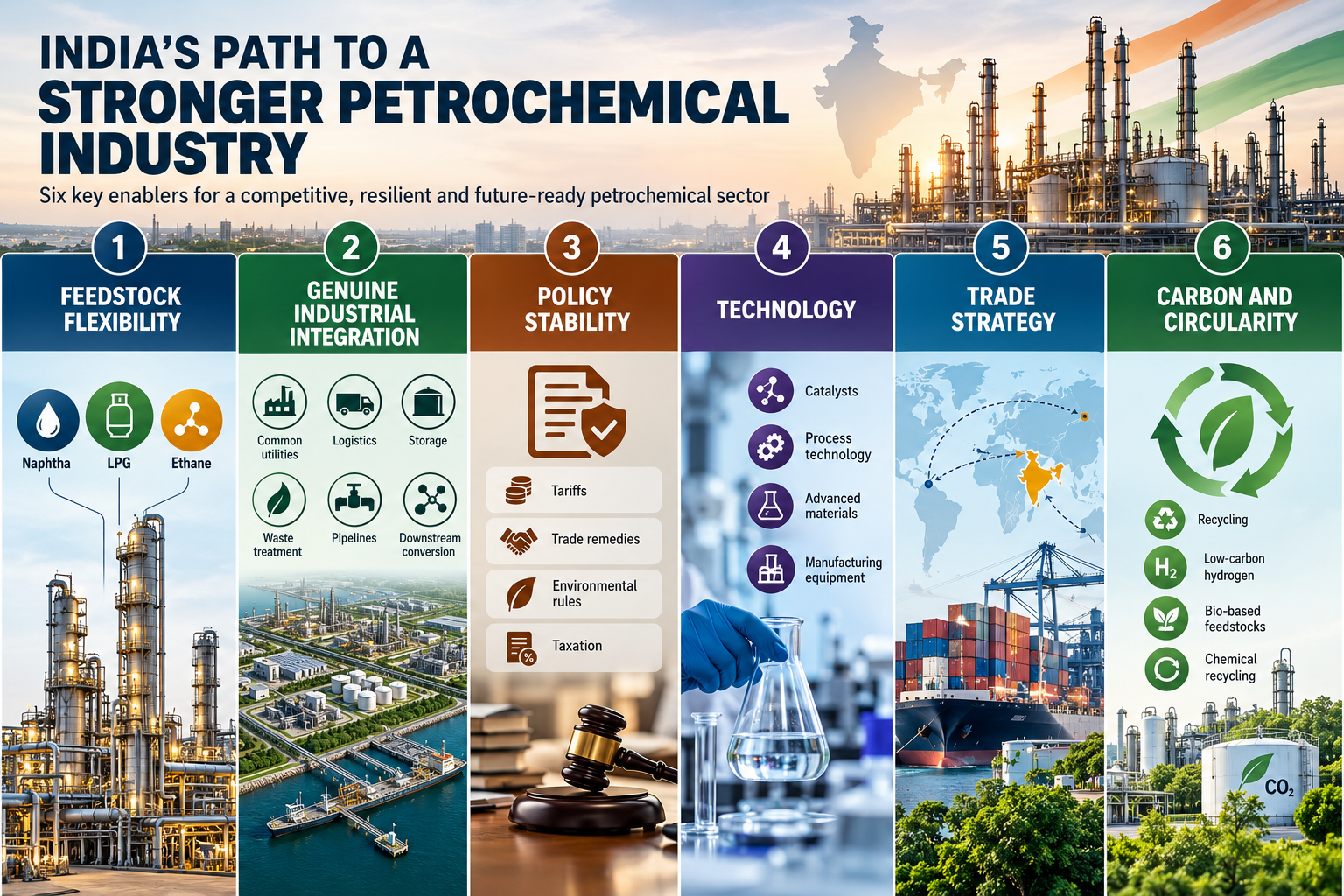
Fourth, technology. India has considerable engineering capability, but a world-class petrochemical industry ultimately requires indigenous expertise in catalysts, process technology, advanced materials and manufacturing equipment.
Fifth, trade strategy. India can benefit from the global “China-plus-one” trend, but only if it is perceived as a reliable manufacturing and trading partner rather than simply an alternative source during periods of geopolitical tension.
Sixth, carbon and circularity. Recycling, low-carbon hydrogen, bio-based feedstocks and chemical recycling cannot be treated as peripheral environmental projects. They increasingly form part of the competitive architecture of the global chemical industry.
The opportunity is bigger than import substitution
There is a temptation to frame India’s petrochemical opportunity simply as a story of import substitution.
That undersells it.
The more consequential possibility is that India could become one of the world’s major manufacturing nodes for chemicals, polymers and advanced materials at a time when multinational companies are reassessing the geography of their supply chains.
The country has three advantages that are difficult to replicate simultaneously: scale, demographics and domestic demand.
It also has serious disadvantages: relatively expensive feedstock compared with the Middle East and US Gulf Coast, infrastructure bottlenecks in some regions, regulatory complexity and a still-developing ecosystem for advanced chemical technology.
The challenge is therefore not whether India can build petrochemical capacity.
It can.
The question is whether it can build the right capacity.
India’s own chemicals ministry is now targeting a $1 trillion chemicals market by 2040, while the government is considering additional support for chemical parks and industrial infrastructure.
That ambition is substantial. But capital alone will not close the competitiveness gap.
India will need to move from a model based primarily on producing more molecules to one based on extracting more economic value from each molecule.
That means integrated refineries and crackers feeding downstream clusters; commodity polymers supporting conversion industries; specialty chemicals feeding electronics, pharmaceuticals and advanced manufacturing; and increasingly sophisticated recycling and low-carbon production systems sitting alongside conventional capacity.
The prize is consequently larger than the elimination of an import bill.
India’s declining oil-import intensity adds another dimension to the opportunity. The country remains exposed to global energy prices, but the economy is no longer as vulnerable to an oil shock as it was during the great commodity cycle of the late 2000s. That greater macroeconomic resilience provides a stronger platform from which to undertake the capital-intensive investments required for the next generation of petrochemical infrastructure.
If India can combine that economic scale with competitive feedstock strategies, integrated industrial infrastructure and a sustained move up the value chain, it could emerge not merely as Asia’s next major petrochemical consumer, but as one of the world’s important chemical manufacturing hubs.
The opportunity is structural.
But so is the competition.
And in petrochemicals, the difference between becoming a global powerhouse and becoming another large producer of undifferentiated capacity will ultimately be measured not in tonnes, but in economics.
| Professor Dr. Sajjid Mitha is the CEO and Founder of Polymerupdate, Polymerupdate Academy, and RACE Expos and Conferences. |