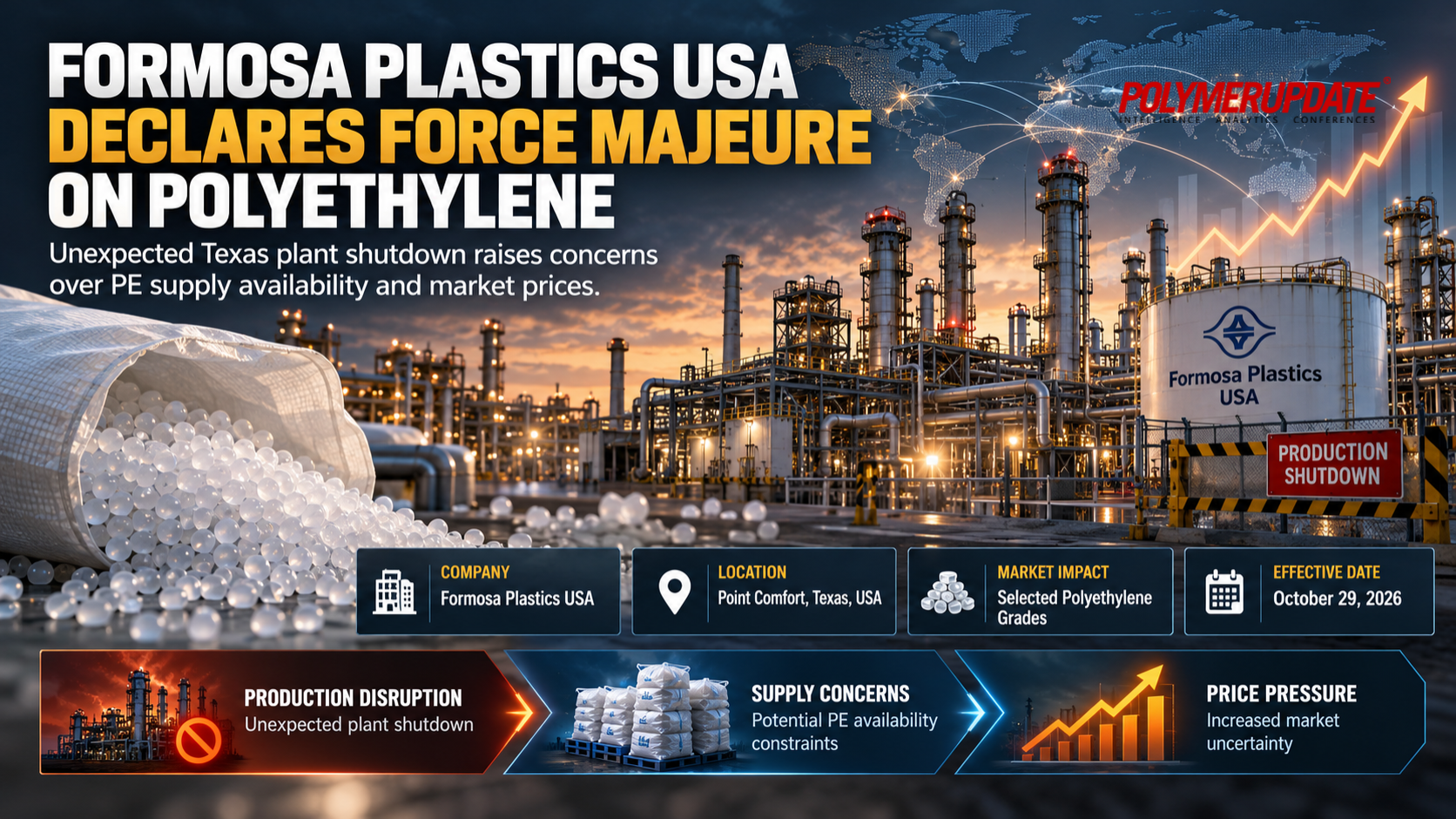
Formosa Plastics Corporation, USA (FPC USA) has declared force majeure on select polyethylene (PE) products following an unexpected production shutdown at its Point Comfort petrochemical complex in Texas, United States, raising concerns over potential supply disruptions in the domestic and international polyethylene markets. The production outage declaration, effective October 29, 2026, follows an operational incident that affected one of the company's polyethylene production units. The affected production assets were shut down unexpectedly, disrupting normal manufacturing operations and potentially constraining supplies of the affected grades.
The company has not publicly specified the duration of the shutdown, the precise production unit involved or the volume of capacity affected. Consequently, the actual extent of the supply disruption will depend on the time required to restore operations and resume normal production. Formosa Plastics USA operates an integrated petrochemical complex at Point Comfort, with an established polyethylene production portfolio covering low-density polyethylene (LDPE), high-density polyethylene (HDPE) and linear low-density polyethylene (LLDPE).
 Capacity and disruptions
Based on available industry capacity data, the facility has an estimated combined PE production capacity of approximately 1.8–1.9 million tonnes per annum (TPA). The capacity comprises approximately 625,000 TPA of LDPE, 800,000 TPA of HDPE and 465,000 TPA of LLDPE, according to facility-level production data. The company has expanded its polyethylene portfolio through successive investments, including the commissioning of a new LDPE unit in November 2020.
However, the capacity of the specific production unit affected by the latest incident has not been disclosed. Therefore, the entire 1.8–1.9 million TPA installed capacity should not be considered offline. The actual shutdown capacity and resulting production losses will depend on the affected unit's nameplate capacity and the duration of the interruption.
The Point Comfort complex is strategically important to the North American petrochemical industry because of its integrated manufacturing operations, which include ethylene production and downstream polymer manufacturing. Its ability to manufacture different grades of polyethylene makes it an important supplier to packaging, film, pipe, injection moulding and other downstream industries.
Potential implicationsThe force majeure declaration comes at a time when polyethylene markets are already monitoring production constraints, planned maintenance and uneven demand across major consuming regions. Any prolonged interruption at Formosa's Texas facility could tighten the availability of selected PE grades, particularly in the North American market, and potentially affect export commitments. The United States is an important global polyethylene exporter, with its competitive production costs and substantial manufacturing capacity supporting shipments to Latin America, Europe, Asia and other international markets.
Consequently, an unexpected production disruption at a major Gulf Coast supplier could affect regional trade flows, particularly if buyers are unable to secure replacement volumes promptly. The impact is likely to vary across product categories. Availability of the specific grades covered by the force majeure could tighten more significantly than the broader polyethylene market, as alternative grades may not always be suitable substitutes for particular processing requirements and applications.
Importantly, the latest development adds to a series of operational constraints affecting polyethylene production in different parts of Asia. Indonesia's Chandra Asri has undertaken a 30–35-day turnaround involving its 536,000 TPA PE plant, while South Korea's Honam Petrochemical planned maintenance at its 370,000 TPA HDPE/LLDPE swing plant. Hanwha Chemical also planned to idle at least one-third of its 335,000 TPA LLDPE capacity for technical tests.
These developments could complicate supply planning for international buyers, particularly those dependent on imported material. Nevertheless, the impact on global availability will depend on the extent of the production losses, the duration of the shutdown and the ability of competing producers to increase operating rates.
Price outlook amid supply uncertaintyThe latest force majeure declaration could provide additional support to polyethylene prices, particularly in the United States, if the production interruption extends into November and restricts the availability of exportable material. According to S&P Global Commodity Insights, several American polyethylene producers have already announced proposed price increases of 5–7 cents per pound for November. Market participants, however, remain divided over whether these increases can be sustained because of uneven regional demand and the traditional slowdown in buying activity towards the end of the year.
Strong demand from Asian and African markets had supported US polyethylene prices during October, giving producers greater leverage in their efforts to implement higher prices. However, buyers in several markets have remained cautious, preferring to purchase according to immediate requirements rather than build inventories amid uncertainty over downstream consumption. A prolonged shutdown at Formosa's Point Comfort facility could strengthen producers' negotiating positions and make it easier to implement announced price increases. It could also encourage buyers to secure alternative supplies, potentially increasing competition for available export cargoes.
Impact on import-dependent marketIn Asia, the effect could be particularly relevant for import-dependent markets if reduced US export availability coincides with ongoing regional production constraints. However, subdued purchasing interest and weak downstream demand could limit the extent of any price increase. For now, the market will closely monitor developments at Point Comfort, particularly the identification of the affected production unit, the estimated shutdown capacity and the timeline for restarting operations.
Overall, the force majeure declaration introduces another element of uncertainty into the global polyethylene market. While the immediate impact is expected to be concentrated on selected grades, an extended interruption could tighten export availability, support regional prices and reinforce upward price expectations heading into November. Nevertheless, the sustainability of any rally will ultimately depend on the balance between production recovery, international trade flows and downstream demand.
DILIP KUMAR JHA
Editor
dilip.jha@polymerupdate.com