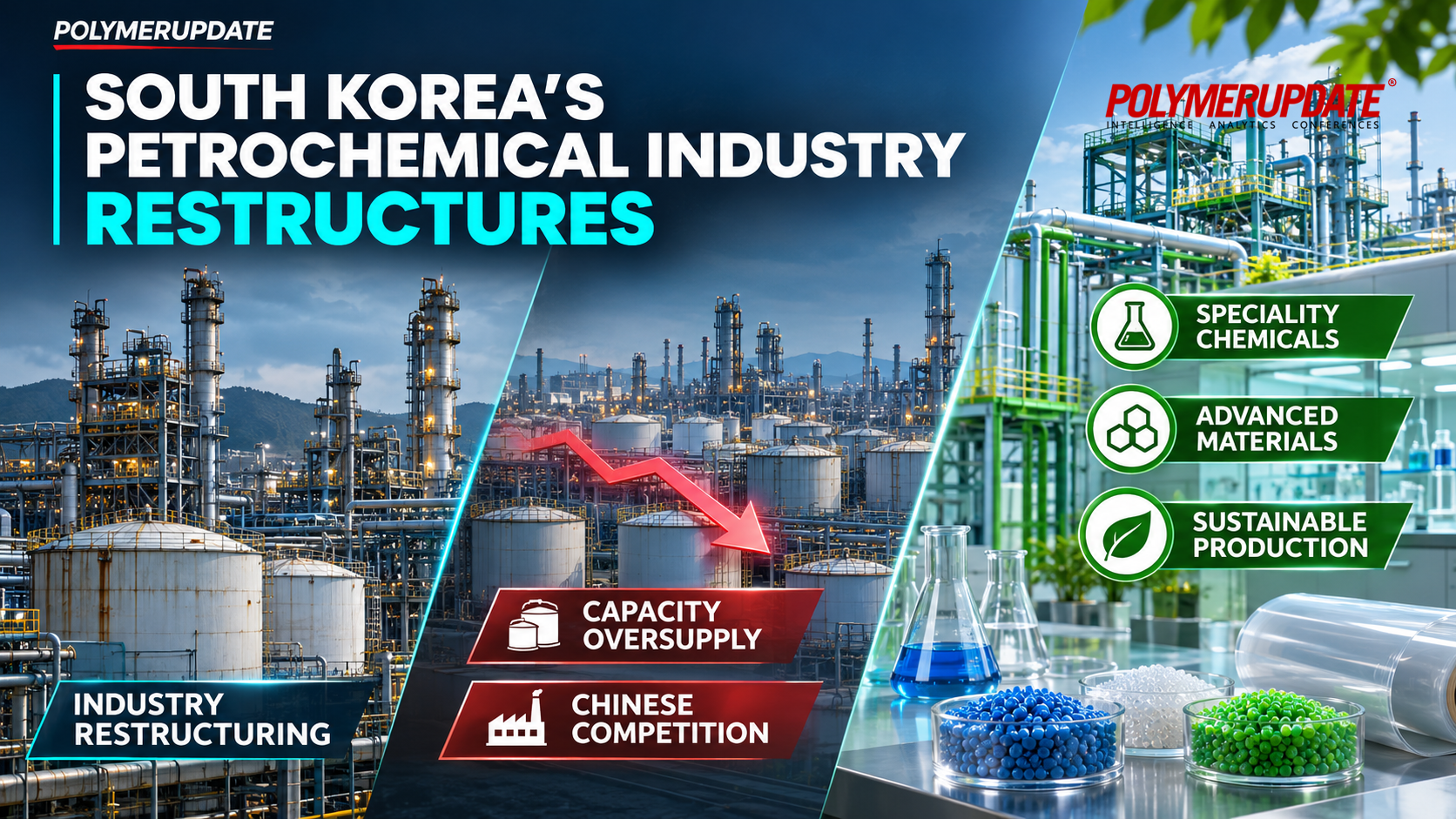
South Korea’s petrochemical industry is accelerating its transition from commodity plastics towards high-value speciality materials, advanced polymers and sustainable chemicals as persistent global oversupply, weak margins and intensifying competition from China undermine the profitability of conventional petrochemical production. According to Spherical Insights, a global data analytics firm, the structural shift reflects manufacturers’ efforts to reduce their dependence on high-volume commodity products and strengthen their presence in technology-intensive applications, including semiconductors, electric vehicles, advanced electronics and healthcare.
The transition is being accompanied by capacity rationalisation, industrial consolidation, greater research and development (R&D) spending and closer collaboration between chemical manufacturers and downstream industries. However, its success will depend on companies’ ability to commercialise innovative products, secure long-term customers and generate adequate returns on investment. Two major restructuring initiatives highlight the scale of the industry's response. In February 2026, South Korea supported a restructuring plan involving Lotte Chemical and HD Hyundai Chemical at the Daesan petrochemical complex, targeting a reduction of 1.1 million metric tonnes of annual naphtha-cracking capacity.
The initiative was accompanied by a financial support package worth 2.1 trillion won (approximately US$1.45 billion). Subsequently, on July 22, 2026, the government approved another restructuring project at Yeosu involving Yeochun NCC, Lotte Chemical, Hanwha Solutions and DL Chemical. The plan envisages idling two ethylene production facilities with combined annual capacity of 1.39 million metric tonnes over three years. The government also pledged more than 700 billion won (approximately US$473 million) in support. These measures underline the growing recognition that maintaining production volumes in an oversupplied market is no longer a sustainable strategy for several domestic producers.
 Oversupply and Chinese competition
South Korea's petrochemical industry has traditionally relied on large integrated complexes producing ethylene, propylene and other basic chemicals used in packaging, construction, automotive components, synthetic fibres and consumer goods. However, substantial capacity additions, particularly in China, have altered global supply-demand dynamics. Chinese manufacturers have expanded production of conventional polymers, intensifying price competition and putting pressure on the margins of South Korean producers.
The industry's production figures reflect these difficulties. South Korea's ethylene production and shipments declined to approximately 10.26 million metric tonnes in 2025 from 10.39 million metric tonnes in 2024. Propylene production and shipments fell more sharply to 8.59 million metric tonnes from 9.22 million metric tonnes over the same period.
Higher feedstock costs, relatively weak downstream demand and volatile international markets have further complicated operating conditions. With standard polyethylene, polypropylene and other commodity products increasingly exposed to price-based competition, manufacturers are seeking opportunities in differentiated products that offer higher technical specifications and greater customer value.
Shift towards advanced materialsThe transition towards speciality chemicals is expected to provide South Korean manufacturers with opportunities to compete on technological capabilities, product performance and application-specific solutions rather than production volumes alone. Advanced polymers and engineering plastics offer applications in automotive components, electrical equipment, industrial machinery and electronics, where heat resistance, chemical stability, electrical insulation and lightweight properties are essential.
The semiconductor industry represents another important growth area. High-purity chemicals, specialised polymers and chip-packaging materials are increasingly important for advanced electronics manufacturing. Similarly, electric vehicles and energy-storage systems require specialised polymers, adhesives, protective coatings and insulating materials for battery safety, thermal management and component durability. Medical devices, healthcare equipment and aerospace applications also offer opportunities for manufacturers capable of meeting stringent quality and performance requirements.
The economic benefits of speciality materials extend beyond potentially higher margins. Developing application-specific products often involves technical collaboration, testing and lengthy customer-qualification processes, which can strengthen supplier relationships and provide greater revenue visibility. However, these advantages are not automatic. Significant investment in research, product development, testing and commercialisation is required before new materials can generate meaningful returns.
Restructuring with innovationAlongside capacity rationalisation, the South Korean government is promoting technological development through its Chemical Industry Innovation Alliance and K-Chemistry Next-Generation Technology Innovation Roadmap 2030. Advanced on March 4, 2026, the initiative seeks to strengthen cooperation between chemical manufacturers, research institutions, smaller businesses and downstream industries, particularly semiconductors, electric vehicles and advanced electronics.
The roadmap identified 217 promising component technologies for assessment and support, drawing on contributions from more than 80 domestic experts. It also promotes artificial intelligence, automated experimentation and intelligent process controls to accelerate material development, improve manufacturing efficiency and optimise energy consumption.
South Korea aims to improve its global ranking in high-value chemical industry competitiveness from fifth in 2025 to fourth by 2030. Achieving this target will require stronger domestic technological capabilities and closer integration between chemical producers and advanced manufacturing industries. The government is also encouraging cleaner production technologies, resource efficiency and the development of sustainable chemicals as environmental requirements become increasingly important for global suppliers.
Major producers’ repositioningSouth Korea's leading chemical companies are adopting different strategies to address the challenging operating environment. LG Chem, which reported consolidated revenue of 45.93 trillion won in 2025, including LG Energy Solution, generated 17.57 trillion won from its petrochemical business and 2.64 trillion won from advanced materials. The company has exposure to both conventional chemicals and higher-value materials.
Lotte Chemical reported consolidated revenue of 18.48 trillion won in 2025 but recorded an operating loss of 943.6 billion won. It is pursuing operational restructuring while prioritising high-performance materials, environmentally friendly businesses and improved cost competitiveness. Hanwha Solutions, with consolidated revenue of 13.33 trillion won in 2025, operates across basic chemicals, advanced materials and renewable energy. Its participation in the Yeosu restructuring initiative reflects the industry's broader efforts to rationalise conventional production.
HD Hyundai Chemical, which operates a petrochemical complex at Daesan with annual ethylene capacity of approximately 850,000 metric tonnes and propylene capacity of 451,000 metric tonnes, is working with Lotte Chemical to improve operational efficiency through restructuring. DL Chemical, another participant in the Yeosu initiative, manufactures petrochemical and polymer products and is also seeking to strengthen its competitive position through industrial rationalisation and downstream integration.
Emerging opportunities and challengesThe transition is opening opportunities in engineering plastics, semiconductor chemicals, battery materials, medical-grade polymers and circular plastics. Chemical recycling, recycled polymers, bio-based feedstocks and lower-emission production processes could also provide alternative growth avenues as manufacturers respond to tightening environmental requirements. Nevertheless, the shift involves considerable commercial and operational risks.
Competition in advanced materials remains intense, with established international suppliers and emerging Chinese manufacturers investing in research and production capabilities. Developing commercially viable speciality products requires substantial capital expenditure, technical expertise and lengthy customer-approval processes. Feedstock security is another concern. South Korea's dependence on imported naphtha exposes manufacturers to fluctuations in international energy prices, shipping costs and geopolitical disruptions. An ethylene facility shutdown at LG Chem in March 2026 also highlighted the operational vulnerabilities facing the industry.
Furthermore, capacity rationalisation could affect employment, contractors, logistics providers and regional economies. Workforce retraining and support for affected communities will therefore be important components of a sustainable restructuring programme. Investments in energy efficiency, emissions reduction, recycling and cleaner feedstocks must also remain commercially viable to ensure that environmental improvements do not further undermine already pressured margins.
OutlookSouth Korea's petrochemical industry is likely to remain focused on restructuring, operational integration and higher-value product development through 2030. The pace of recovery will depend on the extent of capacity rationalisation, improvement in downstream demand and successful commercialisation of advanced materials. Progress should be assessed not merely through announced investment and capacity closures but also through speciality-product sales, plant utilisation, operating margins and repeat customer orders.
Ultimately, South Korea's petrochemical transformation represents a strategic shift from volume-driven commodity manufacturing towards technology-intensive and sustainable chemical production. While opportunities in semiconductors, electric vehicles, healthcare and advanced electronics could strengthen the industry's long-term competitiveness, disciplined capital allocation and commercially successful innovation will determine whether the transition translates into sustainable profitability.
DILIP KUMAR JHA
Editor
dilip.jha@polymerupdate.com