The global chemical industry is unlikely to witness a broad-based recovery in 2027, as persistent overcapacity, uneven end-market demand, geopolitical uncertainties and regional cost disparities continue to weigh on performance. Companies with structural advantages, stronger portfolios, integrated value chains and disciplined capital allocation are expected to be better positioned to navigate volatility and create sustainable value, according to a Deloitte study.
The year 2026 proved challenging for chemical manufacturers, with excess capacity and subdued demand constraining recovery. Geopolitical disruptions, particularly in the Middle East, further affected feedstock availability, energy costs, supply chains and regional competitiveness. Consequently, company performance increasingly depended on factors such as feedstock security, product mix, operational efficiency and geographical presence rather than broader market conditions.
Although some industry participants expect greater stability in 2027, the structural vulnerabilities exposed during 2026 suggest that restoring market balance could take longer. Manufacturers are therefore focusing on portfolio optimisation, operational excellence, innovation and technology adoption rather than simply waiting for the downcycle to end.
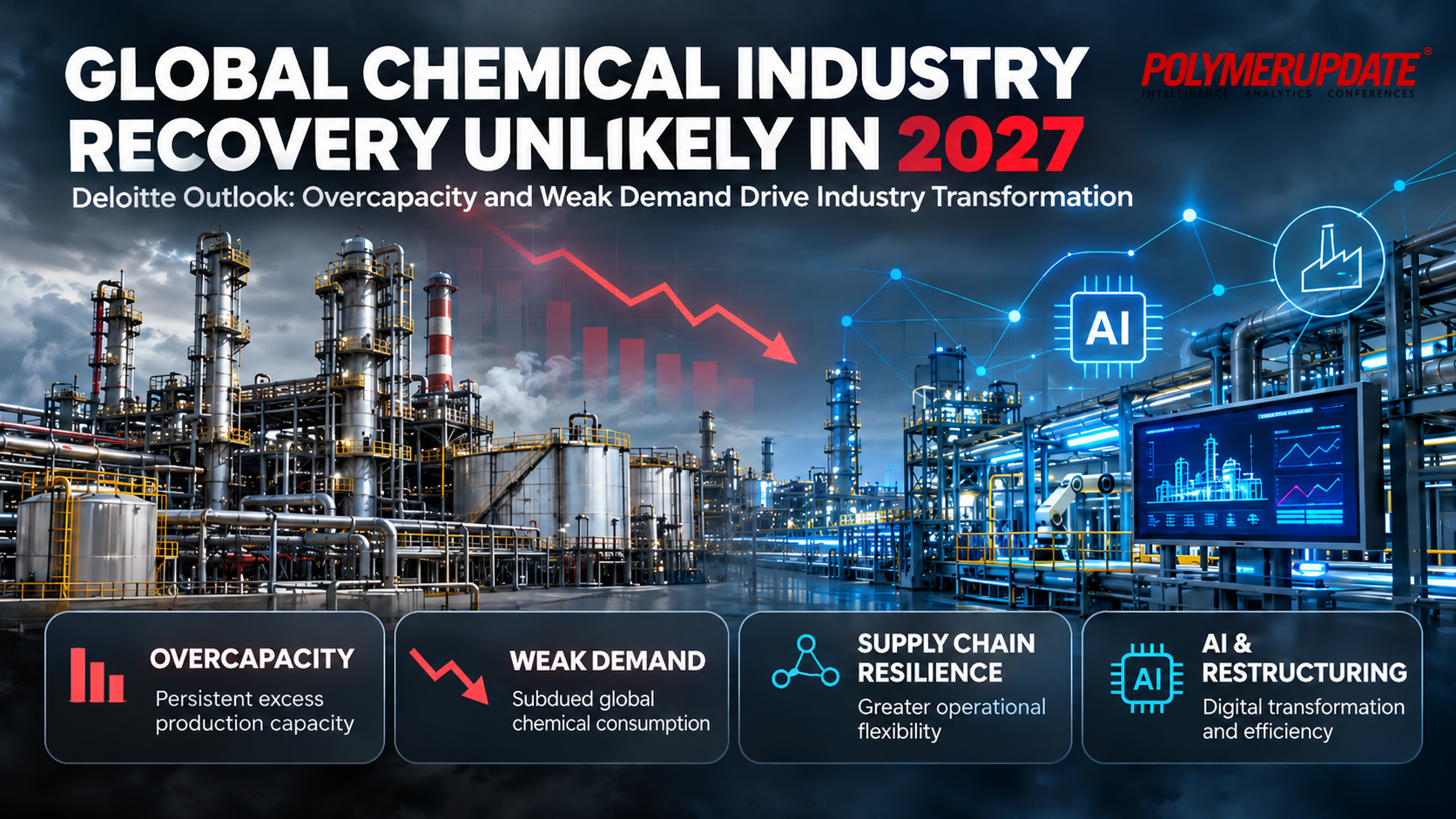
The study identifies five major trends likely to shape the industry in 2027.
1. Supply chain resilience to become a strategic priorityGeopolitical tensions and weather-related disruptions reshaped chemical supply chains in 2026. Middle East disruptions constrained supplies of energy, feedstocks and key chemicals, including polypropylene, methanol and ammonia. Manufacturers responded by shifting production to unaffected regions and rerouting cargoes, increasing transportation costs and delivery timelines. Shipping constraints added to the challenges, with lower water levels affecting transit through the Panama Canal and Rhine River, while the Russia-Ukraine conflict continued to disrupt European supply chains.
In 2027, companies are expected to move towards diversified sourcing, production, inventory and transportation arrangements. Commodity producers may prioritise feedstock flexibility, dual sourcing, regional production and alternative logistics routes, while specialty chemical manufacturers and industrial gas companies could expand facilities closer to customers. Investments in localised storage, digital supply chain monitoring and scenario-based planning are also likely to gain importance as manufacturers seek to reduce geographical and supplier concentration risks.
2. Capacity rationalisation to support strategic reinvestmentFollowing a record number of plant closure announcements in 2025, chemical manufacturers continued restructuring their portfolios in 2026. Divestments, business separations and proposed spin-offs increasingly distinguished commodity operations from higher-value businesses. Mergers and acquisitions became more selective, with buyers prioritising assets offering feedstock access, proprietary technology, economies of scale and downstream integration. While China continued adding capacity and European investments remained subdued, capital expenditure increasingly favoured electronics, advanced materials and competitively positioned US assets.
Persistent oversupply, particularly in commodity chemicals exposed to expanding Chinese capacity, continues to constrain recovery. Middle East disruptions have temporarily altered utilisation rates and pricing but have not resolved the underlying capacity imbalance. In 2027, announced rationalisation programmes are expected to translate into permanent capacity reductions.
Divestments and strategic acquisitions will likely focus on businesses offering sustainable cost advantages, feedstock security and access to attractive end markets rather than simply expanding production. Companies may redirect capital towards advanced materials, specialty products and structurally competitive assets. Partnerships and selective investments could also help manufacturers pursue growth opportunities without putting excessive pressure on their balance sheets.
3. Shift from volume growth to high-value applicationsUneven demand across traditional chemical markets has encouraged manufacturers to explore advanced manufacturing and specialised applications. During 2026, semiconductor-related gases, electronic materials, high-purity water and fabrication infrastructure supported demand. Aerospace, space, biopharmaceuticals, cleanroom protection, data-centre thermal management and electric vehicle battery applications also generated growth opportunities.
More than 80 percent of basic and specialty chemicals are purchased directly by industrial sectors, making chemical demand closely linked to industrial investment trends. In 2027, manufacturers are expected to strengthen their presence in semiconductor fabrication and advanced packaging, which require high-purity gases, electronic chemicals, process-water treatment, hydrogen and dedicated on-site supply infrastructure. Companies may expand production facilities closer to major customer clusters in North America and Asia.
Industrial gases could particularly benefit from demand across electronics, manufacturing, energy, metallurgy and healthcare. High-purity and specification-critical materials offer attractive margins because stringent qualification requirements and specialised production capabilities make substitution difficult. The industry is consequently expected to prioritise high-value products and customer-specific applications over additional undifferentiated commodity capacity.
4. Customer partnerships, innovation and AI to gain importanceChemical customers are increasingly seeking reliable supplies, technical expertise, application support and solutions that improve production processes rather than simply purchasing products by volume.
Artificial intelligence (AI) is expected to support this transition by helping companies identify customer requirements, accelerate formulations, improve manufacturing efficiency and optimise plant operations.
AI spending in the chemical industry is projected to increase from US$ 1.4 billion in 2024 to US$ 8 billion in 2029. Applications include advanced sealants that reduce manual installation in aerospace, digital formulation platforms that help coatings customers select additives and troubleshoot defects, and AI-enabled colour and fragrance formulations that reduce development time and repeated trials.
In 2027, manufacturers are expected to integrate technical expertise, digital tools and application engineering into commercial offerings. Closer collaboration between commercial teams, scientists and plant operators, alongside long-term supply agreements, could strengthen customer relationships. The concept of generating value beyond the molecule is likely to gain traction, with reliable supply, technical services and AI-enabled collaboration becoming important competitive differentiators.
5. Operating models to undergo structural transformationConventional cost-cutting and plant closures alone may not be sufficient to restore long-term competitiveness. Chemical companies are increasingly redesigning operating models by eliminating organisational duplication, simplifying decision-making and reallocating resources towards higher-value activities. A major challenge will be managing commodity and specialty businesses within the same organisation. Commodity operations require scale, cost discipline, feedstock advantages and asset reliability, whereas specialty businesses depend on customer relationships, technical expertise and faster innovation cycles.
In 2027, manufacturers are expected to strengthen shared services and global capability centres while expanding automation, analytics and digital platforms. Enterprise resource planning modernisation, predictive maintenance, digital twins, automated scheduling and logistics visibility could improve operational efficiency. AI applications are also likely to expand across demand forecasting, supply planning, pricing, logistics and working capital management. Better integration of taxation, supply chains, transfer pricing, toll manufacturing and enterprise systems could further convert restructuring savings into sustainable competitive advantages.
Strategic priorities for 2027The Deloitte study concludes that structural overcapacity, uneven demand, geopolitical volatility and regional production-cost differences are likely to remain key challenges for the chemical industry. A broad-based cyclical recovery alone may not resolve these fundamental issues. Companies that streamline operations, improve asset utilisation, strengthen working capital, secure competitive feedstock positions and selectively invest in innovation and advanced technologies are expected to be better positioned to generate sustainable returns. Ultimately, industry performance in 2027 may depend less on the timing of a broad market recovery and more on individual companies' ability to build and leverage structural competitive advantages.
DILIP KUMAR JHA
Editor
dilip.jha@polymerupdate.com