US manufacturing activity strengthened in October, supported by resilient economic growth, rising investments in technology, the protective impact of tariffs and the country's energy security advantages. However, the recovery remains uneven, with high-value manufacturing segments such as technology, pharmaceuticals, electronics, transportation and power-related industries significantly outperforming traditional, labour-intensive and commoditised manufacturing sectors.
The latest manufacturing activity data point towards sustained expansion, with production reaching its highest level in five years. Healthy new orders and order backlogs also indicate that manufacturers are entering the final quarter of 2026 on a relatively strong footing. Nevertheless, persistent cost pressures, international competition and the impact of higher interest rates continue to create challenges for several segments of the industrial economy.
The October manufacturing data released by the Institute for Supply Management (ISM) showed that its manufacturing purchasing managers' index (PMI) rose to 55.5 from 54.5 in September, exceeding market expectations that it would remain unchanged. A reading above 50 indicates expansion, while a reading below that threshold signals contraction. The latest increase therefore points towards an acceleration in manufacturing activity.
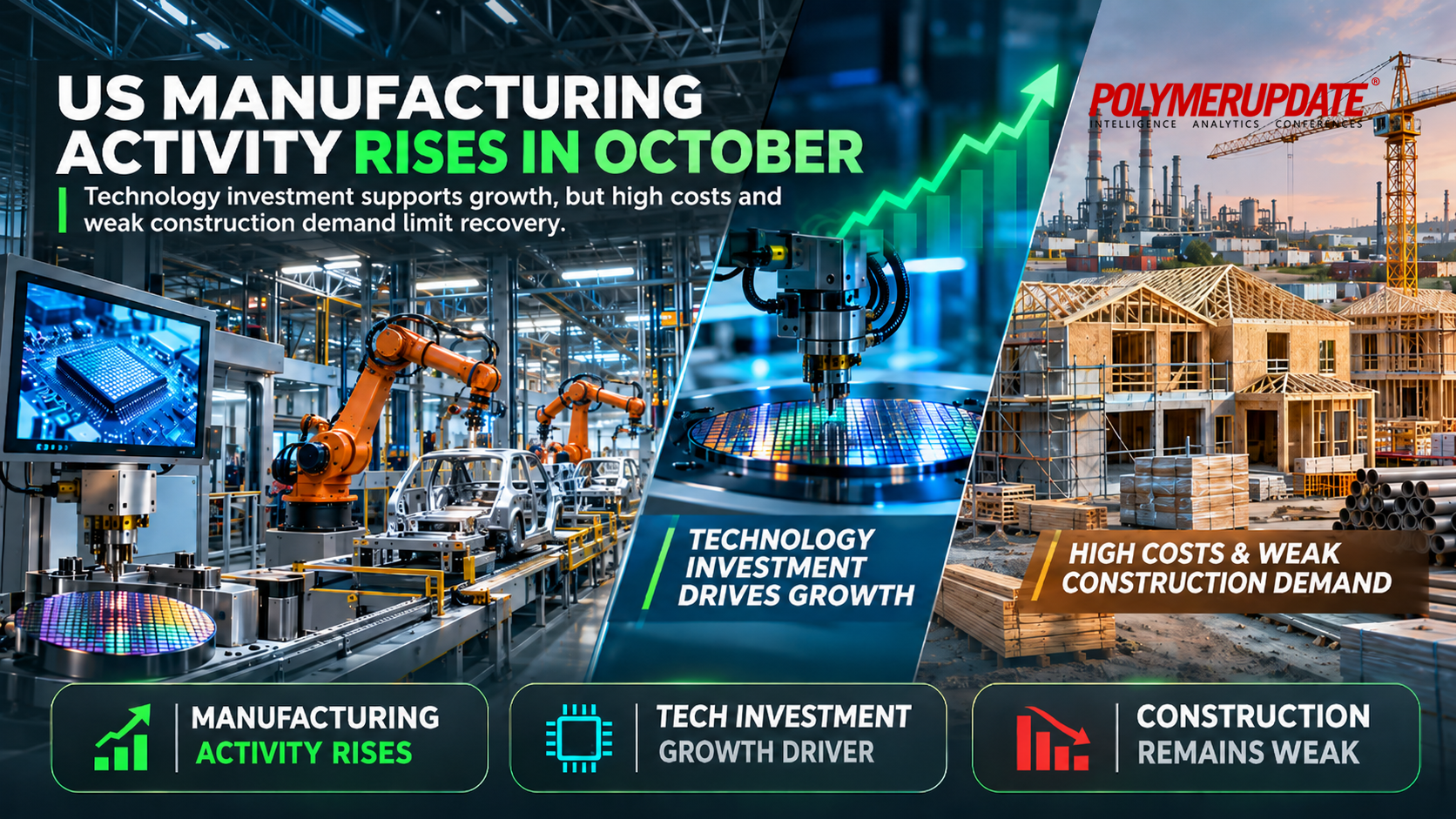 Production index climbs
More importantly, the production index climbed to 59.0 in October from 56.7 in September, marking its highest level in five years and indicating a substantial improvement in factory output. The strong production reading suggests that manufacturers are responding to improving demand conditions and maintaining higher operating activity. The new orders index stood at 55.5, while the backlog of orders index reached 54.6, reflecting healthy demand and a favourable pipeline of business for manufacturers.
Both indicators remained comfortably above the expansion threshold, suggesting that the improvement in production is supported by underlying demand rather than being driven solely by inventory accumulation. The employment index, however, edged down marginally to 52.4 in October from 52.7 in September. Despite the slight moderation, the reading remained in expansion territory, indicating that manufacturing employment should continue contributing positively to the broader US labour market.
The sector's employment performance is also expected to provide support to the country's upcoming monthly non-farm payrolls figures. Meanwhile, the prices paid index remained elevated at 75.2, broadly in line with its six-month average. The persistently high reading highlights continuing input-cost pressures for manufacturers, potentially reflecting the impact of tariffs, raw material expenses and other production-related costs.
Technology leads growthThe improvement in US manufacturing activity reflects a combination of favourable domestic economic conditions and structural advantages that have strengthened the country's industrial competitiveness. The US economy continues to outperform several other major economies, providing domestic manufacturers with a relatively supportive demand environment. In addition, tariffs and improved energy security have increased the attractiveness of domestic manufacturing by encouraging companies to reassess supply chains and production locations. However, the benefits of these developments are not being distributed evenly across industries.
High-value-added and advanced manufacturing segments, particularly technology, electronics, transportation and power-related industries, have recorded significantly stronger performance than traditional manufacturing activities. The growing demand for artificial intelligence (AI), data centres, semiconductor-related infrastructure and advanced electronics has emerged as an important driver of industrial investment. Companies are committing substantial capital to expand computing capacity, strengthen digital infrastructure and secure reliable electricity supplies.
Additional demand driversThese investments are creating additional demand for industrial equipment, electrical components, construction materials and other manufacturing inputs. The transportation and pharmaceutical industries have also demonstrated greater resilience compared with several traditional manufacturing segments. Their relatively stronger performance reflects technological advancement, specialised production capabilities and the ability of companies to operate in higher-value market segments. The outlook for US advanced manufacturing is expected to remain favourable as investment in technology infrastructure continues.
Furthermore, increasing defence expenditure across several countries could provide another source of demand for American manufacturers. The global geopolitical environment has prompted governments to reassess defence preparedness and strengthen military capabilities. This trend could benefit US defence companies through larger procurement programmes, stronger order books and increased demand for specialised equipment and advanced manufacturing components. The expansion of domestic defence production could also support demand across associated industrial supply chains, including electronics, engineering, materials and power systems.
Competitive pressuresIn contrast, the outlook for traditional, labour-intensive and commoditised manufacturing remains challenging. US producers operating in these segments continue to face intense competition from overseas manufacturers, particularly those benefiting from lower labour costs, established production networks and economies of scale. The relatively high cost of manufacturing in the US makes it difficult for domestic producers to compete with international suppliers, even with tariff protection.
Although tariffs have improved the competitive position of certain domestic manufacturers by increasing the cost of imported products, they have not been sufficient to eliminate the structural cost disadvantages faced by several US industries. Manufacturers also face the risk of retaliatory trade measures in overseas markets, which can adversely affect export competitiveness and restrict access to international customers.
Consequently, companies dependent on traditional manufacturing and export-oriented business models may continue to experience pressure on margins and market share. This divergence suggests that the current improvement in US manufacturing is not necessarily indicative of a broad-based industrial recovery. Instead, growth is increasingly concentrated in industries benefiting from technological innovation, specialised production capabilities, strategic investment and favourable long-term demand trends.
Construction slowdownWhile manufacturing activity has strengthened, the construction sector presents a less encouraging picture, reflecting the continuing impact of high borrowing costs and affordability constraints. US construction spending declined 1.9 percent month-on-month in September, reversing a 2 percent increase in August. The August growth figure was initially reported at 0.9 percent, highlighting the substantial revision in the underlying data. Residential construction spending has witnessed particularly sharp fluctuations in recent months. Spending increased 3.6 percent month-on-month in August before declining 5.5 percent in September, indicating considerable volatility in housing-related investment.
Despite these monthly swings, the broader trend in residential construction spending remains downward. Elevated mortgage rates and deteriorating housing affordability have continued to weigh on homebuyers, limiting demand for new residential projects and discouraging developers from committing to fresh investments. Higher financing costs have also increased the financial burden on construction companies and property developers, making several projects less attractive under prevailing market conditions.
The weakness in residential construction highlights the vulnerability of interest-rate-sensitive sectors to the relatively high cost of borrowing. Although the broader US economy remains resilient, the benefits of economic growth are not being felt uniformly across all industries.
Non-residential constructionNon-residential construction spending has demonstrated a more resilient performance, although the improvement is heavily concentrated in data centre-related investments. Construction spending on data centres increased 8.6 percent month-on-month and surged 90.3 percent year-on-year, highlighting the extraordinary pace of investment in digital infrastructure. The rapid expansion of artificial intelligence applications, cloud computing and high-performance computing has triggered substantial demand for data centre capacity.
Technology companies are investing aggressively in new facilities to accommodate growing computing requirements, creating a significant pipeline of construction and infrastructure projects. These developments are also generating demand for electricity generation and transmission infrastructure, cooling systems, electrical equipment, steel, copper and other industrial materials required to build and operate large-scale data centres.
Outside data centres and electric power-related projects, however, non-residential construction spending has largely stagnated. This indicates that the strength of the overall segment is being driven by a relatively narrow group of technology and infrastructure investments rather than a widespread recovery in commercial and industrial construction. The contrast between robust data centre investment and subdued activity across other non-residential segments further underlines the growing influence of technology-related spending on the US economy.
Uneven recoveryThe latest economic indicators suggest that US manufacturing is benefiting from a combination of resilient domestic demand, technological investment, tariff protection and improved energy security. These factors are likely to support continued expansion in advanced manufacturing, particularly technology, electronics, transportation, pharmaceuticals and power-related industries. However, traditional manufacturing sectors are unlikely to experience a comparable improvement unless domestic producers can overcome their structural cost disadvantages and regain competitiveness against international suppliers.
The construction sector also presents a mixed outlook. Continued investment in data centres and electricity infrastructure should support selected industrial activities, while residential construction and other interest-rate-sensitive segments may remain under pressure as financing costs and affordability constraints persist. Overall, the US industrial economy appears to be undergoing a structural shift towards technology-intensive and higher-value manufacturing.
While the latest ISM readings indicate strong momentum in factory production, the divergence between advanced and traditional industries suggests that the recovery will remain uneven. The sustainability of this momentum will depend on the ability of manufacturers to manage elevated input costs, maintain competitiveness and convert strong order pipelines into sustained production growth. Technology investment and strategic infrastructure spending are likely to remain the principal drivers of industrial expansion in the months ahead.
DILIP KUMAR JHA
Editor
dilip.jha@polymerupdate.com