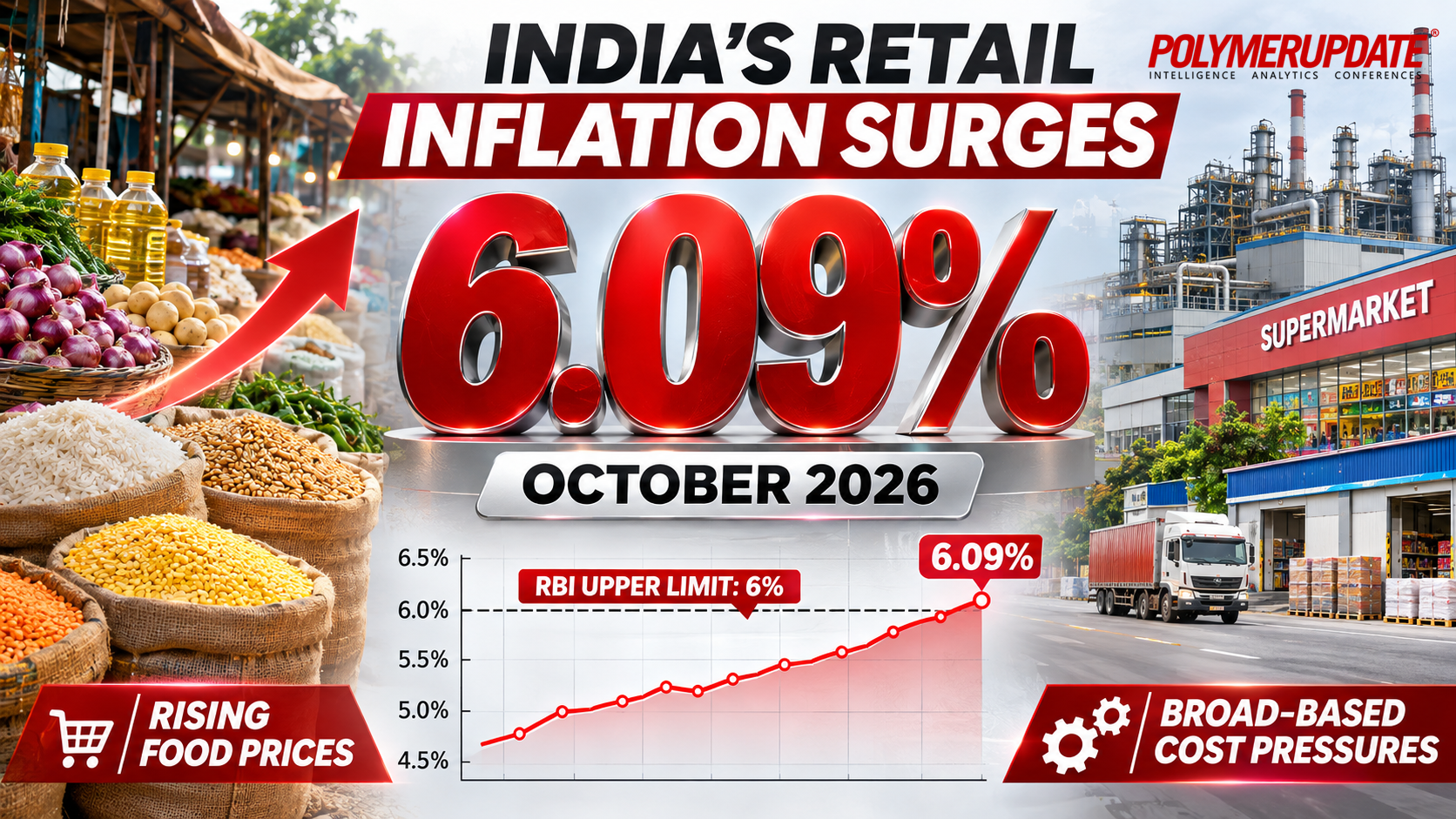
India’s Consumer Price Index (CPI)-based retail inflation accelerated to a two-year high of 6.09 percent in October 2026, breaching the Reserve Bank of India’s (RBI) upper tolerance limit of 6 percent for the first time in the current inflationary cycle, as rising food prices and higher costs across a broad range of goods and services intensified household expenditure pressures. The CPI inflation increased from 5.54 percent in September 2026 and was substantially higher than the historic low of 0.25 percent recorded in October 2025.
The latest reading reflects a broad-based acceleration in price pressures, with 11 of the 12 major consumption categories registering higher inflation compared with the previous month. The increase was largely driven by food and beverages, restaurants and accommodation, personal care products, clothing and footwear, transport and healthcare services. The acceleration in inflation beyond the RBI’s prescribed tolerance band could complicate the central bank’s monetary policy decisions, particularly as food prices remain vulnerable to supply-side disruptions and uncertainties surrounding agricultural production.
According to the Ministry of Statistics and Programme Implementation (MoSPI), year-on-year inflation based on the All India Consumer Price Index, with 2024 as the base year, stood at 6.09 percent in October 2026 over October 2025 on a provisional basis. Rural inflation was considerably higher at 6.63 percent, while urban inflation stood at 5.41 percent. The relatively sharper increase in rural inflation reflects the greater weight of food products in rural consumption baskets, making rural households particularly vulnerable to fluctuations in agricultural commodity prices.
Madan Sabnavis, Chief Economist at Bank of Baroda, said October's retail inflation was broadly in line with the bank's forecast of 6 percent. He noted that inflationary pressures had become broad-based, with 11 of the 12 major sectors recording higher inflation than in September. Food and beverages inflation reached 8.5 percent, while personal care products and restaurants and accommodation also registered substantial increases.
 Exceptionally low inflation last year
The exceptionally low inflation recorded in October last year was partly attributable to a favourable base effect, adjustments in Goods and Services Tax (GST) rates and a sharp decline in food and vegetable prices. Retail inflation had fallen from 1.44 percent in September 2025 to just 0.25 percent in October 2025, substantially below the RBI's mandated tolerance range of 2-6 percent. The reversal in the inflation trajectory over the past year highlights the challenges facing policymakers in maintaining price stability amid volatile food prices and rising input costs.
Sabnavis cautioned that food inflation could remain elevated, pointing to a double-digit increase in Bank of Baroda's Essential Commodities Index (BoB ECI) during October and the first week of November. He added that the emerging harvest situation would provide greater clarity on the likely direction of food prices.
Food inflation emerges as principal concernFood inflation remained the principal driver of the October increase, with inflation based on the Consumer Food Price Index (CFPI) accelerating to 8.94 percent year-on-year, according to MoSPI. Rural food inflation stood at 9.09 percent, while urban food inflation was recorded at 8.68 percent, indicating that households across both segments continued to face significant pressure from rising food expenditure. The food and beverages category registered inflation of 8.51 percent during October. Higher prices of essential food products, coupled with supply-side uncertainties, have raised concerns about the persistence of food-led inflation over the coming months.
However, price movements were not uniform across agricultural commodities. Potato prices declined by 14.24 percent in October, while cauliflower prices fell by 10.57 percent. Brinjal and cabbage prices also eased during the month, providing some relief to consumers. Despite these declines, the broader food inflation outlook remains uncertain. Reports of lower cultivated areas under rice, maize, oilseeds, cotton and sugarcane have raised concerns about agricultural supplies. Pulses production, particularly tur (pigeon pea), is also expected to be lower, potentially adding to upward pressure on prices.
Any shortfall in agricultural output could intensify food inflation, particularly if demand remains firm and market arrivals fail to improve sufficiently. The trajectory of vegetable prices, pulses and cereals will therefore be critical in determining whether the latest inflation spike proves temporary or develops into a more persistent trend.
Restaurants, personal care and transport costs riseBeyond food, inflationary pressures have extended to several service-oriented and non-food categories, highlighting the widening nature of the price increases. Restaurants and accommodation recorded inflation of 10.06 percent in October, while personal care and social protection registered an even higher increase of 10.14 percent. The sustained rise in restaurant-related costs reflects the impact of higher operating expenses, including cooking fuel, energy, transportation and other inputs.
Industry operators generally pass on increases in input costs to consumers, although price reductions are less frequent when energy and other input costs subsequently decline. Consequently, restaurant and accommodation inflation could remain elevated even if some underlying input costs moderate, as businesses seek to protect operating margins. Transport inflation stood at approximately 5.8 percent, reflecting the continued impact of elevated fuel and related operating expenses. Retail fuel prices have remained relatively resistant to downward movements despite fluctuations in international crude oil prices.
Oil marketing companies (OMCs), which incurred substantial losses when international crude prices were elevated, may be reluctant to reduce retail fuel prices immediately, even if global oil prices retreat towards US$80 per barrel. This could keep transportation costs elevated and delay the transmission of any decline in international crude prices to consumers. Personal care and social protection inflation, although still elevated at 10.14 percent, moderated from 13.8 percent in September.
This was the only major category to record a decline in its inflation rate compared with the previous month, suggesting some easing of price pressures in this segment. Meanwhile, prices of paan, tobacco and intoxicants increased by 4.93 percent, while clothing and footwear became 4.96 percent more expensive. Healthcare-related expenses also increased, adding to the overall household expenditure burden.
Rural households face greater inflationary pressureThe divergence between rural and urban inflation remains an important feature of the latest data. Rural inflation of 6.63 percent was substantially higher than the urban rate of 5.41 percent, primarily reflecting the greater contribution of food products to rural household expenditure. States including Andhra Pradesh, Telangana, Tamil Nadu, Madhya Pradesh and Odisha continued to report relatively high inflation, with food prices remaining a dominant contributing factor.
The higher rural inflation rate could also affect consumption demand, particularly for discretionary products, as households allocate a larger proportion of their income towards essential food items. This could have implications for manufacturers of consumer goods, automobiles and other products catering to rural markets. For the fast-moving consumer goods (FMCG) industry, rising input costs and higher operating expenses could translate into further price increases.
Companies have already begun raising product prices in response to cost pressures, potentially contributing to an increase in core inflation. Sabnavis expects core inflation to move towards the 4.5 percent mark by the end of the calendar year, supported by higher prices of consumer products, including mobile phones, televisions, vehicles and healthcare services.
RBI faces difficult monetary policy choicesThe acceleration in retail inflation above the RBI's upper tolerance limit could place additional pressure on the central bank to reassess its monetary policy stance. With food inflation remaining elevated and core inflation showing signs of strengthening, the scope for an immediate easing of monetary conditions could become increasingly limited. Sabnavis expects the RBI to consider a policy rate increase of either 25 or 50 basis points at its December monetary policy review, particularly if inflation remains close to 6 percent during November and December.
A potential rate increase would reflect the central bank's concern that persistent food inflation could gradually spread into other segments of the economy through higher wages, transportation costs, manufacturing expenses and consumer prices. However, monetary tightening also carries economic trade-offs. Higher interest rates could increase borrowing costs for businesses and households, potentially affecting private investment, consumer spending and demand recovery.
Manufacturing sectorFor India's manufacturing sector, particularly industries dependent on energy, petrochemical feedstocks, transportation and consumer demand, sustained inflation could create additional operating challenges. Higher logistics and input costs may put pressure on margins, while elevated interest rates could raise the cost of financing working capital and capacity expansion.
The October inflation data therefore presents a challenging outlook for both policymakers and businesses. While declining prices of selected vegetables offer some relief, the broader acceleration across food, services and consumer goods suggests that inflationary pressures are becoming increasingly entrenched.
The direction of agricultural production, food supplies, international crude oil prices and the ability of companies to absorb higher input costs will remain crucial in determining the inflation trajectory over the coming months. With retail inflation already exceeding the RBI's upper tolerance threshold, the December policy review could prove particularly important in shaping India's monetary policy outlook for the remainder of FY2026-27.
DILIP KUMAR JHA
Editor
dilip.jha@polymerupdate.com