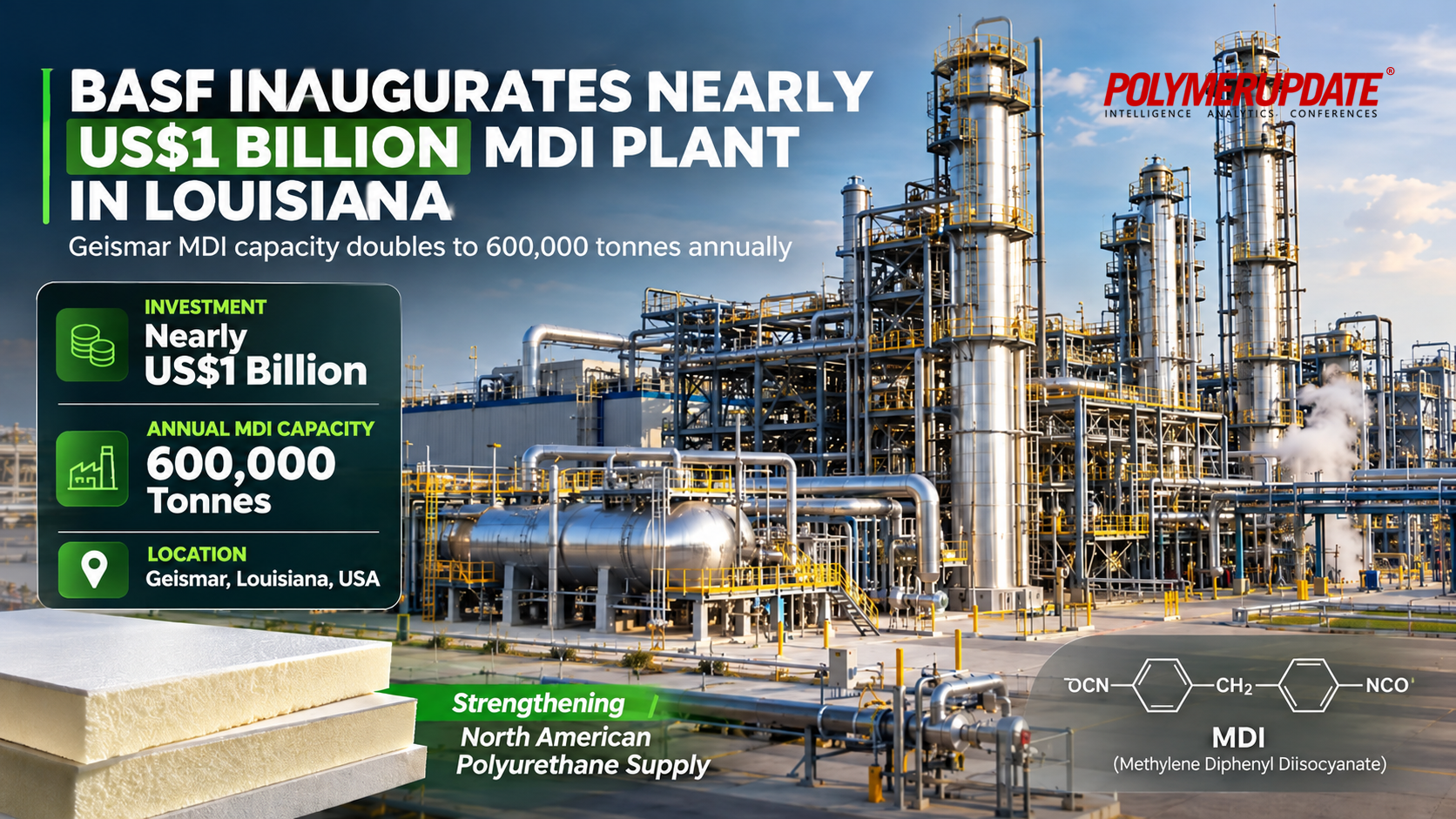
German multinational chemical company, BASF SE has inaugurated its new methylene diphenyl diisocyanate (MDI) production plant at its Geismar site in Louisiana, marking a nearly US$1 billion investment aimed at expanding its manufacturing capabilities, increasing production flexibility and strengthening its position in the North American polyurethane market. The inauguration represents a significant milestone in the German chemicals major's strategy to expand local manufacturing and serve customers through regionally integrated production facilities.
The new plant is expected to enhance the availability of MDI for downstream polyurethane manufacturers while improving supply-chain resilience and reducing the industry's exposure to long-distance imports and international logistics disruptions. The inauguration ceremony was attended by customers from across the region, government representatives, community stakeholders and BASF executives, including Chief Executive Officer Markus Kamieth.
The investment underscores BASF's commitment to its local-for-local strategy, the US manufacturing sector and the broader polyurethane industry. By expanding production capacity within the country, the world’s biggest chemical manufacturing company aims to strengthen its ability to respond to changing customer requirements, improve operational flexibility and support the long-term development of downstream industries.
 Capacity nearly doubles
The expansion almost doubles the annual MDI production capacity at the Geismar site to approximately 600,000 tonnes, positioning BASF as the largest MDI producer in North America. The investment is expected to strengthen the company's ability to meet rising regional demand for polyurethane-based products while providing customers with a more dependable domestic source of supply. The project was implemented in three phases, beginning in 2018. BASF commissioned a new MDI synthesis unit in 2020, followed by expansions of several upstream production units in 2021.
The final phase involved the construction of additional upstream facilities and a splitter, incorporating advanced production technologies, digitalisation and improved operational capabilities. The integrated expansion is designed to provide greater production flexibility, improve manufacturing efficiency and strengthen supply reliability. The company has also invested in predictive maintenance technologies and logistics infrastructure to improve supply assurance and customer service across North America.
BASF Chairman and Chief Executive Officer Markus Kamieth said the investment reflected the company's long-term commitment to the US market and its customers. He noted that the new world-scale facility would strengthen BASF's core businesses, support innovation and bring production closer to customers. Ramkumar Dhruva, President of BASF's Monomers Division, said the investment demonstrated the company's confidence in the continued growth of the polyurethane market. He highlighted the importance of providing customers with a reliable, competitive and locally integrated supply source.
Benefits for the US downstream polyurethane industryThe expanded facility is expected to provide considerable benefits to the US downstream polyurethane industry, particularly manufacturers operating in construction, automotive, transportation, household appliances, furniture, footwear and other industrial applications. MDI is one of the principal raw materials used in manufacturing polyurethane, a versatile polymer known for its insulation properties, durability, strength and lightweight characteristics. Depending on the formulation, polyurethane can be manufactured as rigid or flexible foam, elastomers, coatings, adhesives and sealants.
Rigid polyurethane foam is widely used in building insulation, refrigeration equipment, commercial cold-storage facilities and energy-efficient construction materials. Flexible polyurethane foam finds extensive applications in furniture, mattresses, automotive seating and cushioning products. With Geismar's annual MDI production capacity increasing to approximately 600,000 tonnes, downstream manufacturers are expected to benefit from improved access to domestically produced raw materials. The availability of a larger local supply base could reduce their dependence on imported MDI and exposure to international freight costs, shipping delays, currency fluctuations and geopolitical disruptions.
For polyurethane processors, a more dependable supply of MDI is particularly important because interruptions in the availability of key chemical inputs can affect production schedules, inventory management and contractual commitments to customers. The additional capacity could also provide downstream manufacturers with greater flexibility to plan production and expand operations in response to market demand. Improved access to locally manufactured MDI may encourage investments in new polyurethane processing capabilities and value-added applications across the region.
However, the extent to which the additional production capacity influences domestic MDI prices will depend on overall market demand, operating rates, competing supply and international trade flows. The expansion is more immediately significant for supply security and production flexibility than any guaranteed reduction in raw material prices.
Strengthens upstream supply chainAnother important aspect of the Geismar investment is the expansion of BASF's aniline production capabilities, which further strengthens the integration of its manufacturing operations. Aniline is an important intermediate in the MDI manufacturing process. Increasing its production capacity alongside MDI facilities allows BASF to reinforce its upstream supply chain, improve raw material availability and achieve greater operational integration. The additional aniline production capacity will also enable the company to increase direct sales to customers in North America, particularly those operating in agricultural chemicals, rubber, dyes and pigments industries.
This broadens the benefits of the investment beyond polyurethane manufacturers and strengthens the regional availability of important chemical intermediates. The Geismar complex is BASF's largest integrated Verbund manufacturing site in the United States. Its established infrastructure, access to raw materials and operational synergies provide an advantage in manufacturing and distributing chemicals to customers across the region.
The expansion is also strategically important for the US chemicals industry, which has faced changing trade flows, supply-chain uncertainties and increasing competition in global petrochemical markets. Strengthening domestic production of essential chemical intermediates could help improve the competitiveness of downstream manufacturers and reduce their exposure to external supply disruptions.
Strategic significance for BASFThe inauguration reinforces BASF's local-for-local manufacturing strategy, under which the company seeks to produce materials closer to the markets where they are consumed. BASF operates more than 150 locations across 40 US states. In 2025, approximately 90% of its sales of €13.1 billion in the country came from products manufactured domestically, highlighting the importance of its local manufacturing footprint. The nearly US$1 billion investment is BASF's largest wholly owned investment project in North America to date. Its completion also strengthens the company's competitive position against other regional and international MDI suppliers.
The expansion comes at a time when demand for energy-efficient buildings, lightweight automotive components, advanced insulation materials and durable consumer products is creating opportunities for polyurethane manufacturers. In particular, the growing emphasis on building energy efficiency and thermal insulation is expected to support demand for rigid polyurethane foam. Similarly, automotive manufacturers' efforts to reduce vehicle weight and improve comfort are supporting the use of polyurethane-based materials in vehicle interiors and components.
The additional MDI capacity could therefore help BASF's customers capture future growth opportunities by providing a larger and more flexible domestic supply base. Overall, the Geismar expansion represents more than an increase in BASF's MDI manufacturing capacity. By strengthening upstream integration, improving supply reliability and bringing production closer to downstream customers, the investment is expected to reinforce the North American polyurethane value chain and support the long-term competitiveness of the US chemicals and plastics processing industries.
DILIP KUMAR JHA
Editor
dilip.jha@polymerupdate.com