Thailand's leading petrochemical companies, PTT Global Chemical Public Company Limited (GC) and SCG Chemicals Public Company Limited (SCGC), have announced plans to combine their olefins and polyolefins businesses in Thailand through a proposed joint venture, in a strategic move aimed at strengthening the country's petrochemical industry's competitiveness in global markets. The proposed partnership will bring together the complementary manufacturing capabilities, feedstock flexibility, technological expertise, research and development (R&D) strengths, high value-added (HVA) product portfolios and international customer networks of the two companies.
The combination is expected to establish a larger and more competitive petrochemical business, strengthen Thailand's position as a regional manufacturing hub and support the long-term development of downstream industries. The combined business is expected to have an olefins production capacity of approximately 7.1 million tonnes per year (tpa), placing it among the largest olefins producers globally. It will also rank among the world's 10 largest polyolefins producers by production capacity and establish a leading position in the Association of Southeast Asian Nations (ASEAN) region.
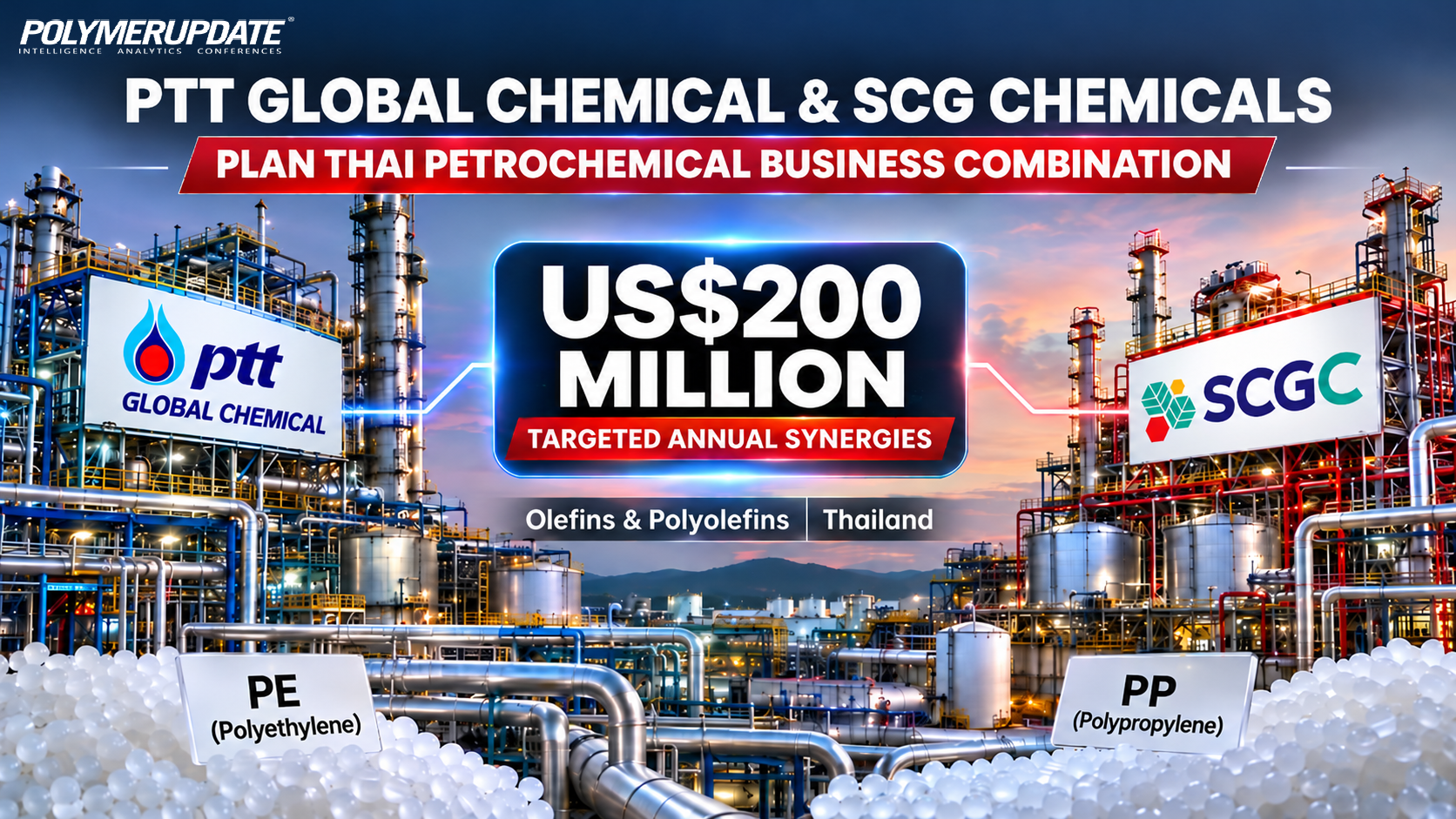
The companies expect the partnership to generate annual synergies of approximately US$ 150–200 million, with the full benefits progressively realised over a period of around three years. These synergies are expected to arise from improved operational efficiency, greater feedstock optimisation, infrastructure sharing, manufacturing integration and the utilisation of complementary technological and commercial capabilities.
The proposed integration comes at a time when the global petrochemical industry is facing considerable challenges, including volatile feedstock prices, persistent capacity additions, changing demand patterns, competitive pressure from low-cost producers and the need to accelerate the development of higher-value products. By combining their respective strengths, GC and SCGC aim to improve operational resilience, optimise production economics and enhance their ability to compete in an increasingly challenging international market.
 Map Ta Phut to emerge as a regional petrochemical hub
A major strategic objective of the partnership is to strengthen Map Ta Phut's position as Thailand's principal petrochemical manufacturing centre and develop it further into a regional petrochemical hub. The industrial complex, located in Rayong Province, is one of Thailand's most important petrochemical and industrial zones. The proximity of GC's and SCGC's manufacturing facilities in Map Ta Phut provides an opportunity to integrate operations, improve supply-chain efficiency and optimise the utilisation of existing infrastructure.
The proposed joint venture is expected to facilitate more efficient management of feedstocks and production processes through the coordinated utilisation of infrastructure, including feedstock pipelines, utilities and production support systems. Sharing these facilities could help reduce operational costs, improve manufacturing efficiencies and enhance the reliability of raw material supplies.
Commenting on the proposed partnership, GC Chief Executive Officer Narongsak Jivakanun, “The collaboration was intended to build on Map Ta Phut's position as Thailand's petrochemical industrial base and develop it into a regional manufacturing hub. The integration of the manufacturing capabilities of both companies with their respective research and development expertise would support the development of products and solutions tailored to the requirements of downstream industries.”
The partnership is also expected to benefit Thai businesses, including small and medium-sized enterprises (SMEs), by providing access to higher-value materials, innovative product solutions and improved opportunities to strengthen their competitiveness in domestic and international markets.
Complementary feedstock and manufacturing strengthsOne of the principal advantages of the proposed combination will be GC's expertise in managing a flexible and diversified feedstock portfolio. The company has capabilities in utilising different feedstocks, including naphtha, liquefied petroleum gas (LPG), propane and ethane. This flexibility provides an important competitive advantage in an industry where feedstock availability and pricing can significantly influence production costs and operating margins.
GC's refinery operations further strengthen its position by providing greater feedstock supply security and the ability to respond to fluctuations and uncertainties in global energy and petrochemical markets. The company's integrated manufacturing operations and product development capabilities are expected to complement SCGC's strengths in high value-added products, technology and innovation. SCGC has established expertise in developing specialised polymer products and working closely with customers to translate their industrial requirements, business challenges and product development ideas into commercially viable solutions.
A key component of this capability is its i2P Center (Ideas to Products), an integrated innovation centre that supports research, product development and collaboration with customers. The facility enables the company to convert innovative concepts into market-ready products designed to address evolving industrial requirements. By combining GC's diversified feedstock capabilities and manufacturing expertise with SCGC's technology, innovation and HVA product development strengths, the proposed venture aims to strengthen its product portfolio and improve its ability to serve specialised downstream markets.
Focus on high-value products and downstream industriesThe development of high-value products is expected to be a major growth driver for the combined business. The companies intend to leverage their complementary R&D capabilities and customer relationships to identify new product opportunities, expand their customer base and develop differentiated polymer solutions for industries with long-term growth potential. Key target sectors include automotive, solar energy, construction materials and specialised industrial applications.
In the automotive sector, the demand for advanced polymer materials is being supported by the development of electric vehicles, lightweight components and improved performance requirements. Similarly, the expansion of solar energy installations is creating opportunities for specialised polymer applications used in photovoltaic systems and related infrastructure. The construction industry is also expected to provide opportunities for advanced polymer materials offering improved durability, performance and application-specific properties.
Specialised industrial products represent another potential growth area where customised material solutions can provide higher value compared with conventional commodity polymers. The companies believe that a stronger upstream olefins and polyolefins foundation will support the expansion of downstream businesses and improve the availability of competitive raw materials for manufacturers in Thailand and the wider ASEAN region. SCGC Chief Executive Officer and President Sakchai Patiparnpreechavud said the partnership would combine the distinct but complementary strengths of the two organisations to create a competitive business capable of sustainable growth.
He highlighted the importance of feedstock flexibility, manufacturing capabilities, technological innovation and high value-added product development in strengthening the competitiveness of Thailand's petrochemical industry. According to him, the increase in combined production capacity would help elevate Thailand's position as a regional petrochemical hub while placing the business among the world's 10 largest polyolefins producers. The enhanced scale and capabilities would also improve its ability to navigate the challenges and volatility of an evolving global market.
Operational synergiesApart from production scale and product development, the proposed joint venture is expected to benefit from improved operational integration and access to a broader international customer network. The combined business will be able to leverage the worldwide market networks and customer relationships of both companies, strengthening its ability to respond to changing demand patterns and identify new commercial opportunities, particularly across ASEAN markets.
The regional market offers long-term growth potential, supported by industrial development, infrastructure investments, manufacturing expansion and rising demand for polymer-based products.
The sharing of manufacturing infrastructure and production support systems is expected to create additional operational efficiencies. The companies also intend to facilitate knowledge sharing and adopt best practices from their respective operations to improve productivity, optimise processes and strengthen overall manufacturing performance.
The anticipated annual synergies of US$ 150–200 million are expected to be progressively realised within approximately three years. The benefits are likely to reflect improvements across feedstock procurement and utilisation, production planning, infrastructure management and operational efficiency.
Strengthening Thailand's petrochemical competitivenessThe proposed combination represents an important development for Thailand's petrochemical industry, which faces increasing competition from large-scale producers in the Middle East, China and other Asian markets. Global petrochemical producers are increasingly focusing on scale, cost competitiveness, feedstock advantages, operational integration and specialised product development to protect margins and maintain market share.
Against this backdrop, the GC-SCGC partnership is aimed at creating a stronger domestic industrial platform with the production scale, technological capabilities and international market access required to compete more effectively. The combination is also expected to support the development of Thailand's downstream manufacturing ecosystem by improving access to competitive petrochemical raw materials and facilitating the development of higher-value applications.
With approximately 7.1 million tonnes/year of combined olefins production capacity, a position among the world's 10 largest polyolefins producers and targeted annual synergies of US$ 150–200 million, the proposed joint venture could significantly reshape Thailand's petrochemical landscape. By combining feedstock flexibility, manufacturing scale, innovation capabilities and international customer networks, GC and SCGC aim to establish a more resilient and competitive business capable of supporting Thailand's ambitions to strengthen its position as a leading petrochemical manufacturing hub in Southeast Asia.
DILIP KUMAR JHA
Editor
dilip.jha@polymerupdate.com