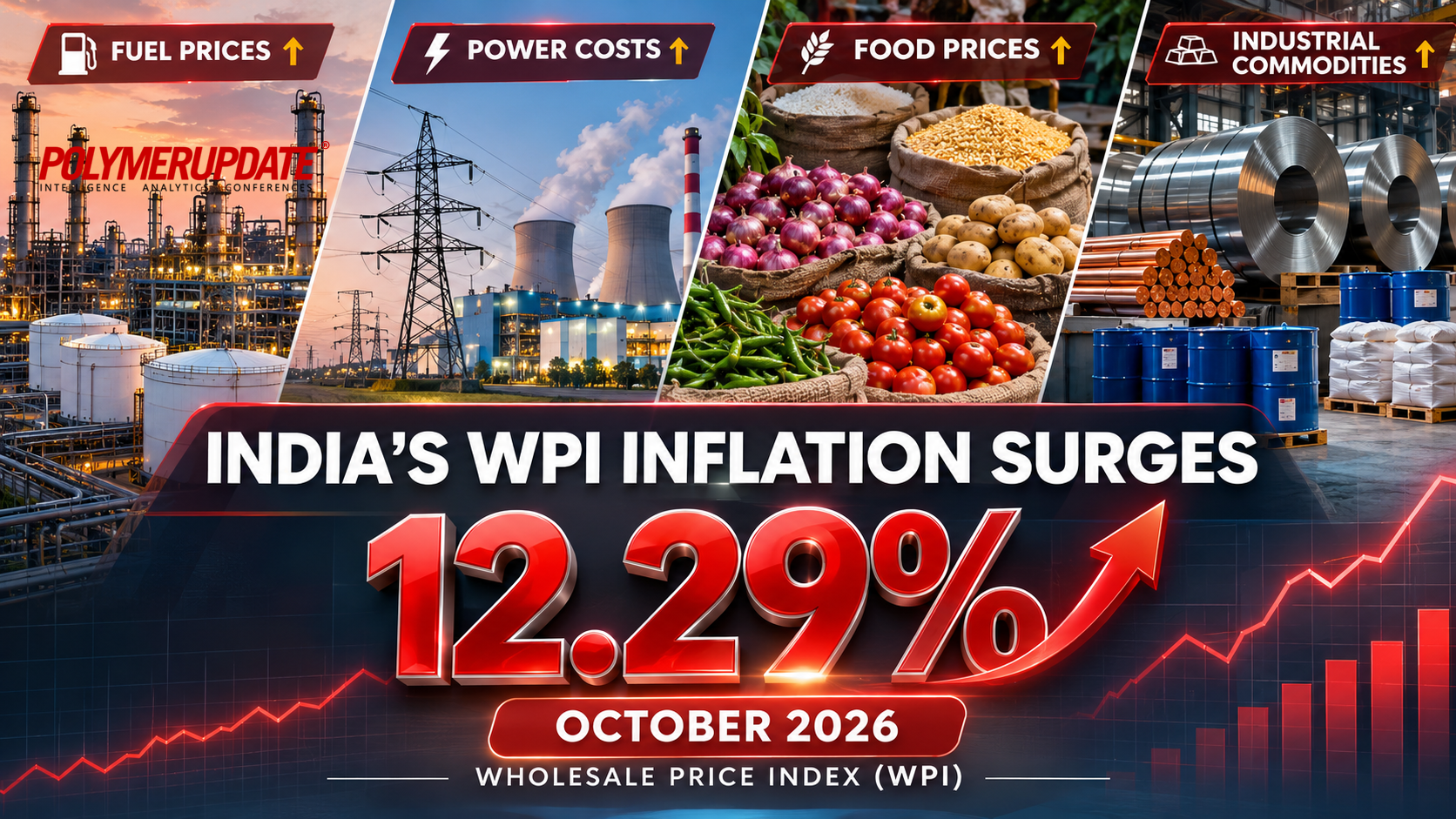
India’s wholesale inflation, measured by the Wholesale Price Index (WPI), rose to 12.29 percent year-on-year (YoY) in October 2026, reaching its highest level in the current 2022-23 base series, driven by a sharp increase in the prices of food articles, fuel and allied services, including transportation, according to data compiled by the Union Ministry of Commerce and Industry. The increase marked a substantial rise in wholesale commodity prices compared with inflation of 11.39 percent in the preceding month and deflation of 1.18 percent in October 2025.
A Ministry statement said, “India’s Wholesale Price Index (WPI) inflation rose to 12.29 percent year-on-year in October 2026, compared with 11.39 percent in September 2026, indicating an acceleration in wholesale price pressures. The All Commodities Index increased to 113.3 in October from 112.5 in the previous month, reflecting a further rise in overall wholesale prices.”
| India’s Wholesale Price Index (WPI) based inflation metrics (%) |
| Month | 2025 | 2026 |
| January | 2.31 | 1.19 |
| February | 2.38 | 2.18 |
| March | 2.05 | 3.98 |
| April | 0.85 | 8.36 |
| May | 0.39 | 9.88 |
| June | (-)0.13 | 9.97 |
| July | (-)0.58 | 9.78 |
| August | 0.52 | 9.92 |
| September | 0.13 | 11.39 |
| October | (-)1.18 | 12.29 |
| November | (-)0.59 | |
| December | 0.3 | |
Source: Union Ministry of Commerce & Industry
Madan Sabnavis, Chief Economist at Bank of Baroda, commented, “WPI inflation was high and peaked at 12.3 percent in October. While this inflation is not considered actively when formulating monetary policy, it is very critical when evaluating the input costs for manufacturers of all commodities. Here, it has been seen that manufactured goods in particular have witnessed an increase of 9.5 percent, with high inflation rates in textiles, tobacco products, chemicals, rubber products, metals and electrical equipment. This will pressurise companies into increasing their product prices at some point of time.”
Sabnavis further added that companies have so far passed on only a limited portion of the increase in input costs to consumers, taking into consideration the prevailing inflationary environment and the impact of higher prices on consumer demand. However, sustained pressure on raw material, energy and other operating costs could prompt manufacturers to gradually revise their selling prices to protect profit margins. The extent and timing of such price increases will depend on individual industry dynamics, competitive pressures and demand conditions. Any further pass-through of higher input costs is likely to be reflected in the core component of the Consumer Price Index (CPI) over the coming months, depending on the pricing decisions taken by industry.
 Food inflation moderates
The Food Index, which comprises ‘Food Articles’ under the Primary Articles major group and ‘Manufacture of Food Products’ under the Manufactured Products major group, recorded year-on-year inflation of 8.58 percent in October 2026, marginally lower than the 8.66 percent registered in September 2026. The moderation indicates a slight easing in food-related wholesale price pressures during the month, although inflation remained elevated.
The marginal decline in food inflation suggests that price pressures across the food supply chain have eased to some extent. However, the relatively high inflation rate indicates that food-related input costs continue to remain a concern for manufacturers and businesses engaged in food processing and allied industries. Any sustained moderation in food inflation could provide some relief to producers and consumers while also helping contain broader inflationary pressures in the economy.
On the food front, pulses registered inflation of 12.6 percent, with tur recording inflation of 26 percent. Production of the crop is expected to be lower this season. The meat products category also witnessed a sharp rise in prices, continuing a trend observed throughout the year. In the non-food basket, fibres and oilseeds recorded high inflation rates of 27.6 percent and 22.4 percent, respectively. These increases can be attributed to expectations of lower output due to sowing patterns, as well as seasonal factors associated with the end of the crop season.
According to Rajani Sinha, Chief Economist at Care Ratings Ltd, “WPI inflation edged up to 12.3 percent YoY in October from 11.4 percent in September, led by higher fuel and power and primary articles inflation. Within fuel and power, the uptick reflected higher prices of crude petroleum, natural gas, electricity and mineral oils. Ahead of the US midterm elections, markets priced in heightened geopolitical risk, building a war-risk premium into energy prices. Inflation in key industrial commodities such as base metals, industrial chemicals and electrical equipment remained in double digits during the month. Food inflation also firmed, with elevated prices of food grains, sugar and edible oils pushing up primary food articles inflation. In line with the WPI, output Purchase Price Index (PPI) inflation rose to 12.1 percent in October from 11.4 percent in September.”
Category-wise inflationYear-on-year inflation rates for the major groups, namely Primary Articles, Fuel and Power, and Manufactured Products, stood at 9.24 percent, 32.84 percent and 9.54 percent, respectively, in October 2026, compared with 8.67 percent, 25.85 percent and 9.76 percent, respectively, in September 2026. The indices for Primary Articles, Fuel and Power, and Manufactured Products stood at 120.6, 115.7 and 110.2, respectively, in October 2026, compared with 120.3, 110.5 and 110.2, respectively, in September 2026.
Across the major groups, ‘Mineral Oils (containing Petroleum Products)’, ‘Crude Petroleum and Natural Gas’, ‘Electricity’, ‘Food Articles’, ‘Manufacture of Basic Metals’, ‘Manufacture of Chemicals and Chemical Products’, ‘Manufacture of Food Products’, ‘Non-Food Articles’, ‘Manufacture of Textiles’ and ‘Manufacture of Rubber and Plastic Products’ were the key drivers of WPI inflation in October 2026.
Devendra Pant, Chief Economist at India Ratings and Research, attributed the surge in India’s WPI inflation to the base effect and a broad-based increase in prices across the Primary Articles and Fuel and Power groups. He said, “The prolonged West Asia crisis continues to drive fuel and power inflation higher and is likely to keep it elevated until the crisis is resolved. However, an appreciation in the currency and a decline in crude oil prices, if sustained during the remainder of November 2026, may bring down wholesale inflation to around 11.5 percent in November 2026. The tapering off of the adverse base effect (October 2025 wholesale inflation: (-)1.18 percent; November 2025 wholesale inflation: (-)0.59 percent) would also help moderate wholesale inflation during the remainder of FY27.”
OutlookLooking ahead, the inflation outlook remains vulnerable to weather-related and geopolitical risks, although the recent moderation in crude oil prices following the US midterm elections is encouraging. The narrowing spread between India’s crude oil basket and spot Brent prices, compared with Brent futures, also signals easing tightness in the physical crude market. However, the risk of renewed conflict remains elevated, at least until the new US Congress convenes in January 2027.
DILIP KUMAR JHA
Editor
dilip.jha@polymerupdate.com