Eurokey, the recycling business of international circular economy specialist Reconomy, has officially opened a £20 million (approximately €24 million) plastic recycling facility in Corby, Northamptonshire, marking a significant investment in the UK's domestic plastics recycling infrastructure. The new facility will add 38,000 tonnes of annual plastic recycling capacity to the UK market once it reaches full operational capacity.
Spread across 138,000 sq. ft, the facility is designed to strengthen domestic recycling capabilities by converting used plastic packaging collected from supermarkets, retailers and grocery businesses into recycled plastic pellets for manufacturing new packaging. The investment comes at a time when the UK's plastics recycling industry is facing considerable challenges, including high operating costs, competition from cheaper virgin polymers and a shortage of domestic processing infrastructure.
The plant will operate under Eurokey, which is part of Reconomy, an international resource management and circular economy group. The facility is expected to become one of the UK's largest dedicated plastic recycling plants, particularly focused on supporting closed-loop recycling solutions for the retail and supermarket sectors. According to the company, the new facility will enable retailers and supermarket chains to recycle plastic packaging domestically rather than relying extensively on overseas processing facilities. The investment is also expected to create more than 30 local jobs, providing an economic boost to the Corby region.
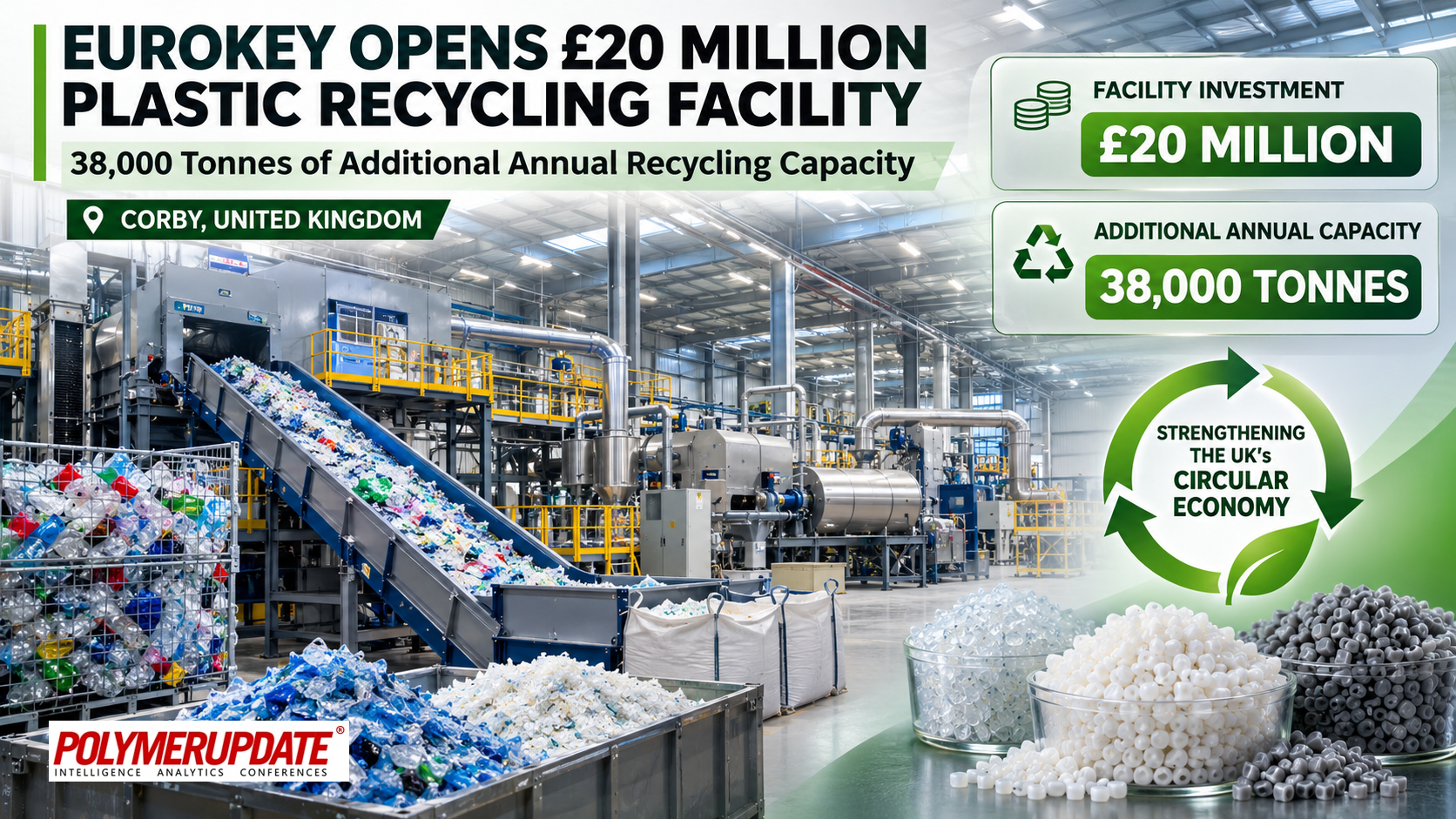 Integrated recycling and pelletisation operations
A key feature of the project is its integration with Eurokey's existing plastic sorting facility in nearby Kettering, located less than 10 miles from the new Corby plant. The Kettering facility has an annual processing capacity of approximately 70,000 tonnes of material and uses automated infrared and robotic sorting technologies to separate different grades of plastic waste. Under the integrated operating model, plastic packaging collected from supermarkets and retailers will first be sorted at Kettering before being transported to Corby for further processing.
The Corby facility will receive several grades of pre-sorted plastic material and convert them into recycled plastic pellets suitable for manufacturing new packaging products. This arrangement is expected to improve operational efficiency by integrating sorting, processing and pelletisation within a relatively compact geographical area. It will also help reduce the transportation of plastic waste over long distances, lowering logistics costs and associated carbon emissions.
Eurokey estimates that the new facility could eliminate the need to ship approximately 1,900 containers of plastic material overseas annually and save more than 1,000 tonnes of carbon dioxide equivalent emissions through reduced transportation. The company expects the investment to strengthen domestic recycling supply chains while enabling supermarkets and retailers to increase the recycled content in their packaging operations.
UK recycling industry faces capacity constraintsThe opening of the Corby facility comes against the backdrop of mounting pressure on the UK's plastics recycling industry, which has experienced capacity closures and challenging operating conditions in recent years. High energy costs, expensive labour, volatile prices for recovered plastic materials and competition from relatively inexpensive virgin polymers have affected the profitability of domestic recycling businesses. Recyclers have also faced difficulties in securing sufficient volumes of consistently sorted and high-quality waste plastic, as well as finding customers willing to pay a premium for recycled materials.
Industry reports have highlighted the scale of the infrastructure gap. According to figures reported by The Chemical Engineer in March 2026, the UK generates approximately 2.2 million tonnes of recyclable plastic annually but has domestic capacity to reprocess only around 23% of this volume. The country also exports approximately 600,000 tonnes of plastic waste annually to overseas markets where processing costs are comparatively lower.
The same report highlighted that 21 plastic recycling companies had closed over the preceding two years, underscoring the difficulties facing domestic processors. Industry estimates suggest that greater investment in domestic recycling infrastructure could unlock a recycling market worth approximately £2 billion and support around 5,000 jobs.
Supporting circular economyAgainst this backdrop, Eurokey's investment represents an important addition to the UK's domestic plastic recycling capacity. Although the new plant alone will not address the country's infrastructure deficit, its annual processing capacity of 38,000 tonnes will provide additional scope to recover and reuse plastic packaging that might otherwise be exported for processing. The facility is expected to contribute to the development of a more resilient domestic market for recycled plastics by retaining valuable polymer materials within the UK supply chain.
Instead of treating used plastic packaging as waste requiring disposal or export, the closed-loop model will enable recovered materials to be processed into secondary raw materials for further manufacturing. For the plastics industry, this could help strengthen the availability of domestically produced recycled polymers and improve the integration of recyclers with packaging manufacturers and major retail customers. It could also reduce exposure to international waste-processing markets and associated transportation costs.
However, the commercial success of such investments will depend on several factors, including the availability of suitable waste feedstock, consistency in recycled pellet quality, processing costs and demand from downstream converters. The competitiveness of recycled polymers against virgin polyethylene and polypropylene will remain particularly important, as price differences can influence purchasing decisions among packaging manufacturers. The availability of reliable offtake agreements with supermarket groups and packaging producers will therefore be crucial to ensuring stable plant utilisation and long-term commercial viability.
Reconomy highlights strategic importanceCommenting on the opening, Guy Wakeley, chief executive of Reconomy, described the facility as a major milestone for the company and the UK's plastics recycling industry, which has faced significant headwinds in recent years. He said the plant would play an important role in increasing domestic recycling capacity and reducing dependence on virgin plastic.
Zubair Bajwa, operations director at Eurokey, said, “The company had been helping leading UK supermarkets and retailers maximise the recycling potential of their plastic materials for more than 30 years. The new investment would strengthen its capabilities and enable it to deliver more comprehensive circular solutions to customers. The local economic benefits of the project, particularly the creation of more than 30 jobs in Corby.”
The investment is part of Reconomy's broader strategy to expand its recycling infrastructure and provide businesses with solutions to minimise waste, conserve resources and reduce carbon emissions. The opening of the Corby plant underscores the growing importance of domestic recycling infrastructure in strengthening the plastics industry's transition towards a circular economy.
As regulatory pressure, corporate sustainability commitments and demand for recycled content continue to influence packaging supply chains, investments in large-scale recycling and pelletisation facilities are likely to become increasingly important. For the UK plastics industry, Eurokey's new facility represents a step towards retaining more post-consumer and commercial plastic packaging within the domestic economy, reducing dependence on virgin polymers and building a more integrated recycling ecosystem.
DILIP KUMAR JHA
Editor
dilip.jha@polymerupdate.com