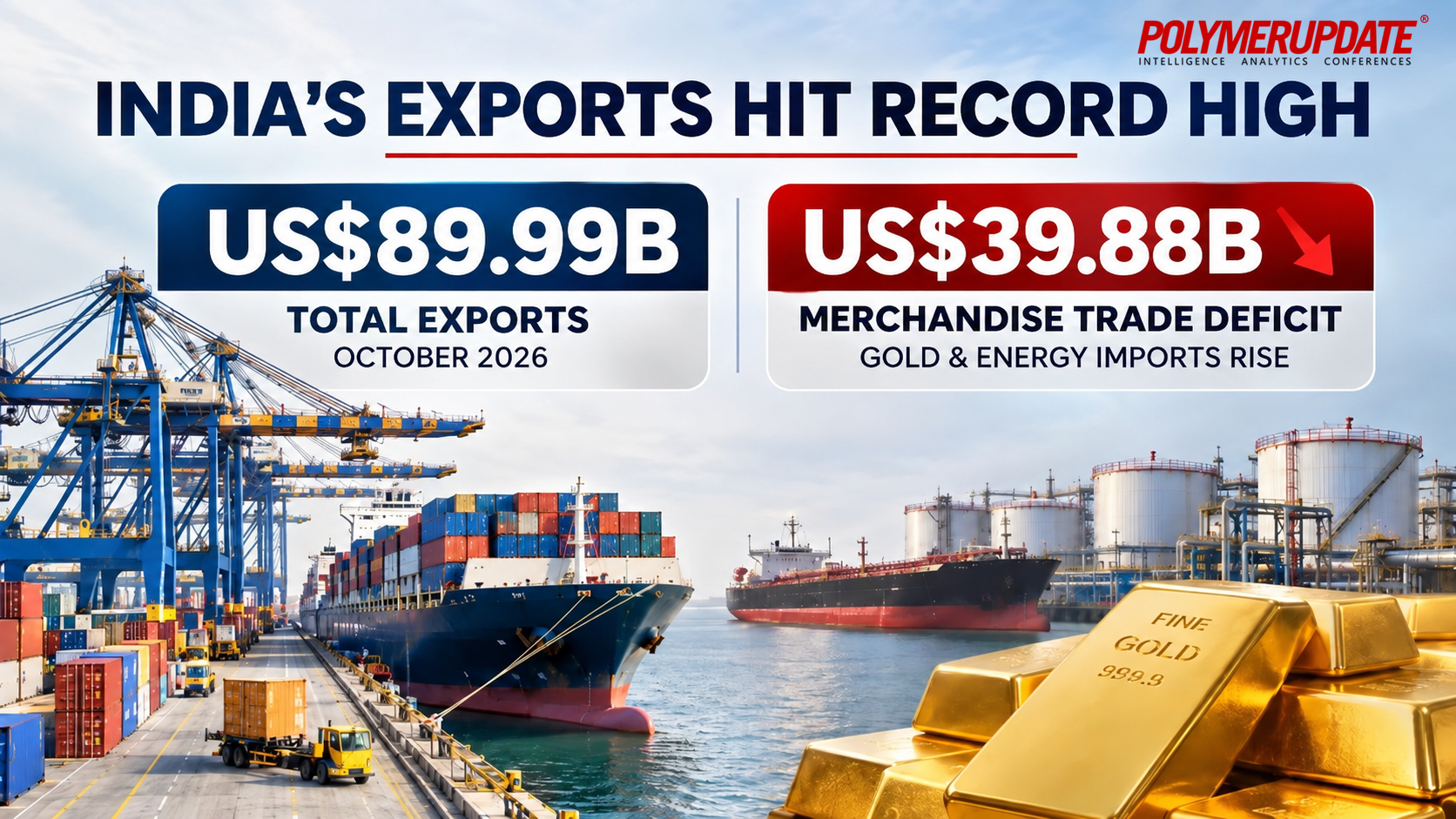
India’s total exports, comprising merchandise and services, surged to an all-time monthly high of US$ 89.99 billion in October 2026, registering a robust year-on-year growth of 29.90 percent, compared with US$ 69.27 billion in the corresponding month last year, driven by a sharp increase in merchandise shipments and sustained growth in services exports. However, the strong export performance was accompanied by a substantial increase in merchandise imports, pushing the country's merchandise trade deficit to a one-year high of US$ 39.88 billion.
Despite the widening merchandise trade gap, the overall trade deficit narrowed to US$ 20.09 billion from US$ 25.15 billion in October 2025, supported by a sizeable surplus in services trade. According to data released by the Ministry of Commerce and Industry, merchandise exports reached a record US$ 49.47 billion in October, representing a 45.06 percent increase over US$ 34.11 billion in the year-ago period. Exports also increased from US$ 44.40 billion in September 2026, highlighting the acceleration in India's external trade performance.
A Crisil report reads, “Strong export performance has helped cushion India's external account against the sharp rise in crude oil prices this fiscal. Although crude prices have eased since November, they remain significantly higher than a year ago and continue to exert pressure on the trade balance. Consequently, we expect the current account deficit (CAD) to widen to 1.5 percent of gross domestic product this fiscal, from 0.6 percent last fiscal. Higher crude oil prices are likely to remain the primary driver of the goods trade deficit. Nevertheless, exports should continue to support the current account, aided by resilient global growth, higher goods prices and lower US tariffs. Services exports, which are generally less vulnerable to current global disruptions, should also help contain the widening in CAD. That said, recurring trade disruptions linked to geopolitical volatility remain a key downside risk.”
 Trade balance
Trade Secretary Rajesh Agrawal said India had recorded its highest-ever monthly merchandise exports in October, supported by increased shipments of petroleum products, electronics, engineering goods and gems and jewellery. Nevertheless, the surge in exports was accompanied by a significant rise in imports. Merchandise imports increased 16.49 percent year-on-year to US$ 89.35 billion in October from US$ 76.69 billion in the corresponding month last year. On a month-on-month basis, imports rose sharply from US$ 74.61 billion in September.
Consequently, the merchandise trade deficit widened to US$ 39.88 billion in October from US$ 30.21 billion in September, exceeding the US$ 32.25 billion forecast. The deficit was also higher than the US$ 32.25 billion level anticipated by market participants, reflecting the combined impact of rising energy import costs and increased domestic demand for gold.
Gold and energy imports drive merchandise trade gapA sharp increase in gold imports ahead of the festive season was among the major factors contributing to the widening trade deficit. India's gold imports more than tripled to US$ 5.51 billion in October from US$ 1.80 billion in September, as jewellers and consumers increased purchases ahead of Diwali, when gold buying is traditionally considered auspicious. India, the world's second-largest gold consumer, remains heavily dependent on overseas supplies to meet domestic demand. The recovery in gold imports was also attributed to a correction in international gold prices and the revival of festive-season purchasing activity.
Higher energy import costs further contributed to the widening merchandise trade gap. Petroleum product imports, predominantly crude oil, increased 54.31 percent year-on-year to US$ 22.82 billion in October, reflecting elevated international crude prices and disruptions in global energy supplies following the conflict in the Middle East. India, the world's third-largest oil consumer after the United States and China, imports nearly 85 percent of its crude oil requirements, leaving its trade balance particularly vulnerable to fluctuations in international energy prices. The average price of the Indian crude basket had approached US$ 120 per barrel, significantly increasing the country's petroleum import bill.
Services exports provide cushionIn contrast to the widening merchandise trade deficit, India's services sector continued to provide considerable support to the overall trade balance. Services exports were estimated at US$ 40.51 billion in October 2026, registering growth of approximately 15.2 percent from US$ 35.17 billion in October 2025. Services imports also increased to an estimated US$ 20.72 billion from US$ 17.73 billion in the corresponding month last year. Consequently, the services trade surplus stood at US$ 19.79 billion, helping offset a substantial portion of the merchandise trade deficit of US$ 39.88 billion.
The Commerce Ministry clarified that October services trade figures are estimates, as the latest actual data released by the Reserve Bank of India pertained to September. Total imports, comprising merchandise and services, increased 16.58 percent year-on-year to US$ 110.07 billion in October from US$ 94.42 billion a year earlier. The comparatively stronger growth in overall exports helped narrow the combined merchandise and services trade deficit to US$ 20.09 billion, against US$ 25.15 billion in October 2025.
Broad-based export growsIndia's export performance was also supported by geographical diversification and increased demand across several major international markets. According to the Federation of Indian Export Organisations (FIEO), merchandise exports expanded across 43 of India's top 50 export destinations in October, indicating that the growth was not restricted to a handful of markets. Exports to the United States, India's largest export destination, increased 39 percent, while shipments to China and Japan rose 48 percent and 45 percent, respectively. Exports to the United Kingdom, Taiwan and Kenya registered growth of more than 50 percent.
Welcoming the October performance, S C Ralhan, President of FIEO, said the expansion across 43 of India's top 50 export markets reflected the resilience of Indian exporters and their ability to identify opportunities despite uncertainties in global trade. He emphasised that market diversification, stronger international buyer relationships, competitive products and greater utilisation of preferential access under India's Free Trade Agreements would be essential to sustaining export growth.
Cumulative exports maintain upward momentumIndia's external trade performance remained encouraging during the first seven months of the current financial year. Combined merchandise and services exports during April-October 2026-27 reached an estimated US$ 568.84 billion, registering growth of 16.66 percent compared with US$ 487.59 billion in the corresponding period of the previous financial year. Total imports during the same period increased 16 percent to US$ 662.19 billion, widening the cumulative overall trade deficit to US$ 93.35 billion from US$ 83.25 billion a year earlier.
Meanwhile, exports to the United States increased to US$ 59.52 billion during April-October from US$ 51.99 billion in the corresponding period last year. Trade Secretary Agrawal said negotiations between India and the United States were progressing in the right direction, with teams from both countries engaged in discussions to finalise the first tranche of a bilateral trade agreement. India's export prospects are also expected to receive support from recently concluded trade agreements with the United Kingdom and New Zealand, while the proposed trade agreement with the European Union is expected to take effect early next year.
Competitiveness remains keyWhile the record October export performance provides an encouraging indication of India's growing participation in global trade, sustaining the momentum will require addressing several structural and external challenges. The widening merchandise trade deficit highlights the country's continued dependence on imported energy, gold and other essential commodities. Volatility in international crude oil prices, geopolitical disruptions, elevated freight costs and uncertainties surrounding global trade policies could influence India's import bill and export competitiveness.
Ralhan stressed that affordable export credit, lower transaction costs and efficient logistics would be critical to sustaining export momentum, particularly for micro, small and medium enterprises (MSMEs). He also highlighted the importance of continued government-industry collaboration, timely policy facilitation and effective utilisation of trade agreements to convert the recent gains into durable improvements in India's global market share. The October figures underline the growing strength of India's merchandise and services export sectors. However, the challenge ahead will be to sustain export growth while containing the merchandise trade deficit and reducing vulnerability to external energy and commodity price shocks.
OutlookWith cumulative exports maintaining double-digit growth, India remains on course to strengthen its position in international trade and advance towards its ambitious US$ 1 trillion export aspiration. Achieving this objective, however, will depend on maintaining manufacturing competitiveness, diversifying export markets and ensuring that rising domestic demand does not translate into a disproportionate increase in import dependence.
DILIP KUMAR JHA
Editor
dilip.jha@polymerupdate.com