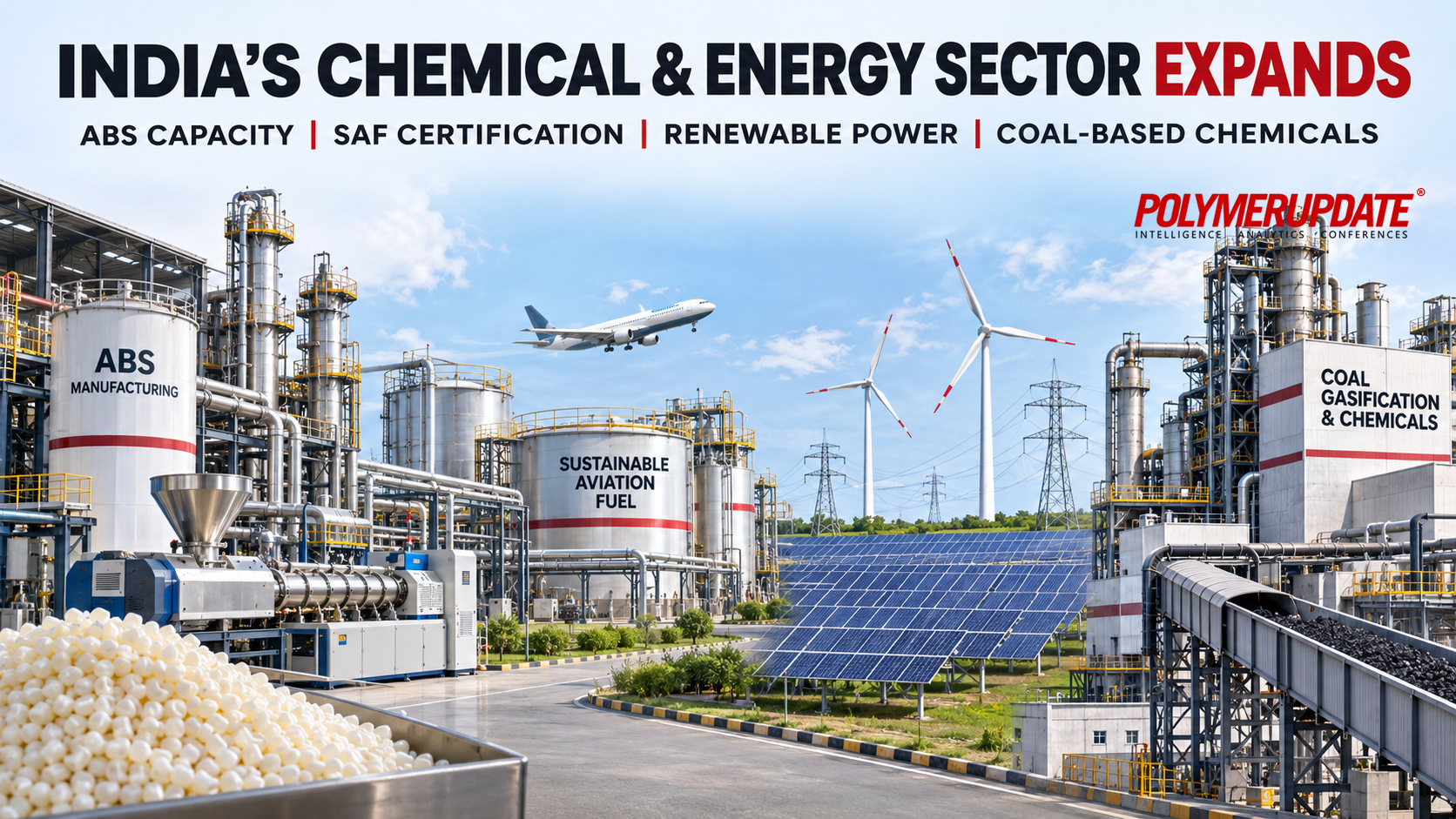
Indian chemical and energy companies are stepping up investments in capacity expansion, renewable energy and low-carbon technologies, reflecting the industry's growing focus on meeting domestic demand, improving cost competitiveness and diversifying business operations. Recent developments involving Supreme Petrochem, Indian Oil Corporation, Vishnu Chemicals and Coal India highlight the changing investment priorities across India's petrochemical, specialty chemicals and energy sectors.
While Supreme Petrochem is strengthening its position in the domestic acrylonitrile butadiene styrene (ABS) market through a major capacity expansion, Indian Oil Corporation (IOC) has moved forward with commercial certification for sustainable aviation fuel (SAF). Meanwhile, Vishnu Chemicals is pursuing renewable power procurement to optimise operating costs, and Coal India is accelerating its diversification into coal gasification, chemicals and renewable energy. Together, these initiatives underscore the increasing importance of domestic manufacturing capabilities, energy security, sustainability and value-added production in India's industrial growth strategy.
 Supreme Petrochem doubles mABS capacity
Supreme Petrochem has entered into a second technology licensing agreement with Italy-based Versalis S.p.A. for establishing an additional 70,000 tonnes per annum (TPA) mass acrylonitrile butadiene styrene (mABS) production line, taking its planned capacity for the product to 140 KTPA. The agreement, executed on November 12, 2026, follows an earlier technology agreement with Versalis for the first 70 KTPA production line. The company said the signed copy of the second agreement was received on November 23, 2026, and the additional production line is now expected to be mechanically completed by December 2028.
The second production line will involve an investment of approximately Rs 450 crore, which will be financed entirely through internal accruals. The expansion forms part of the company's strategy to capitalise on the growing demand for ABS products in India. Supreme Petrochem currently has a planned first-line mABS capacity of 70 KTPA, with utilisation reported at approximately 60 per cent. The proposed second line will double the company's planned mABS manufacturing capacity, strengthening its ability to serve the domestic market and potentially reduce dependence on imported material.
ABS is an important engineering thermoplastic valued for its combination of impact resistance, toughness, rigidity, dimensional stability and surface finish. It finds applications across automobiles, consumer electronics, electrical appliances, household products, toys and various industrial components. Demand for ABS is expected to benefit from the expansion of India's automotive and electronics manufacturing sectors, increasing consumer spending and the growing use of engineering plastics in place of conventional materials.
The government's emphasis on domestic manufacturing and localisation of supply chains could further support consumption. The additional capacity could improve the availability of domestically manufactured ABS, provide customers with greater sourcing flexibility and help downstream processors manage procurement risks associated with international supply disruptions and import price volatility. The use of Versalis technology for both production lines also provides continuity in the company's manufacturing and technology strategy. However, the commercial success of the expansion will depend on the pace of domestic demand growth, operating efficiency, raw material availability and the competitiveness of locally produced material against imports.
Indian Oil secures certification for commercial SAF productionIndian Oil Corporation has achieved commercial approval and International Sustainability and Carbon Certification (ISCC) CORSIA certification for sustainable aviation fuel at its Panipat Refinery, marking an important development for India's emerging sustainable aviation fuel industry. With this certification, Indian Oil has become India's first certified commercial supplier of SAF, positioning the state-owned refiner ahead of upcoming blending requirements and the country's efforts to reduce emissions from the aviation sector.
SAF is considered one of the most promising alternatives to conventional aviation turbine fuel, particularly because it can be used in existing aircraft engines and aviation infrastructure when blended within approved limits. Depending on the feedstock, production pathway and lifecycle assessment, SAF can significantly reduce greenhouse gas emissions compared with conventional jet fuel. The International Civil Aviation Organization's Carbon Offsetting and Reduction Scheme for International Aviation (CORSIA) provides a framework for addressing emissions from international aviation.
ISCC CORSIA certification establishes compliance with sustainability and traceability requirements for eligible aviation fuel pathways. The certification at Panipat is significant as airlines and fuel suppliers prepare for progressively higher sustainability requirements. India's aviation sector has been expanding rapidly, increasing the importance of developing alternative fuel sources to manage the environmental footprint of air transportation. For Indian Oil, the development provides an opportunity to strengthen its position in the emerging low-carbon aviation fuel market.
It could also encourage investment in domestic SAF production infrastructure, feedstock collection, processing technologies and associated supply chains. The availability of certified SAF from a domestic producer could help airlines access sustainable fuel while supporting India's broader energy transition objectives. Going forward, the scale-up of production will depend on the availability of sustainable feedstocks, production economics, technology improvements and the development of a reliable distribution network.
Vishnu Chemicals strengthens renewable power sourcingHyderabad-based Vishnu Chemicals, a specialty chemical manufacturer established in 1989, is taking steps to improve its energy cost structure through greater access to renewable electricity. Through its subsidiary Vishnu Barium, the company has signed an agreement to acquire an 18.69 per cent stake in Fractal Nova for Rs 1.47 crore. The investment is aimed at securing captive solar power and optimising electricity procurement costs. Vishnu Chemicals manufactures chromium chemicals, barium compounds and related specialty chemical derivatives, supplying customers across more than 50 countries.
Its products serve a range of industrial applications, including ceramics, glass, pigments, coatings and other specialised manufacturing segments. Electricity is an important component of operating costs for chemical manufacturers, particularly those involved in energy-intensive production processes. Greater access to captive renewable power can help companies reduce their exposure to fluctuations in conventional electricity tariffs and improve long-term cost visibility.
The investment also reflects a broader trend among Indian chemical manufacturers towards integrating renewable energy into their operations. As customers increasingly focus on the environmental footprint of their supply chains, access to cleaner electricity can improve the sustainability credentials of chemical producers and strengthen their competitiveness in export markets. For Vishnu Chemicals, the arrangement could provide greater control over a portion of its power requirements while supporting its efforts to improve operational efficiency. The financial benefits will ultimately depend on the volume of electricity available, the commercial structure of the arrangement and the company's actual consumption requirements.
Coal India expands beyond conventional miningCoal India is advancing its diversification strategy as it seeks to move beyond its traditional coal mining operations into coal gasification, renewable energy and chemical production. The company is exploring opportunities in value-added products such as methanol and ammonia, which could create additional revenue streams while supporting India's efforts to develop domestic chemical and energy manufacturing capabilities. Coal gasification converts coal into synthesis gas, primarily comprising carbon monoxide and hydrogen.
This syngas can subsequently be processed into chemicals, fuels and industrial feedstocks, including methanol and ammonia. The technology offers an opportunity to extract greater value from domestic coal resources by converting them into products that serve the chemical, fertiliser, energy and industrial sectors. Methanol is used as a chemical feedstock in the manufacture of formaldehyde, acetic acid, plastics and several other industrial products. It is also being explored as an alternative fuel and a potential component of India's efforts to diversify its energy mix.
Ammonia, meanwhile, is an essential feedstock for fertiliser manufacturing and has applications in several industrial processes. Developing domestic production capabilities could help strengthen supply security for important industrial inputs. Coal gasification could therefore open new business opportunities for Coal India while supporting the government's objective of reducing dependence on imported chemical feedstocks and energy products.
However, the commercial viability of coal-to-chemical projects will depend on capital expenditure, coal quality, gasification technology, water availability, operating costs and environmental considerations. Managing carbon emissions and ensuring access to appropriate emission-control technologies will remain important challenges for large-scale deployment. The company's parallel interest in renewable energy also reflects the need to diversify its portfolio as the country's energy mix gradually evolves.
Sustainability as a common priorityThe developments across these four companies reflect a wider transformation underway in India's industrial and energy sectors. Investments in engineering plastics, sustainable aviation fuels, renewable electricity and coal-based chemicals demonstrate how companies are seeking to address both traditional market opportunities and emerging sustainability requirements. Supreme Petrochem's planned expansion could strengthen domestic ABS availability and support downstream industries.
On the other hand, Indian Oil's SAF certification represents progress towards developing a commercial sustainable aviation fuel ecosystem. Vishnu Chemicals' renewable power initiative highlights the growing importance of energy efficiency and cost management in specialty chemicals manufacturing. Coal India's diversification, meanwhile, could create new opportunities in the domestic chemicals and alternative fuels value chain.
OutlookGoing forward, the success of these initiatives will depend on execution, technology competitiveness, demand growth and the economics of production. Nevertheless, they represent important steps towards strengthening India's manufacturing capabilities, improving industrial energy security and developing higher-value products for domestic consumption and international markets.
DILIP KUMAR JHA
Editor
dilip.jha@polymerupdate.com