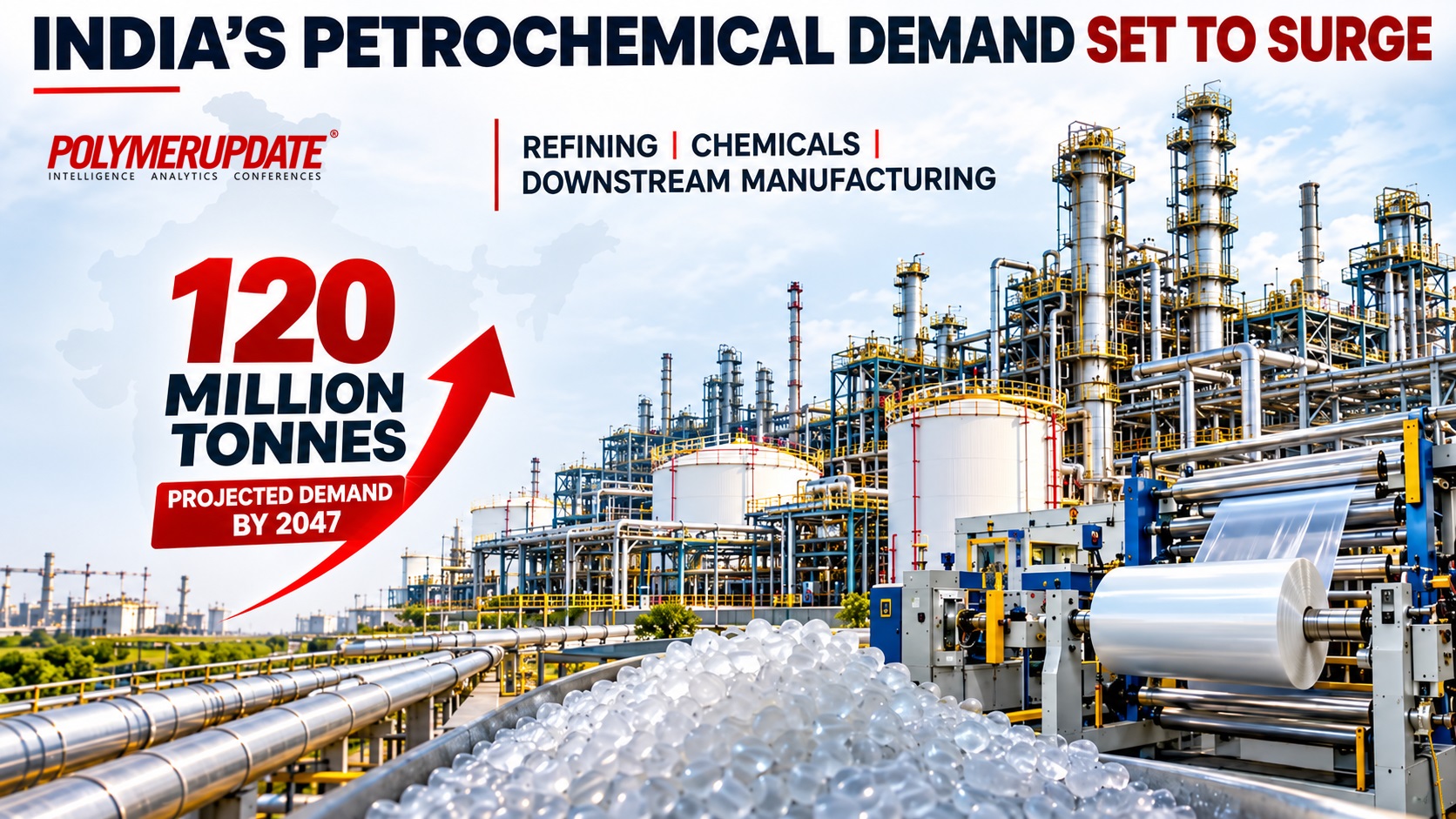
India’s petrochemical industry is poised for a major expansion over the next two decades, with domestic demand projected to rise to 55 million tonnes by 2030 and reach 120 million tonnes by 2047, driven by economic growth, rising consumption and the rapid expansion of downstream manufacturing. The projected increase is expected to create significant investment opportunities across polymers, speciality chemicals, chemical intermediates and value-added products, while strengthening India's position as a global petrochemical and chemical manufacturing hub.
Union Minister for Petroleum and Natural Gas Hardeep Singh Puri outlined the country's long-term petrochemical ambitions at the Federation of Indian Chambers of Commerce and Industry (FICCI) annual general meeting and convention. He emphasised that India's relatively low per-capita petrochemical consumption compared with the global average provides considerable headroom for future demand growth, requiring a corresponding expansion in domestic production and processing capabilities.
India currently has petrochemical production capacity of approximately 36.4 million tonnes. Meeting the projected increase in consumption will therefore require substantial investments in new facilities, capacity expansions, technology upgrades and integrated manufacturing infrastructure. The minister's projections underline the growing importance of petrochemicals in India's industrial development, particularly as the country seeks to reduce its dependence on imported chemical products and establish stronger domestic supply chains.
 Downstream industry to prosper
The anticipated increase in petrochemical consumption is expected to benefit a broad spectrum of industries, including plastics, packaging, automotive, construction, textiles, pharmaceuticals, electronics, agriculture and consumer goods. Polymers such as polyethylene (PE), polypropylene (PP), polyvinyl chloride (PVC), polystyrene (PS) and polyethylene terephthalate (PET) are likely to remain important growth drivers, supported by increasing demand for packaging materials, infrastructure development, automobiles, household appliances and consumer products.
Higher petrochemical production will also create additional opportunities for manufacturers of chemical intermediates, speciality chemicals, additives, coatings, adhesives and performance materials. As downstream industries increasingly move towards sophisticated applications, demand for higher-value and application-specific products is expected to gain momentum. For domestic chemical manufacturers, the projected demand expansion could encourage investments in both commodity and speciality chemicals, while creating opportunities for technology partnerships, joint ventures and capacity additions.
The growth trajectory could also attract greater participation from international petrochemical producers seeking access to India's expanding consumption market. Investments in integrated complexes combining refining, petrochemical production and downstream processing could improve operational efficiencies, strengthen feedstock security and enhance the competitiveness of domestically manufactured products. However, translating the demand projections into actual industrial growth will depend on the timely development of infrastructure, competitive feedstock availability, investment in research and development and a supportive policy environment.
To support petrochemical ambitionsPuri also highlighted India's plans to expand refining capacity to support the country's growing energy and petrochemical requirements. India currently has refining capacity of approximately 267 million tonnes per annum (MTPA), which is expected to increase to around 290 MTPA over the next two years. The government has set a longer-term target of 320 MTPA, while an even more ambitious capacity expansion target of 450 MTPA has also been outlined.
The proposed expansion comes at a time when refining capacity in certain developed markets, particularly Europe and China, is undergoing rationalisation amid changing demand patterns, environmental regulations and pressure on operating economics. India's expanding refining infrastructure could provide an important foundation for petrochemical growth by improving the availability of feedstocks such as naphtha, LPG and other hydrocarbon streams.
Greater integration between refineries and petrochemical complexes could also enable producers to capture higher value from crude oil processing rather than focusing predominantly on transportation fuels. For the domestic chemical industry, increased refining and petrochemical integration could improve feedstock security, reduce exposure to international supply disruptions and support the development of competitive downstream manufacturing clusters. The expansion could also create opportunities for engineering, construction, equipment suppliers, logistics operators and infrastructure developers.
West Asia crisis and energy securityThe recent geopolitical tensions in West Asia have further reinforced the importance of strengthening India's energy security and diversifying its supply sources. Puri said the closure of the Strait of Hormuz on February 28 exposed vulnerabilities in global energy supply chains. Approximately 40 percent of India's crude oil and natural gas requirements were sourced from the region, while dependence on West Asia for liquefied petroleum gas (LPG) was estimated at close to 90 percent.
The disruption triggered a sharp increase in domestic LPG demand, prompting the government and oil marketing companies to step up production and strengthen supply management. According to the minister, domestic LPG production was increased from approximately 35,000 tonnes per day to 55,000 tonnes per day during the disruption. Daily LPG cylinder bookings also surged from around 52 lakh to 92 lakh, partly reflecting panic buying and concerns over potential shortages. The government conducted worst-case scenario assessments to evaluate the country's ability to maintain supplies if imports and domestic production were simultaneously affected.
Puri said the assessments indicated that India had approximately 60 days of crude oil and natural gas supplies under severe supply-stress scenarios. However, continued military activity in the Red Sea remains a concern for international energy transportation and supply chains. The disruption has highlighted the importance of expanding domestic production, diversifying import sources, strengthening strategic storage infrastructure and improving supply-chain resilience. For petrochemical manufacturers, reliable access to crude oil, natural gas and intermediate feedstocks will be essential to maintaining uninterrupted operations and supporting planned capacity expansions.
Alternative fuels create new opportunitiesAlongside conventional hydrocarbons, the government is also promoting alternative fuels and cleaner energy technologies, opening additional opportunities for the chemical and energy industries. Puri highlighted India's substantial biomass availability and its potential to become a supplier of sustainable aviation fuel (SAF). The development of a domestic SAF ecosystem could create demand for bio-based feedstocks, catalysts, processing technologies and specialised chemicals. He also referred to international aviation's phased SAF blending requirements, with targets of 1 percent from 2027, 2 percent in 2028 and 5 percent by 2030.
The development of domestic SAF production facilities could encourage investments in biomass processing, waste-to-fuel technologies and advanced bio-refineries, while providing opportunities for chemical companies involved in catalysts, solvents and process technologies. Green hydrogen is another area receiving policy attention. Puri said production costs had declined from approximately US$5.40 per kg to around US$3 per kg, with a price of approximately US$2.50 per kg considered commercially competitive.
The minister also highlighted India's progress in ethanol blending, which has increased to 20 percent from approximately 1.5 percent in 2014. These developments could support the emergence of new industrial value chains involving green hydrogen, bio-based chemicals, sustainable fuels and low-carbon manufacturing technologies. For the chemical industry, green hydrogen could eventually provide an alternative feedstock for ammonia, methanol and other chemical production processes, subject to improvements in production economics and infrastructure availability.
Exploration policyThe government is simultaneously seeking to increase domestic hydrocarbon production through a broader exploration programme. Puri said nearly one million square kilometres of India's approximately 3.5 million square kilometres of sedimentary basins, previously classified as no-go areas due to security considerations, had been opened for exploration. The government is supporting the drilling of 150 wells over three years to encourage exploration activity. Under the proposed risk-sharing mechanism, companies can receive financial support of up to Rs 650 crore if drilling does not result in a discovery.
However, the assistance must be repaid if commercially viable oil or gas resources are found. The mechanism is intended to reduce the financial risks associated with exploration and encourage greater private-sector participation in India's upstream energy sector. Puri expressed optimism about the country's unexplored hydrocarbon potential, suggesting that significant discoveries could emerge from its sedimentary basins. Successful exploration could improve domestic availability of crude oil and natural gas, supporting refining operations, petrochemical feedstock requirements and the wider manufacturing ecosystem.
Growth driversIndia's projected petrochemical demand growth presents a significant opportunity for domestic and international chemical manufacturers. However, achieving the projected 120 million tonnes of consumption by 2047 will require a coordinated expansion across the entire value chain. Investment in integrated refining and petrochemical complexes, pipeline connectivity, port infrastructure, storage facilities and downstream manufacturing clusters will be critical. Equally important will be access to competitively priced feedstocks, advanced processing technologies and skilled manpower.
The industry will also need to balance capacity expansion with changing environmental requirements, increasing recycling rates and the transition towards sustainable materials. For polymer processors and downstream manufacturers, greater domestic availability of petrochemical raw materials could improve supply security and reduce dependence on imports. It could also encourage the development of higher-value products, strengthen export competitiveness and create employment opportunities across the manufacturing sector.
The projected growth in demand could provide a long-term investment roadmap for India's chemical industry, particularly in speciality chemicals, engineering plastics, performance materials and advanced intermediates. The government's broader strategy of expanding exploration, refining, petrochemical production and alternative fuels indicates that India's energy and chemical sectors are increasingly being viewed as interconnected components of industrial development.
If supported by timely investments, infrastructure development and technological advancements, the anticipated increase in petrochemical consumption could transform India's chemical manufacturing landscape over the coming decades, positioning the country as an increasingly important global supplier of petrochemicals, polymers and value-added chemical products.
DILIP KUMAR JHA
Editor
dilip.jha@polymerupdate.com