
Click the icon to add a specified price to your Dashboard list. This makes it easy to keep track on the prices that matter most to you.

- Production of high-performance recycled polyester T-shirts enabled by Carbios’ technology
- Full validation across the textile value chain, from pre-industrial recycling to industrial-scale manufacturing
- Identical performance between EnzyTex[1] recycled polyester and virgin polyester
- Three years of collaboration demonstrating the performance of fiber-to-fiber enzymatic recycling at scale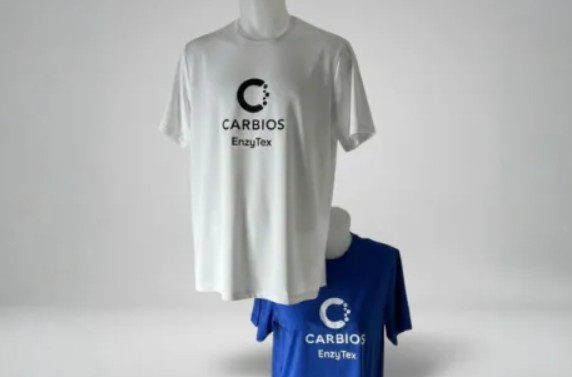
Carbios (Euronext Growth Paris: ALCRB) announces the successful production of high-quality recycled polyester T-shirts made from complex textile and plastic waste[2] on European industrial manufacturing lines, in collaboration with the Fiber-to-Fiber Consortium members: Patagonia, PUMA and Salomon.
This achievement demonstrates the ability of Carbios’ biorecycling technology to transform complex waste streams into high-performance textile products meeting the requirements of every stage of industrial processing.
A EUROPEAN ACHIEVEMENT TO SERVE A GLOBAL TEXTILE INDUSTRY
This achievement is the result of close collaboration between Carbios, the members of the Fiber-to-Fiber Consortium, and European industrial partners spanning the entire textile value chain, from polymerization and spinning to knitting, dyeing, and garment manufacturing.
From complex feedstock to finished garment:
Starting from textile waste[3] and complex plastic waste, the Carbios process enabled the production of monomers that meet stringent quality and performance standards, comparable to those of petrochemical-derived materials.
These monomers were then repolymerized by Selenis in Portugal to produce more than one ton of high-quality r-PET, marketed under the name EnzyTex, and designed for seamless integration into existing industrial production lines.
The resulting r-PET was converted into yarn on ANTEX’s industrial production lines in Spain, then knitted into Interlock fabric on Henitex’s industrial equipment in France, dyed in an industrial bath by TAD (Teintures et Apprêts Danjoux) in France, and finally turned into garments by ToptexCube (Chamatex Group) in France, with each step carried out under standard industrial conditions.
The resulting fibers demonstrated full compatibility with conventional textile manufacturing processes, while delivering performance characteristics, including mechanical strength, dyeability, and color fastness, equivalent to those of virgin polyester.
Manufactured entirely in Europe, this garment demonstrates the scalability of circular textile manufacturing without compromising on quality.
A CONSORTIUM PUSHING THE BOUNDARIES OF TEXTILE CIRCULARITY
Initiated by Carbios, the Fiber-to-Fiber Consortium has enabled major progress:
Validation of enzymatic recycling on complex textile waste streams, including blended and contaminated materials;
Demonstration that EnzyTex recycled polyester matches the performance of its fossil-based counterpart;
Confirmation of the industrial scalability of the Carbios process through the production of 100% recycled polyester products under standard operating conditions;
European value chain integration.
Beyond the technical performance, Carbios and its partners have demonstrated that high-quality garments can be produced from complex waste streams and that circularity can be achieved without compromising performance.
Available as textile-grade r-PET pellets or yarn, EnzyTex is a high-purity recycled material produced using Carbios’ biorecycling technology and designed for seamless integration into existing textile production lines.
These materials are considered difficult to recycle due to fiber blends (cotton, elastane) and contaminants (dyes, finishes, silicones).
Pre-industrial and post-consumer textiles.
Note: This story has not been edited by The Polymerupdate Editorial team and is auto-generated from a syndicated feed.
