Click the icon to add a specified price to your Dashboard list. This makes it easy to keep track on the prices that matter most to you.

Established in 1985, Ester Industries Ltd has unveiled a new brand identity which underscores the company’s commitment to innovation, sustainability, and the design of high-performance materials for a lasting future. The new identity also explains the company’s objectives with current and futures strategy. This transformation marks a significant step towards our future growth, says Arvind Singhania, Chairman and Managing Director of Ester Industries Ltd, in an exclusive interaction with Dilip Kumar Jha, Editor at Polymerupdate. Edited excerpts: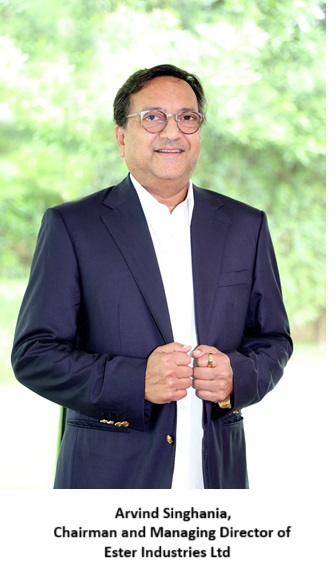 What does this new brand identity reflect?
We unveiled a refreshed company logo on July 11, 2025, which aligns with our long-term strategic focus and goes beyond mere visual aesthetics. Our new identity reflects our evolving mindset—precise, purposeful, and firmly future-focused approach. It represents our commitment to innovation, sustainability, and the design of high-performance materials for a lasting future. It also signals our sharper and quicker response to the ever-changing nature of the industries we serve. This transformation marks a significant step in how we present ourselves to various stakeholders and sets the tone for the next phase of our journey.
What is Ester’s operational realignment?
We witnessed a remarkable improvement in our standalone financial performance this quarter, driven by a sharp rise in recycled PET revenue, which jumped from just Rs 0.5 crore in the April–June 2024 quarter (Q1FY25) to Rs 14 crore in the April–June 2025 quarter (Q1FY26), propelled by significant volume expansion. As part of operational realignment and a revised approach to performance evaluation and resource allocation, recycled PET revenue will now be reported under the polyester films segment instead of the specialty polymer segment, starting this quarter. This change better reflects our business structure and highlights the growing importance of sustainable materials within our core films operations.
How has been your financial performance during the April-June’25 quarter?
On a consolidated basis, capacity utilization across the polyester films business improved to 82 percent in Q1FY26, up from 64 percent in the corresponding quarter of the previous year. Polyester films delivered a robust performance, recording sales of 21,531 metric tonnes in Q1FY26—an increase of 22.57 percent over Q1FY25.
An improved demand–supply scenario, coupled with a higher proportion of value-added and specialty products, boosted revenue from Rs 228.67 crore to Rs 276.07 crore, marking a growth of 20.7 percent. Through concerted efforts, we increased the share of value-added products to 24 percent of total segmental volume, with volumes of VAS products rising 37 percent year-on-year. The increasing shift from commodity to specialty products has contributed significantly to both profitability and differentiation.
In the specialty polymers business, we recorded a 4 percent year-on-year volume growth, with total sales reaching 954 metric tonnes in Q1FY26. The quarter ended June 2024 benefited from an exceptionally favourable product mix, resulting in an EBIT margin of 43 percent. In comparison, the quarter ended June 2025 reflects a more typical product mix, with EBIT margins in the range of 30 to 35 percent.
How has PWMR benefited the industry so far?
The implementation of the Plastic Waste Management Rules (PWMR), effective April 1, 2025, has begun to drive demand for differentiated offerings of BOPET films with varied PCR content levels. We are proud to be at the forefront of capitalizing on this opportunity. The significant growth in rPET sales, in volumetric terms, has led to a remarkable increase in revenue, underscoring the growing traction of sustainable product categories. We are also pleased to report that the project to install an additional 20,000 tonnes per annum capacity in Hyderabad is progressing as scheduled, with commercial production expected to commence by September 2025.
What is your long-term vision for Ester’s business expansion—both in domestic and international markets—over the next five years? Could you highlight key geographies, capacities, or verticals you are prioritizing?
Over the next five years, our long-term vision is to establish Ester Industries as a global frontrunner in sustainable materials—anchored by innovation, circularity, and high-performance solutions. Domestically, we are significantly enhancing our capacities at Khatima and Hyderabad to meet growing demand for specialty polymers and high-barrier films. On the global front, we are strategically expanding in Southeast Asia, the Middle East, and Europe—regions that are actively adopting eco-friendly, advanced packaging solutions. We are also deepening our focus on high-growth verticals like flexible packaging, technical textiles, insulation, and automotive. These sectors demand cutting-edge, sustainable materials, and our strong IP portfolio—bolstered by 36 patents—along with our R&D-driven product pipeline, positions us to lead in these spaces.
A cornerstone of our global expansion is our joint venture with Loop Industries to establish an Infinite Loop™ chemical recycling facility in India. This will help close the loop on PET waste by producing rDMT and rMEG, reinforcing our commitment to circularity and low-impact manufacturing. Innovation and sustainability remain the foundation of everything we do—not just in what we make, but how we make it. Our products reflect global standards, and our people reflect an unwavering commitment to customer success.
With over four decades of expertise, how has Ester Industries contributed to shaping the polyester film and specialty polymer landscape in India and globally? What differentiates your approach from other players in the segment?
Over the years, Ester Industries has emerged as a trusted name in the polyester films and specialty polymers segment, evolving from a traditional manufacturer into a forward-looking, innovation-driven organization. With advanced facilities in Khatima and Telangana, we support critical industries including packaging, textiles, electronics, and more. Our expanding global reach—spanning over 75 countries—reflects our strong reputation for quality, customization, and reliability.
Our Specialty Polymers division is a key growth driver, with a portfolio tailored to applications such as flame-retardant solutions, stain-resistant textiles, sustainable fabrics, and high-performance coatings. Innovation at Ester is powered by a strong IP base, with more than 36 patents, and a sustainability-first mindset.
What distinguishes us is not just our technical capability, but our steadfast commitment to responsible manufacturing, deep customer focus, and long-term partnerships. Headquartered in Gurugram, we continue to shape material solutions that are future-ready and globally competitive.
With rapid advances in polymer processing and film manufacturing technologies, what modernization initiatives has Ester undertaken recently? How are these upgrades improving production efficiency, sustainability, and product innovation?
At Ester, modernization is integral to our growth strategy and our commitment to innovation, efficiency, and sustainability. Our BOPET film manufacturing facility in Khatima, Uttarakhand, operational since 1989, has evolved into a highly advanced setup aligned with global standards.
We now operate three sophisticated Dornier (Germany) film lines, producing widths from 3.2 to 8.7 meters. These are backed by two high-end metallizers from Applied Materials, a backward-integrated continuous PET polymerization plant, and a state-of-the-art offline coating machine. Notably, our 8.7-meter line receives direct melt from the polymerization unit, giving us tighter control on product quality.
These modernization efforts have significantly improved our production speed, consistency, and flexibility, allowing us to cater to advanced applications in packaging and beyond. They’ve also enabled us to deliver recyclable, high-barrier film solutions that support sustainability goals—positioning Ester as a future-ready leader in specialty polyester films.
The demand for polymers including especially PET and polyester films has been dynamic post-COVID and amid evolving global trade policies. How do you see the current demand-supply situation shaping up in India and globally?
The demand for PET and polyester films has shown strong growth momentum both in India and globally following COVID-19, fuelled by rapid industrialization, rising packaging requirements—especially for consumer goods and online food delivery—and a heightened focus on sustainability. Asia Pacific, led by India and China, continues to be the largest market due to abundant raw materials, cost-effective labour, and significant investments in capacity expansion and technological innovation. North America is also experiencing robust growth, driven by evolving packaging standards and increasing demand from the food, beverage, and FMCG sectors.
On the supply side, the industry is adapting to sustainability and regulatory pressures, with notable investments in recyclable and bio-based film formulations. Global trade disruptions and tariffs, particularly those implemented by the US in 2025, have caused regional price volatility and forced supply chain realignments, leading producers in Asia and India to focus on innovation and efficiency. As a result, the market outlook remains bullish, characterized by ongoing product innovation and a shift towards thinner, higher-performance, and eco-friendly films to secure long-term competitive advantage.
What factors are currently influencing price fluctuations in the polymer and polyester film markets, and how is Ester navigating these changes?
The polymer and polyester film markets are facing pricing volatility due to rising raw material costs (linked to crude oil), global supply chain disruptions, and regional overcapacity, especially in Asia. In India, macroeconomic slowdowns and weaker consumer demand have dampened polymer usage, particularly in packaging. Additionally, regulatory mandates—like the upcoming 2025 rule requiring 30% rPET in packaging—are driving a market shift while raising compliance costs. Despite these pressures, Ester has shown strong operational and financial resilience. In FY2025, we returned to profitability with a net profit of Rs 13.7 crore, supported by cost control and strategic investments. Our pivot toward high-margin specialty polymers and films, alongside operational efficiency measures, continues to strengthen our performance. We’re focused on scaling our specialty business, creating a self-sustaining cycle of innovation and reinvestment. These efforts, underpinned by robust processes and digital transformation, position us well to manage costs and lead as a high-tech, future-ready company.
DILIP KUMAR JHA
Editor
dilip.jha@polymerupdate.com