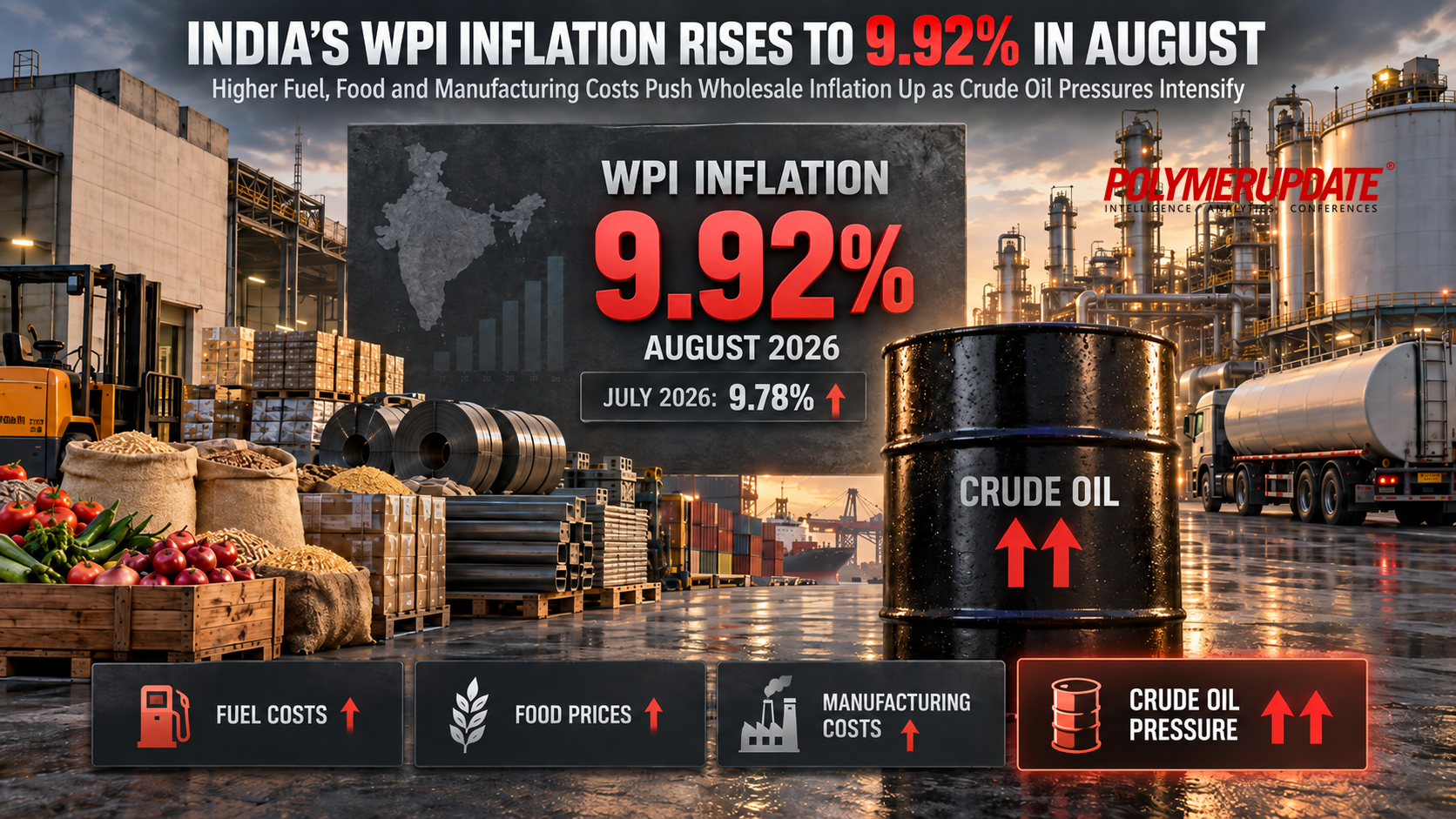
India’s bulk inflation measured by Wholesale Price Index (WPI) accelerated to 9.92 percent in August 2026 from 9.78 percent in July, underscoring the growing pressure on producers and businesses from higher energy, food and manufacturing costs, data compiled by the Ministry of Commerce showed. The latest reading, which is significantly above the zero inflation recorded in August 2025, points to a broad-based increase in input costs and raises concerns about their eventual transmission to consumer prices.
The Ministry said in a statement, “All India Wholesale Price Index (WPI) inflation for August is 9.92 percent on year-on-year (yoy) basis, compared to 9.78 percent in July. The index for All Commodities for August stands at 110.8, whereas it was 110.0 in the previous month. Annual inflation rates for major groups, namely, primary articles, fuel and power, and manufactured products are 7.76 percent, 22.93 percent, and 8.37 percent, respectively in August, compared to 8.52 percent, 20.05 percent, and 8.29 percent, respectively in July.”
The indices for Primary Articles, Fuel and Power, and Manufactured Products are 118.1, 108.3 and 108.8, respectively, in August, whereas they were 117.2, 105.4, and 108.4, respectively, in July. The August increase was driven primarily by a sharp acceleration in fuel and power prices, alongside higher food and manufactured-product inflation. According to government data, inflation in the fuel and power category surged to 22.93 percent in August from 20.05 percent in July. Within the category, prices of petroleum and natural gas rose 34.41 percent, compared with 26.99 percent in July, reflecting the impact of elevated global energy prices and continuing geopolitical tensions in West Asia.
An analyst with a public sector bank stated, “The increase in wholesale inflation comes against the backdrop of a sharp rise in global crude oil prices. The continuing conflict in West Asia and uncertainty surrounding shipments through the Strait of Hormuz have disrupted energy markets and increased the risk premium on crude. India, as a major crude oil importer, remains particularly exposed to such external shocks.”
 Food inflation up
Food inflation also strengthened, rising to 7.05 percent in August from 6.65 percent in July. Food prices have become an increasingly important source of wholesale price pressure, with higher prices of fruits, vegetables, milk and other food articles contributing to the acceleration. The food component of primary articles increased during the month, even as overall primary-article inflation moderated to 7.76 percent from 8.52 percent in July.
Higher crude prices affect the economy through several channels. The immediate impact is visible in petroleum products, but the consequences extend much further. Fuel is a critical input for transportation, manufacturing, agriculture, mining and logistics. An increase in diesel, aviation fuel, natural gas and other energy costs raises the cost of moving raw materials and finished goods, while also increasing production expenses for energy-intensive industries.
Manufactured products under cost pressureThe pressure is already evident in manufactured products. Inflation in manufactured products increased marginally to 8.37 percent in August from 8.29 percent in July. The persistence of manufacturing inflation suggests that higher input costs are increasingly being absorbed across the industrial economy.
For manufacturers, the immediate challenge is the squeeze between rising input costs and the ability to pass those costs on to customers. Companies operating in sectors such as chemicals, petrochemicals, plastics, metals, packaging, textiles, transportation and other energy-intensive industries are particularly vulnerable. If demand remains strong, producers may be able to pass a larger portion of the increase to downstream buyers. However, in price-sensitive markets, companies may have to absorb part of the cost, resulting in lower operating margins.
This creates an important distinction between wholesale and retail inflation. WPI captures price movements at an earlier stage of the supply chain, whereas CPI measures the prices ultimately faced by consumers. A sharp increase in WPI does not automatically translate into an equivalent increase in CPI. Companies can absorb some of the additional costs through lower margins, improve efficiency, renegotiate contracts or delay price increases.
Impact comes with a lagHowever, if elevated wholesale inflation persists for several months, the probability of greater pass-through to retail prices rises. This is particularly relevant at a time when India’s consumer inflation has already accelerated. CPI inflation rose to 4.8 percent in August from 4.5 percent in July, while food inflation increased to around 6 percent. The simultaneous rise in wholesale and retail inflation suggests that price pressures are becoming broader rather than remaining confined to a single segment of the economy.
The food component presents another significant risk. The rise in wholesale food inflation comes despite improved sowing activity, as weather conditions remain an important uncertainty for agricultural output. Delayed rainfall, uneven distribution of monsoon precipitation and the risk of lower crop yields can affect supplies of vegetables, pulses, oilseeds and other essential commodities.
Higher food prices have a disproportionately large impact on households because food accounts for a substantial share of consumer expenditure. If wholesale food inflation remains elevated, retailers could eventually face higher procurement costs, increasing the risk of further pressure on consumer prices.
Agri impactThe energy shock could also affect agriculture indirectly. Higher diesel prices raise the cost of farm machinery, irrigation and transportation, while higher fertiliser and chemical costs increase cultivation expenses. These additional costs can eventually feed into farm-gate and retail prices. The impact on the wider economy could therefore be significant. Persistently high wholesale inflation can increase working-capital requirements for businesses because companies need more funds to purchase the same quantity of raw materials. It can also raise inventory costs and reduce profitability, particularly for small and medium-sized enterprises with limited pricing power.
For exporters, higher domestic input costs could affect competitiveness if Indian producers are unable to pass on the increase in international markets. At the same time, a weaker rupee, if it occurs alongside higher crude prices, could further increase the domestic cost of imported commodities and intensify imported inflation. Monetary policy presents another challenge. The Reserve Bank of India has maintained the repo rate at 5.25 percent, but the combination of rising CPI inflation, accelerating WPI inflation and crude oil prices above US$ 100 a barrel could narrow the central bank’s room to maintain an accommodative stance.
Important distinctionThe RBI is likely to distinguish between temporary supply-driven inflation and more persistent second-round effects. A one-off increase in fuel or food prices may not necessarily trigger immediate monetary tightening. However, if higher energy and food costs begin to feed into core inflation, wages and broader services prices, the case for a rate increase would become stronger. The August data suggest that this transmission process deserves close monitoring. Core wholesale inflation has remained elevated, while manufactured-product inflation has strengthened.
At the same time, retail core inflation has also moved higher, indicating that inflationary pressures are gradually becoming more broad-based. The near-term outlook for wholesale inflation will therefore depend heavily on crude oil prices, the duration of geopolitical disruptions in West Asia, the movement of the rupee, domestic food supplies and the ability of companies to absorb higher costs.
Fuel impact on transportation costIf crude prices remain above US$ 100 a barrel for an extended period, fuel and transportation costs could exert further pressure on the manufacturing and services sectors. Conversely, any meaningful easing in geopolitical tensions, improved energy supply flows or correction in global crude prices could provide some relief.
For now, the August WPI reading is a warning that inflationary pressures are no longer confined to the consumer economy. The sharp rise in wholesale prices indicates that businesses are facing substantially higher costs across energy, food and industrial inputs. Whether these pressures remain largely within corporate margins or eventually translate into higher consumer prices will be one of the most important economic questions for the remainder of FY27.
DILIP KUMAR JHA
Editor
dilip.jha@polymerupdate.com