
Click the icon to add a specified price to your Dashboard list. This makes it easy to keep track on the prices that matter most to you.

- New compressor in Dormagen reduces Covestro's energy consumption in Germany by two percent
- Investment in the low double-digit million-euro range
- Modernization saves approximately 40,000 tons of CO2 emissions per year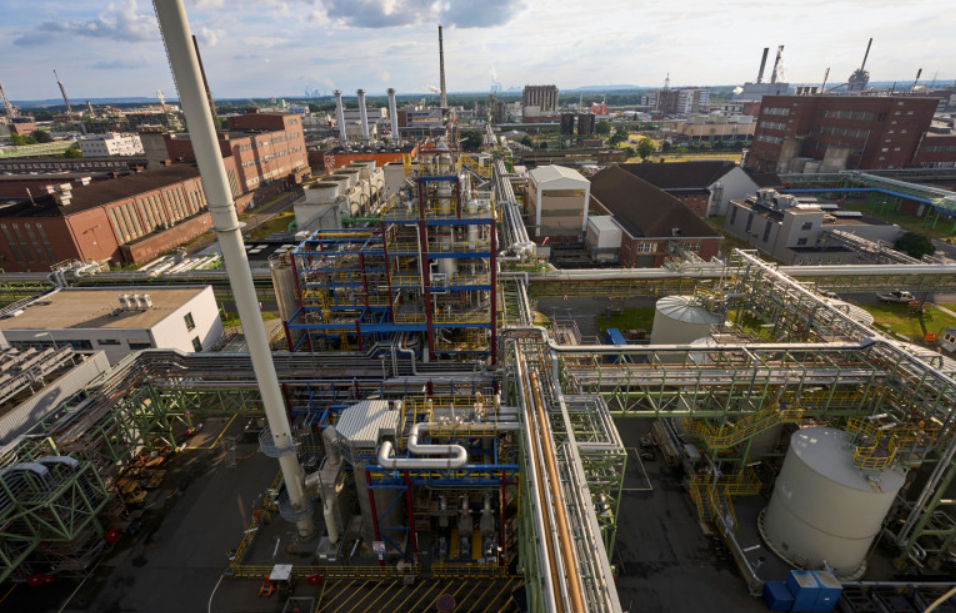
With the investment in a new steam compressor at its Dormagen site, Covestro will reduce its energy consumption in Germany by two percent per year compared to 2025. The company's largest energy efficiency project to date will save a low three-digit GWh volume of energy and more than 40,000 tons of CO2 emissions per year. This is equivalent to the CO2 emissions of a town of 5,000 inhabitants or approximately 20,000 cars. Covestro is investing a low double-digit million Euro amount in the modernization project.
The new compressor operates on the principle of a heat pump: Water vapor is generated during the production processes for TDI, a component of flexible foam. Covestro requires steam for many production processes, but the steam produced during TDI manufacturing is not hot enough. Therefore, some of it is released into the environment as waste heat. The compressor raises the steam to a higher temperature and pressure level, making it suitable for use in production processes.
“Energy efficiency is a key lever for transforming our production towards climate neutrality and a circular economy. The principle is: the less energy we need, the better,” says Thorsten Dreier, CTO of Covestro. “That’s why we’re using every opportunity to make our production even more energy-efficient with modern, innovative process technologies.” From 2005 to 2022, Covestro already reduced its energy consumption by around 40 percent. The next goal: By 2030, the company aims to consume 20 percent less energy per ton of product produced than in 2020.
This project is part of an energy efficiency strategy with which Covestro is driving its transformation to climate-neutral production. As part of the master plan, the company is continuously searching for further potential energy efficiency measures. “With these projects, we are not only reducing our CO2 emissions, but also saving on energy costs,” says Andreas Doerfer, Global Energy Excellence Manager. “To achieve our energy efficiency target, we must utilize all available options for using the waste heat generated in our processes to manufacture our products.”
Following the installation of an energy-efficient reactor at the TDI plant last year, the new compressor for the Dormagen site is the next major project to future-proof the location: “This investment clearly demonstrates Covestro’s long-term belief in the Dormagen site and its commitment to investing here,” says Philip Bahke, Head of Operations in Dormagen and North Rhine-Westphalia.
Construction is scheduled to begin at the end of this year, with the compressor expected to go into operation in mid-2027.
About Covestro:
Covestro is one of the world’s leading manufacturers of high-quality polymer materials and their components. With its innovative products, processes and methods, the company helps enhance sustainability and the quality of life in many areas. Covestro supplies customers around the world in key industries such as mobility, building and living, as well as the electrical and electronics sector. In addition, polymers from Covestro are also used in sectors such as sports and leisure, telecommunications and health, as well as in the chemical industry itself.
The company is geared completely to the circular economy. In addition, Covestro aims to achieve climate neutrality for its Scope 1 and Scope 2 emissions by 2035, and the Group’s Scope 3 emissions are also set to be climate neutral by 2050. Covestro generated sales of EUR 12.9 billion in fiscal year 2025. At the end of 2025, the company had 46 production sites worldwide and employed approximately 17,600 people (calculated as full-time equivalents).
Note: This story has not been edited by The Polymerupdate Editorial team and is auto-generated from a syndicated feed.
