The sharp depreciation of the Indian rupee, which slipped to record lows of Rs 93.94 per US dollar, marks a significant shift in India’s external sector dynamics and reflects a confluence of global and domestic pressures. The breach of key psychological levels—first Rs 90 and now approximately Rs 94—signals sustained stress in currency markets, driven primarily by surging crude oil prices, capital outflows, and a strengthening US dollar.
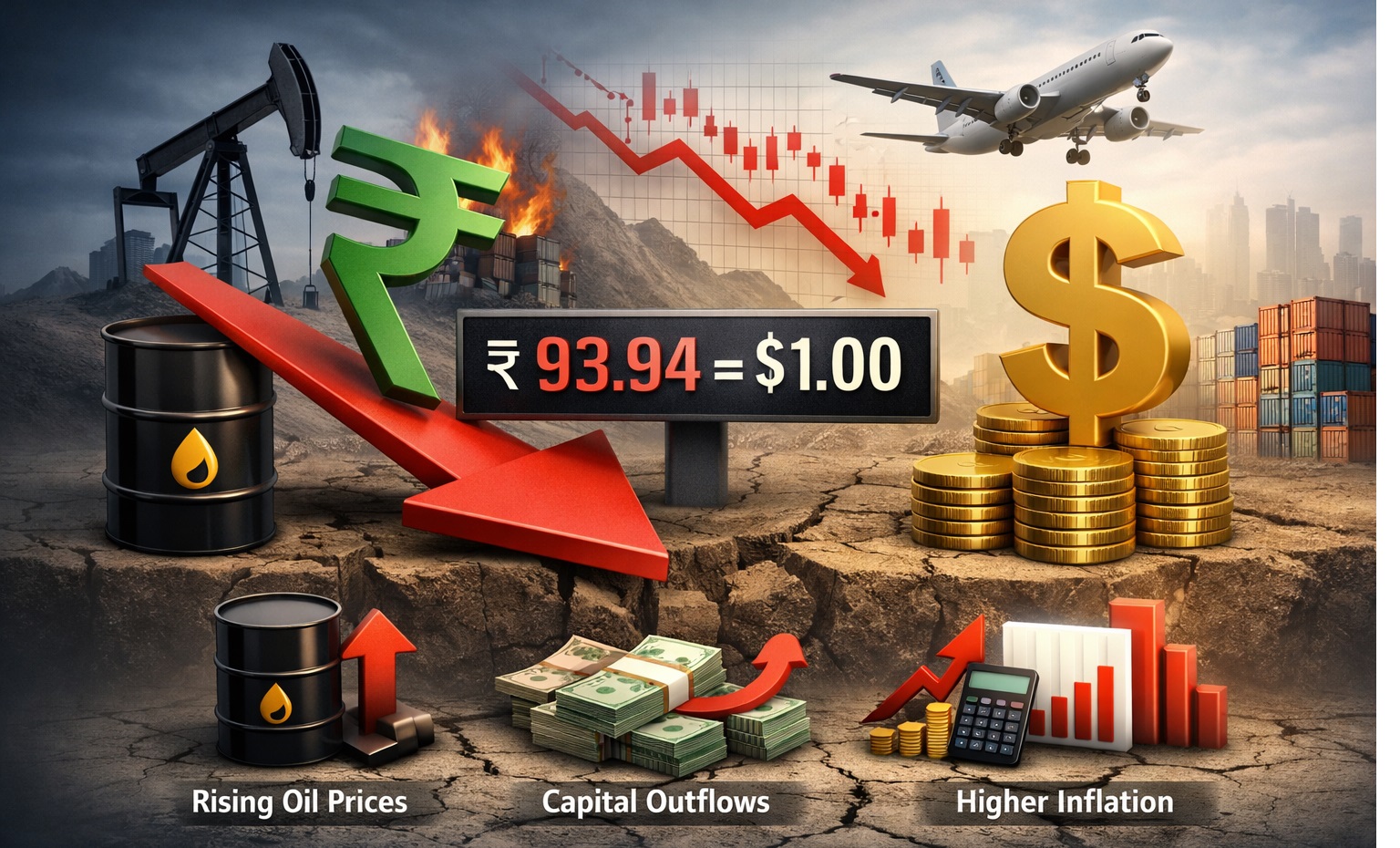
There are multiple reasons for a sharp fall in the Indian currency. The most immediate trigger has been the sharp spike in global crude oil prices amid escalating geopolitical tensions in the Middle East. Oil prices have risen over 55 percent in the past weeks i.e. since Israel-US missile attacks began on February 28, 2026, significantly increasing India’s import bill. As India imports more than 85 percent of its crude requirements, higher oil prices translate directly into increased demand for US dollars, exerting downward pressure on the rupee.
Another factors added to rupee’s fall include widening current account deficit (CAD) which reached the all-time high in recent months. Rising import costs, especially for crude oil and gold, coupled with relatively weaker export growth, have widened India’s trade deficit. A larger deficit increases net dollar demand in the economy, weakening the domestic currency.
Foreign capital outflowsSustainably increasing global uncertainty stemming out of the Iran war has raised fear in the equity market of capital protection and hence, foreign investors have started squaring of their investments from Indian equity markets in recent months. In fact, the foreign capital outflow began with the war in Ukraine which began with Russia starting offensive on Kyiv on February 26, 2022. India remained the worst high among Asian stock markets witnessing huge foreign investors’ outflow.
Sustained outflows from foreign portfolio investors (FPIs), estimated at nearly US$ 9–10 billion in recent weeks, have reduced dollar inflows into Indian markets. Higher US bond yields and global risk aversion have prompted investors to shift funds away from emerging markets like India.
Other factorsThe US dollar has strengthened due to higher interest rates and safe-haven demand amid geopolitical uncertainty. This has put additional pressure on emerging market currencies, including the rupee. India continues to face a “dollar gap,” where demand for foreign currency (for imports, debt servicing, and investments abroad) exceeds supply from exports and capital inflows.
Meanwhile, the Reserve Bank of India (RBI) has intervened intermittently to curb volatility but has largely allowed a gradual depreciation to maintain export competitiveness and conserve forex reserves. India’s central bank intermittently intervenes in the market and releases dollars from its strategic reserves to arrest free fall in the Indian rupee.
Major impactsA weaker rupee raises the cost of imports, particularly crude oil, fertilizers, and electronic goods. This feeds into higher wholesale and consumer inflation, complicating monetary policy. Additionally, higher oil import bills increase subsidy burdens and widen the current account deficit, potentially impacting fiscal consolidation efforts.
Companies with foreign currency borrowings face higher repayment burdens due to exchange rate losses, affecting profitability and balance sheets. Currency depreciation has coincided with falling equity markets and rising bond yields, reflecting broader macroeconomic uncertainty.
Broader macroeconomic implicationsA weaker rupee generally improves export competitiveness by making Indian goods cheaper in global markets. Sectors such as textiles, pharmaceuticals, and IT services may benefit. However, this advantage is partly offset by weak global demand, and higher input costs (especially imported raw materials and energy).
The impact on imports is more pronounced and adverse crude oil imports become significantly more expensive, higher costs for capital goods, electronics, and chemicals, as well as increased input costs for manufacturing and petrochemical sectors. Given India’s heavy dependence on imports—especially energy—the negative impact on imports outweighs export gains, leading to a widening merchandise trade deficit.
The rupee’s depreciation underscores structural vulnerabilities in India’s external sector with high dependence on energy imports, sensitivity to global capital flows, and exposure to geopolitical risks.
If crude oil prices remain elevated and capital outflows persist, the rupee may remain under pressure in the near to medium term. While RBI intervention can smooth volatility, sustained recovery will depend on easing global tensions, stabilising oil prices, and revival in capital inflows.
ConclusionThe breach of key exchange rate levels by the rupee is not an isolated event but the result of a cumulative build-up of global shocks and domestic imbalances. While a weaker currency offers limited export advantages, the broader impact—particularly through higher import costs and inflation—poses significant challenges for India’s economy and merchandise trade balance.
DILIP KUMAR JHA
Editor
dilip.jha@polymerupdate.com