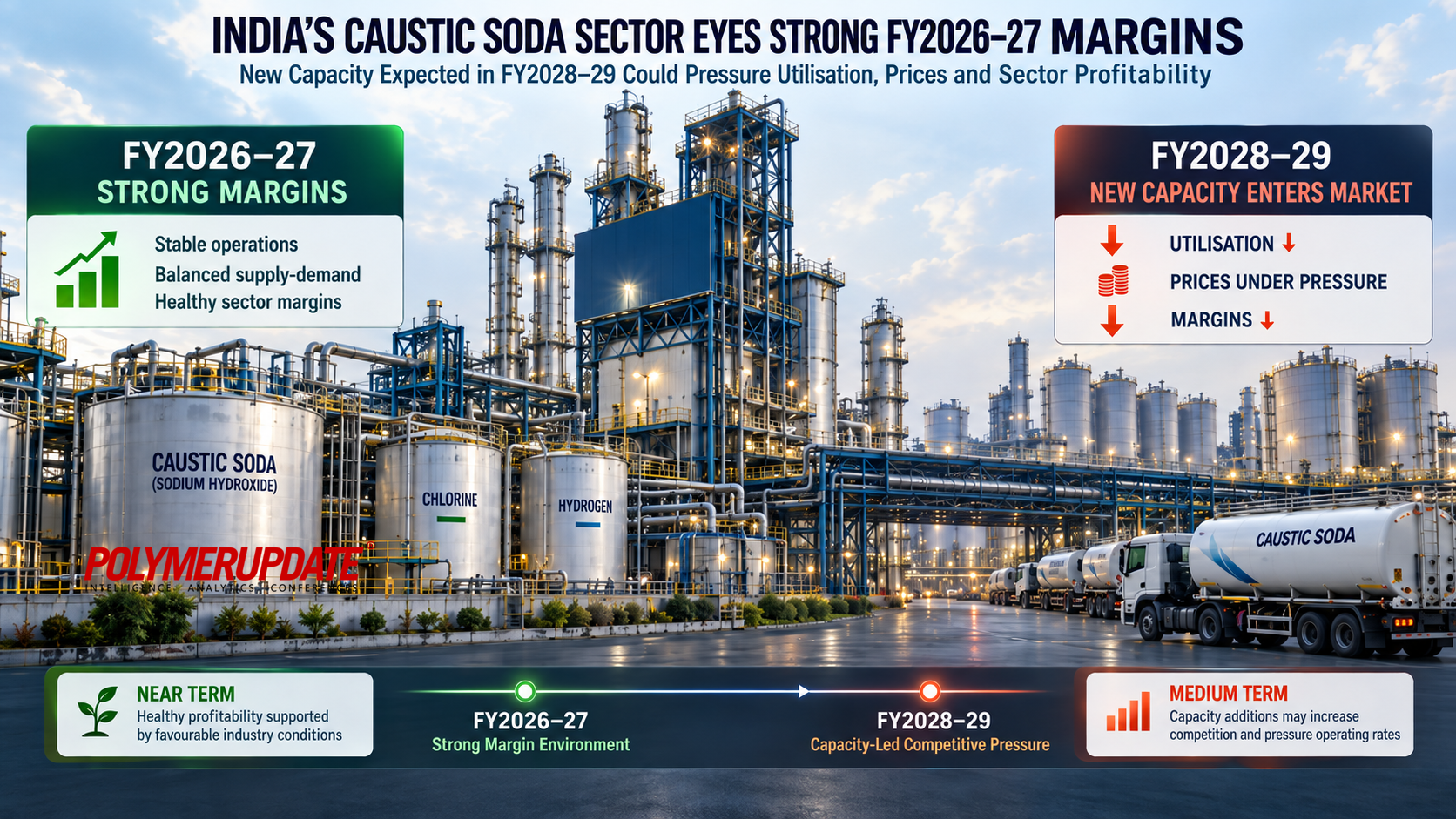
Domestic caustic soda producers are likely to witness strong profit margins, supported by a sharp rise in capacity utilisation during the financial year (FY) 2026–27, driven by robust industrial demand and the limited commissioning of new plants. However, margins are expected to come under pressure in FY2028–29, when a substantial wave of new capacity is scheduled to become operational, potentially reducing operational efficiency unless supported by exponential growth in export demand, according to a report released on Tuesday.
Published by India Ratings and Research (Ind-Ra), the report titled Chemical Insight expects domestic caustic soda capacity utilisation to remain strong at 85–90 percent during the current financial year ending March 2027, supported by limited capacity additions and robust demand from the alumina sector. However, the scheduled commissioning of around 2 million tonnes per annum (mtpa) of new capacity in FY2028–29 could moderate utilisation rates and put pressure on prices unless accompanied by higher exports.
“On the global front, weak Chinese downstream demand and the availability of exportable surplus continue to cap global price recovery. Both global and domestic prices corrected to pre-conflict levels from May 2026, which may weigh on FY2026–27 sectoral margins. Producers with diversified chemical portfolios, chlorine integration, captive energy, and export access remain better positioned, while sector credit profiles continue to benefit from diversified cash flow streams across chemicals,” said Shubham Kumar, Senior Analyst, Corporate Ratings, India Ratings.
 Domestic consumption growth
The report expects India’s caustic soda demand to register low double-digit year-on-year growth in FY2026–27, with incremental demand of 600,000–750,000 tonnes, surpassing the FY2020–21 to FY2025–26 compounded annual growth rate (CAGR) of around 5 percent. Domestic consumption in FY2025–26 was supported by steady demand from key end-use sectors, including textiles (18 percent), alumina (16 percent), detergents (8 percent), chemicals (32 percent), and pulp (4 percent), which together contributed 200,000–250,000 tonnes of additional caustic soda demand during FY2022–23 to FY2024–25.
However, the report expects an additional 400,000–500,000 tonnes of demand in FY2026–27, over and above the regular growth, driven by the ramp-up of 3 mtpa of incremental alumina capacity commissioned in phases (1.5 mtpa in 2024 and 1.5 mtpa in the October–December 2025 quarter), following an estimated 200,000–300,000 tonnes of demand contribution in FY2025–26. Combined with underlying industrial demand, this is expected to support mid- to high-single-digit domestic demand growth in FY2026–27. Furthermore, a recovery in textile exports could provide additional upside to caustic soda demand, subject to evolving US tariff policies.
Healthy short-term operating rateIndia’s chlor-alkali industry is approaching its next major capacity addition cycle, with nearly 2 mtpa of announced capacity under various stages of implementation by both incumbent producers and new entrants. Limited capacity additions have driven domestic caustic soda utilisation to an estimated 85–90 percent in FY2025–26, exceeding both FY2024–25 levels and the decadal average of 80–81 percent. India’s caustic soda capacity is expected to remain stable at around 6.4 mtpa as of the end of FY2025–26 and has nearly doubled over the past decade.
With the 2 mtpa of announced capacity additions expected to be commissioned only during FY2027–28 and FY2028–29, industry utilisation is likely to remain robust through FY2026–27. However, the commissioning of these new capacities could soften utilisation levels and put pressure on domestic caustic soda prices unless supported by a meaningful increase in exports.
Furthermore, the upcoming capacity addition cycle could increase industry fragmentation, reducing the combined market share of the top six producers to around 50 percent from the current 65 percent. As a result, export growth and downstream chlorine integration will be critical to sustaining utilisation levels and pricing after the expansion. Moreover, high freight costs continue to limit regional supply movement, benefiting producers in southern and eastern India through relatively balanced demand-supply conditions.
India to remain net exporterDomestic capacity additions (around 7 percent) have outpaced demand growth (around 4 percent) over the past decade, driving India’s transition to a net exporter since FY2020–21. Net exports increased nearly fivefold from FY2019–20 levels to around 627,000 tonnes in FY2025–26, supported by a domestic surplus, higher freight costs that limited imports, and capacity rationalisation in Europe due to elevated energy costs. Meanwhile, the Middle East conflict disrupted global ethylene supplies, reducing chlorine consumption and, in turn, caustic soda production, particularly across Southeast Asia.
In FY2025–26, India’s key export destinations—South Africa (12 percent), Indonesia (12 percent), Saudi Arabia (10 percent), Kenya (9 percent), and Tanzania (9 percent)—accounted for more than half of the country’s caustic soda export volumes. Western India’s concentration of production capacity and proximity to major ports provide a structural freight advantage, supporting exports to Africa and the Middle East. However, exports to Europe and the United States remain limited due to high logistics costs and the presence of well-established local producers. Even so, Europe’s declining cost competitiveness and ongoing capacity rationalisation could create new export opportunities for Indian producers, particularly as substantial domestic capacity additions come on stream.
China surplus to weigh on global marketsThe global capacity utilisation rate remained robust, rising to 88 percent in 2025 (2024:84 percent; decadal average: 80 percent) from 2024: 84 percent (decadal average: 80 percent), supported by capacity rationalisation in China and Europe. However, weak Chinese downstream demand and surplus export volumes continue to weigh on prices. China remains the dominant market, accounting for roughly 46 percent of global capacity and 45 percent of consumption, with its share rising modestly by 2–3 percent over the past decade. Chinese production was around 3 percent higher year on year in 2025, despite weak downstream demand conditions, indicating relatively stable capacity utilisation levels in the country.
Furthermore, China is set to expand its capacity over the next two to three years, potentially increasing exportable surpluses and reinforcing its influence on global prices. Consequently, a recovery in Chinese demand remains critical for sustained price improvement. The report expects a sustained recovery in prices over the near to medium term to be largely dependent on a recovery in Chinese downstream demand, which may be prolonged, given China’s large share of global consumption and the potential for further capacity additions over the medium term. However, supply chain disruptions resulting from an escalation of the Middle East conflict could trigger a temporary uptick in prices.
Middle East conflicts soften demandGlobal prices declined to around US$ 454 a tonne in FY2025–26 (FY2024–25: US$ 500 a tonne), due to a surplus in China and weak international downstream demand, while stronger domestic demand-supply dynamics supported higher domestic prices of around US$ 581 a tonne. Middle East-driven supply disruptions and higher freight costs lifted caustic soda prices sharply in March–April 2026, with global prices rising around 40 percent year on year to US$ 580 a tonne, outpacing the 20 percent year-on-year increase in domestic prices to US$ 650 a tonne.
However, following the easing of Middle East tensions and softer demand, caustic soda prices began to normalise from May 2026, reverting to pre-conflict levels, which could weigh on sectoral margins in the second half of the current financial year. Global prices declined to around US$ 390 a tonne by August 2026, below the long-term average of US$ 450 a tonne. Domestic prices also corrected, albeit less sharply, due to a more moderate run-up and relatively favourable domestic demand-supply dynamics, reaching around US$ 525 a tonne, compared with a long-term average of US$ 600 a tonne.
DILIP KUMAR JHA
Editor
dilip.jha@polymerupdate.com